Quranic Answer
In the Holy Quran, the observance of covenants and promises is not merely an ethical virtue; it is considered a fundamental pillar of true faith and piety. Allah Almighty has repeatedly commanded and urged believers in various verses to fulfill their covenants and avoid breaking them. This emphasis is so profound and comprehensive that breaking covenants is listed among the characteristics of hypocrites and those who have deviated from the path of truth, with severe worldly and eternal consequences outlined for such actions. The Quran addresses covenants on multiple levels: from covenants with God to social, economic, political, and even personal and individual agreements. One of the most important types of covenant is the one human beings make with Allah. This covenant includes belief in monotheism, obedience to divine commands, and sincere worship. In Surah Al-Baqarah, verse 177, Allah states: "Righteousness is not that you turn your faces toward the East or the West, but [true] righteousness is [in] one who believes in Allah, the Last Day, the angels, the Book, and the prophets and gives wealth, in spite of love for it, to relatives, orphans, the needy, the traveler, those who ask [for help], and for freeing slaves; [and who] establishes prayer and gives zakah; and those who fulfill their promise when they promise; and [those who] are patient in poverty and hardship and during battle. Those are the ones who have been true, and it is those who are the righteous." This verse illustrates that fulfilling covenants, alongside faith and good deeds, is a sign of piety and sincerity in belief. Divine covenants encompass Allah's commands and prohibitions, which humans must adhere to and prioritize in their lives. Beyond the covenant with God, the Quran places significant emphasis on the importance of observing agreements and contracts between people. This includes commercial contracts, marriage agreements, peace treaties, and any other legitimate form of agreement. In Surah Al-Ma'idah, verse 1, Allah explicitly states: "O you who have believed, fulfill [all] contracts." This verse unequivocally emphasizes the necessity of fulfilling every legitimate contract within the framework of divine laws. This emphasis forms the foundation of trust and social order. If people do not adhere to their covenants and promises, chaos and distrust will prevail in society, leading to the deterioration of human relationships and the collapse of social structures. In Surah An-Nahl, verse 91, Allah says: "And fulfill the covenant of Allah when you have made it, and do not break the oaths after their confirmation while you have made Allah, over you, a security. Indeed, Allah knows what you do." This verse not only stresses the obligation to fulfill covenants but also warns that Allah is a witness and observer of human actions, and no breach of covenant goes unnoticed by Him. This divine oversight provides a strong incentive for individuals to be truthful in fulfilling their commitments. Breaking a covenant is not merely a violation of a human agreement but, in essence, a disregard for Allah's testimony and a transgression against His command. Verse 34 of Surah Al-Isra is also a key verse in this regard: "...and fulfill [every] covenant. Indeed, [every] covenant will be questioned about." This verse explicitly states that fulfilling covenants is a great responsibility that will be inquired about on the Day of Judgment. This means that every covenant a person makes, whether small or large, individual or collective, is recorded in their book of deeds and they will be held accountable before Allah. This aspect of the Quran's emphasis adds to people's moral and psychological responsibility, preventing them from shying away from responsibilities due to negligence or personal gain. The Holy Quran considers breaking covenants a cause of corruption and disorder on earth and severely condemns those who violate their agreements. In Surah Ar-Ra'd, verses 20 and 21, Allah describes true believers as those who "fulfill the covenant of Allah and do not break the compact" and "those who join that which Allah has commanded to be joined and fear their Lord and dread the severity of account." In contrast, those who break covenants are identified as perpetrators of corruption on earth. These verses clearly indicate that observing covenants is not merely an individual act but has broad implications for the well-being of society and the preservation of justice and public order. Fulfilling covenants is a sign of strong faith, good morals, and divine upbringing, leading to peace, trust, and stability in human relationships. Ultimately, adhering to these divine commands not only brings worldly prosperity but also paves the way for salvation in the Hereafter. In summary, the Quran's emphasis on fulfilling covenants and promises is a comprehensive and multifaceted command that encompasses theological, ethical, social, and even legal dimensions. This demonstrates the high importance Islam places on establishing justice, order, and trust in human society. Loyalty to covenants is a sign of truthfulness and sincerity of faith, while breaking covenants is a sign of weak faith and hypocrisy. These teachings guide Islamic societies toward building structures based on trust, cooperation, and responsibility, encouraging individuals to prioritize ethical and divine principles in their interactions, thereby avoiding any form of betrayal or treachery. This issue is not limited to major contracts but also includes small daily promises and agreements; for any breach of covenant, no matter how trivial, gradually erodes the foundation of trust and diminishes the significance of this vital principle.
Related Verses
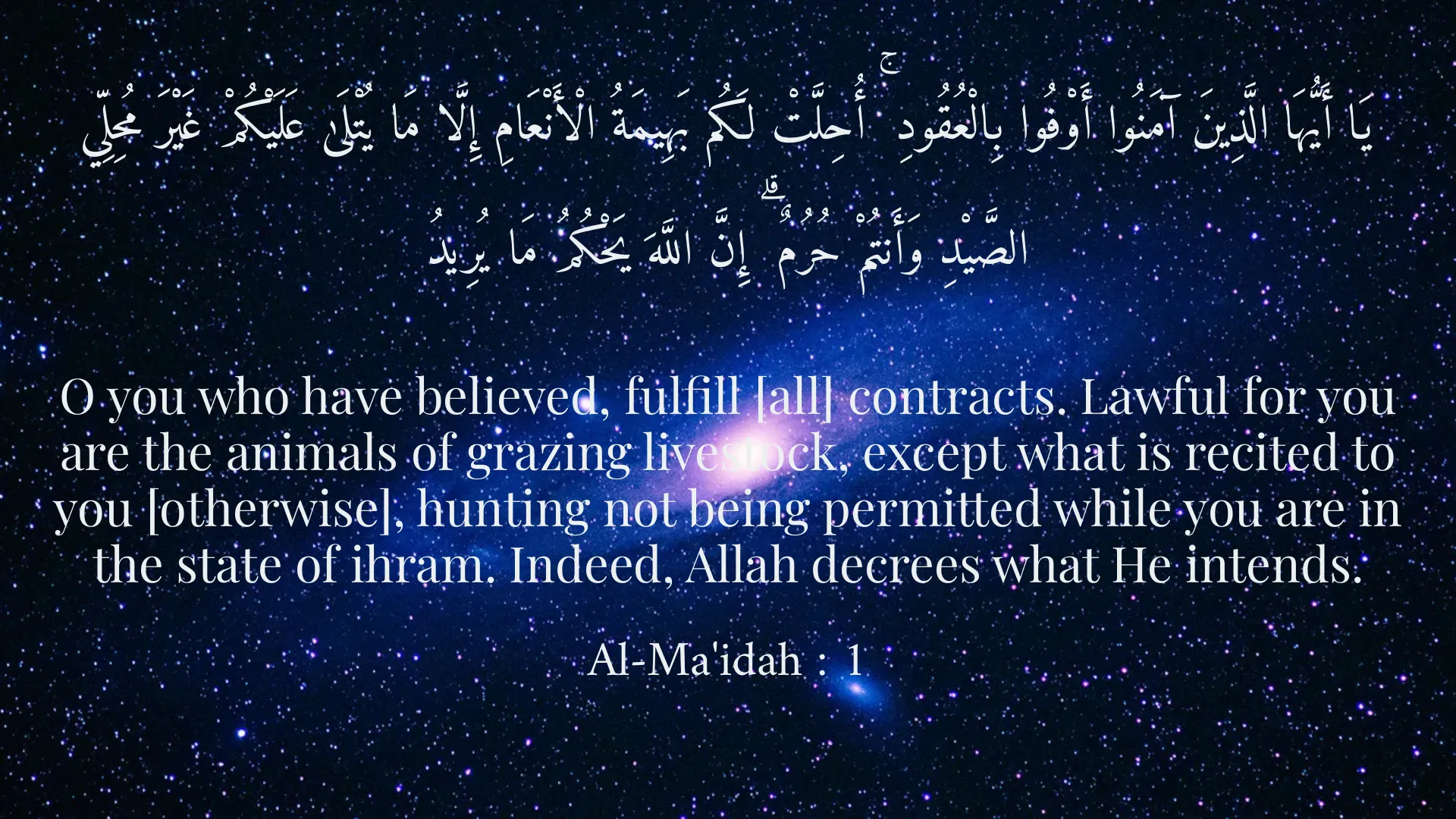
يَا أَيُّهَا الَّذِينَ آمَنُوا أَوْفُوا بِالْعُقُودِ ۚ أُحِلَّتْ لَكُم بَهِيمَةُ الْأَنْعَامِ إِلَّا مَا يُتْلَىٰ عَلَيْكُمْ غَيْرَ مُحِلِّي الصَّيْدِ وَأَنتُمْ حُرُمٌ ۗ إِنَّ اللَّهَ يَحْكُمُ مَا يُرِيدُ
O you who have believed, fulfill [all] contracts. Lawful for you are the animals of grazing livestock, except what is recited to you [otherwise], hunting not being permitted while you are in the state of ihram. Indeed, Allah decrees what He intends.
Al-Ma'idah : 1
وَأَوْفُوا بِعَهْدِ اللَّهِ إِذَا عَاهَدتُّمْ وَلَا تَنقُضُوا الْأَيْمَانَ بَعْدَ تَوْكِيدِهَا وَقَدْ جَعَلْتُمُ اللَّهَ عَلَيْكُمْ كَفِيلًا ۚ إِنَّ اللَّهَ يَعْلَمُ مَا تَفْعَلُونَ
And fulfill the covenant of Allah when you have made it, and do not break the oaths after their confirmation while you have made Allah, over you, a security. Indeed, Allah knows what you do.
An-Nahl : 91
وَلَا تَقْرَبُوا مَالَ الْيَتِيمِ إِلَّا بِالَّتِي هِيَ أَحْسَنُ حَتَّىٰ يَبْلُغَ أَشُدَّهُ ۚ وَأَوْفُوا بِالْعَهْدِ ۖ إِنَّ الْعَهْدَ كَانَ مَسْئُولًا
And do not approach the orphan's property except in a way that is best until he reaches maturity. And fulfill [every] covenant. Indeed, [every] covenant will be questioned about.
Al-Isra : 34
Short Story
It is narrated that in ancient times, there lived a merchant named Fereydoon, renowned for his truthfulness and trustworthiness. He had made an agreement with a man from another city to deliver a specific commodity at a fixed price by a certain date. Along the way, the market for that commodity suddenly boomed, and its price quadrupled. Fereydoon's friends and colleagues urged him to sell the goods at the current market price, pocketing a huge profit, and disregard his promise. However, Fereydoon, who held the Quranic teachings and Saadi's wisdom in his heart, replied with a smile: "Worldly gain is fleeting, and peace of mind is far superior. How can I break a promise I have made, when God is my witness and I will be held accountable one day? Saadi wisely said: 'Fulfill your promise and word, for man rises from promise and word.'" Fereydoon stood by his word and delivered the goods to the customer at the agreed-upon price. This act earned him not only the customer's admiration for his loyalty but also ensured that the customer conducted all his future dealings with Fereydoon, always referring to him as a paragon of honesty and integrity. Thus, Fereydoon gained not only greater material profit but also unparalleled credibility and inner peace, whose endurance far surpassed any fleeting wealth.