Quranic Answer
The Holy Quran, as the timeless divine word, is not merely a guide for worship and legal rulings, but also a gateway to opening the mind and elevating human insight. This sacred book, in its unique methodology, invites us on a profound journey through various dimensions of existence, resulting in a broader perspective and liberation from biases and narrow intellectual horizons. One of the most significant ways the Quran promotes open-mindedness is its repeated call for 'Tadabbur' (contemplation) and 'Tafakkur' (reflection). These two terms, frequently reiterated throughout the Quranic verses, do not simply mean reading or memorizing, but rather signify deep thinking, deliberation, and achieving a true understanding of divine concepts and signs. The Quran commands believers to contemplate its verses so that they may grasp its hidden truths and derive lessons from them. This invitation to Tadabbur is a continuous intellectual exercise that moves the mind beyond superficiality, guiding it towards analysis, questioning, and root-cause understanding. When an individual examines the divine verses, they not only perceive the apparent meanings but also uncover deeper layers and profound wisdom. This process inherently encourages the human mind to seek discovery and comprehension, rather than mere unquestioning acceptance. Furthermore, the Quran strongly emphasizes the importance of 'Ilm' (knowledge). In many verses, the high status of scholars and learned individuals is mentioned, and ignorance is highlighted as one of the primary obstacles to growth and awareness. By encouraging the acquisition of knowledge, whether religious or worldly, the Quran propels the mind towards lifelong inquiry and learning. This encouragement liberates the individual from intellectual stagnation, urging them to constantly seek a greater understanding of the world, humanity, and the Creator. This implies an openness of mind to accept new truths and re-evaluate prior beliefs if they are supported by evidence and logic. The Quran values not only apparent sciences but also 'Hikmah' (wisdom). Wisdom is an insight that helps humans discern truth and apply it in their lives. This insight goes beyond mere information, allowing individuals to grasp deeper connections between phenomena and to judge correctly. Attaining wisdom requires an open mind that can see beyond superficialities and delve into the core of matters. By inviting observation and reflection on the creation of the heavens and the earth, humanity itself, and natural phenomena, the Quran guides the mind toward discovering the laws of existence and the grandeur of creation. This observation, coupled with reflection, leads humans to recognize the Creator's unity and transcend their mental limitations. Every leaf, every drop of rain, and every living creature in this universe is an 'Ayah' (sign) for those with intellect, demanding an open mind to comprehend these signs. Moreover, the Quran indirectly helps open the mind by promoting concepts such as 'justice' (Adl), 'fairness' (Insaf), 'mercy' (Rahmah), and 'good ethics'. When an individual strives for justice and fairness in their relationships with others, they are compelled to view issues from multiple perspectives and not judge solely based on personal interests. This approach liberates the mind from egocentrism, leading it towards empathy and understanding diverse viewpoints. Additionally, the Quran's emphasis on respecting human dignity and the inherent differences among people encourages individuals to accept diversity and variations. Although the Quran is a religion of monotheism, it stresses 'no compulsion in religion' (La Ikraha fi al-Din), which itself is a sign of inviting intellectual freedom and conscious choice. This freedom provides a fertile ground for intellectual growth and the opening of the mind. Finally, through recounting the stories of prophets and past nations, the Quran imparts numerous lessons about the consequences of ignorance, fanaticism, and arrogance. These stories are not just historical narratives but 'Ayat' for reflection and learning, through which one can avoid past mistakes and open their mind towards a brighter, more insightful future. Therefore, studying and contemplating the Quran, beyond being an act of worship, is a mental exercise that helps us view the world and ourselves with a broader and deeper perspective, set aside biases, and embark on a path of intellectual and spiritual growth. This book is a guiding light that dispels the darkness of ignorance and paves the way for true understanding.
Related Verses
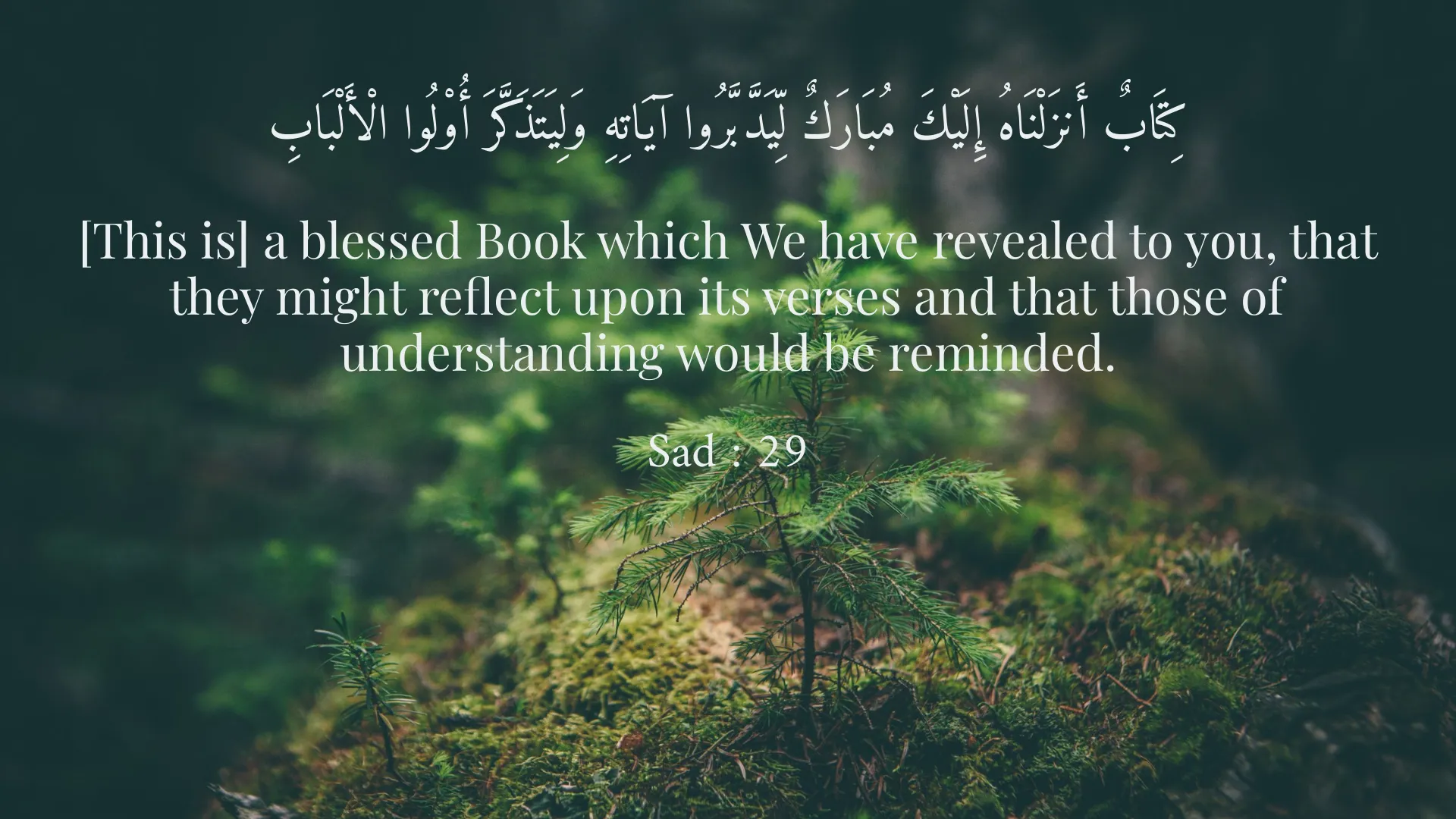
كِتَابٌ أَنزَلْنَاهُ إِلَيْكَ مُبَارَكٌ لِّيَدَّبَّرُوا آيَاتِهِ وَلِيَتَذَكَّرَ أُوْلُوا الْأَلْبَابِ
[This is] a blessed Book which We have revealed to you, that they might reflect upon its verses and that those of understanding would be reminded.
Sad : 29
إِنَّ فِي خَلْقِ السَّمَاوَاتِ وَالْأَرْضِ وَاخْتِلَافِ اللَّيْلِ وَالنَّهَارِ لَآيَاتٍ لِّأُولِي الْأَلْبَابِ
Indeed, in the creation of the heavens and the earth and the alternation of the night and the day are signs for those of understanding.
Al-Imran : 190
يَرْفَعِ اللَّهُ الَّذِينَ آمَنُوا مِنكُمْ وَالَّذِينَ أُوتُوا الْعِلْمَ دَرَجَاتٍ ۚ وَاللَّهُ بِمَا تَعْمَلُونَ خَبِيرٌ
Allah will raise those who have believed among you and those who were given knowledge, by degrees. And Allah is Acquainted with what you do.
Al-Mujadila : 11
Short Story
It is narrated that once a renowned scholar, who considered himself unparalleled in knowledge, was traveling to a distant land. On his way, he encountered a simple-hearted shepherd. The scholar, out of arrogance, asked him, "O shepherd, what do you know in this wilderness? Have you comprehended anything of the secrets of existence or high knowledge?" The shepherd replied with a gentle smile: "O esteemed scholar, everyone looks at the world through a different window. Although I cannot read or write, every morning and evening when I take my sheep to graze and gaze upon the sky and earth, I see a sign of the Creator's grandeur in every leaf and every drop of rain. This constant observation has led me to insights that perhaps cannot be found in books." The scholar, who did not expect such an answer, paused in thought for a moment. Then, with a humility he had not possessed before, he said, "You speak the truth, O wise man. Perhaps true wisdom lies in the hands of those who look at creation with an open heart and keen eyes, not just in the pages of books. You have taught me a great lesson that has opened my mind." And from that day forward, alongside his scholarly knowledge, the scholar turned to observing and contemplating nature, understanding that to have an open mind, one must always be ready to learn from any source.