Quranic Answer
The Holy Quran, as the divine guide, places immense importance on the unity and cohesion of the Muslim community. This is presented not merely as a moral ideal but as a divine command and a fundamental prerequisite for the success and prosperity of the Islamic Ummah. From the Quranic perspective, division and discord are the root of many weaknesses and failures, while unity and solidarity are sources of strength, honor, and progress. Numerous verses explicitly and subtly address this issue, providing practical guidelines for achieving and maintaining it. One of the most pivotal verses in this regard is Surah Al-Imran, verse 103, which states: "And hold firmly to the rope of Allah all together and do not become divided. And remember the favor of Allah upon you when you were enemies, and He brought your hearts together, so you became by His favor brothers…" This verse clearly emphasizes the necessity of collectively clinging to the 'rope of Allah.' This 'rope' is a metaphor for the Quran and the Sunnah of the Prophet (peace be upon him); that is, the common ideological and practical principles upon which all Muslims agree. The message of this verse is that unity is founded on divine teachings and prohibits any form of division or separation. The reminder of the past state, before Islam, when Arab tribes were in hostility and enmity with each other, and then through the light of Islam became brothers, is clear evidence of Islam's power in creating cohesion and solidarity. The Quran also strongly emphasizes the concept of spiritual brotherhood. In Surah Al-Hujurat, verse 10, we read: "The believers are nothing else than brothers. So make reconciliation between your brothers, and be mindful of Allah that you may receive mercy." This verse establishes brotherhood as the foundation of the relationship among believers and reminds them of their mutual responsibility to make peace and resolve grievances. This brotherhood is not merely an emotional bond but a social and spiritual covenant that entails specific rights and duties, including mutual support, sincere advice, refraining from backbiting and slander, and striving to resolve disputes. This concept of brotherhood transcends race, language, social class, or human geography, bringing all Muslims together under a single divine umbrella. Another unity-promoting aspect of the Quran is the recommendation to obey Allah and His Messenger and to avoid disputes. In Surah Al-Anfal, verse 46, it is stated: "And obey Allah and His Messenger, and do not dispute and [thus] lose courage and [then] your strength would depart; and be patient. Indeed, Allah is with the patient." This verse shows that adherence to a common divine leadership, namely Allah and His Prophet, is key to preventing disunity. Dispute and conflict mean losing morale, weakness, and the disintegration of the Islamic community's prestige and power. This verse constantly reminds Muslims that if they wish to be honored and powerful, they must obey the single divine source and avoid any disagreement or conflict that leads to their weakening. Furthermore, the Holy Quran warns Muslims by condemning those who became divided after receiving divine guidance. In Surah Al-Imran, verse 105, it says: "And be not like those who became divided and differed after the clear proofs had come to them. And for them is a great punishment." By referring to previous nations that perished due to disunity, this verse doubles the importance of preserving unity and warns of the severe consequences of division. The Quran invites Muslims towards a straight and unified path and prohibits pluralisms that lead to fragmentation and separation. In summary, the Holy Quran regards the unity of Muslims not just as a moral recommendation but as a religious obligation and a vital strategy for the survival and progress of the Ummah. This unity is built upon the belief in one God, adherence to the Quran and the Sunnah of the Prophet, and the strengthening of brotherhood and cooperation. By warning against the consequences of disunity and by providing practical solutions for resolving disputes, the Quran invites Muslims to form a united and powerful Ummah that, in the light of divine guidance, spreads justice and mercy throughout the world. This unity will pave the way for the emergence of Islam's true power and the realization of divine ideals on earth, enabling Muslims to set aside minor differences and focus on fundamental commonalities, standing as one body against challenges and enmities. It is this practical and heartfelt unity that brings prosperity in this world and the hereafter to the Ummah, allowing them to lead in all spheres. Finally, the Quran encourages Muslims that whenever a dispute arises, instead of resorting to prejudices and desires, they should refer to Allah and His Messenger. In Surah An-Nisa, verse 59, it says: "...And if you disagree over anything, refer it to Allah and the Messenger, if you should believe in Allah and the Last Day. That is better and [more suitable for] ultimate interpretation." This verse indicates that the ultimate solution for disputes is recourse to fixed divine and prophetic principles, not following personal or partisan opinions that can lead to division. This mechanism for dispute resolution ensures that the unity of Muslims is based on truth and justice and is preserved in all circumstances, because the main purpose of the Quran in speaking of unity is not merely superficial solidarity, but true unity based on truth.
Related Verses
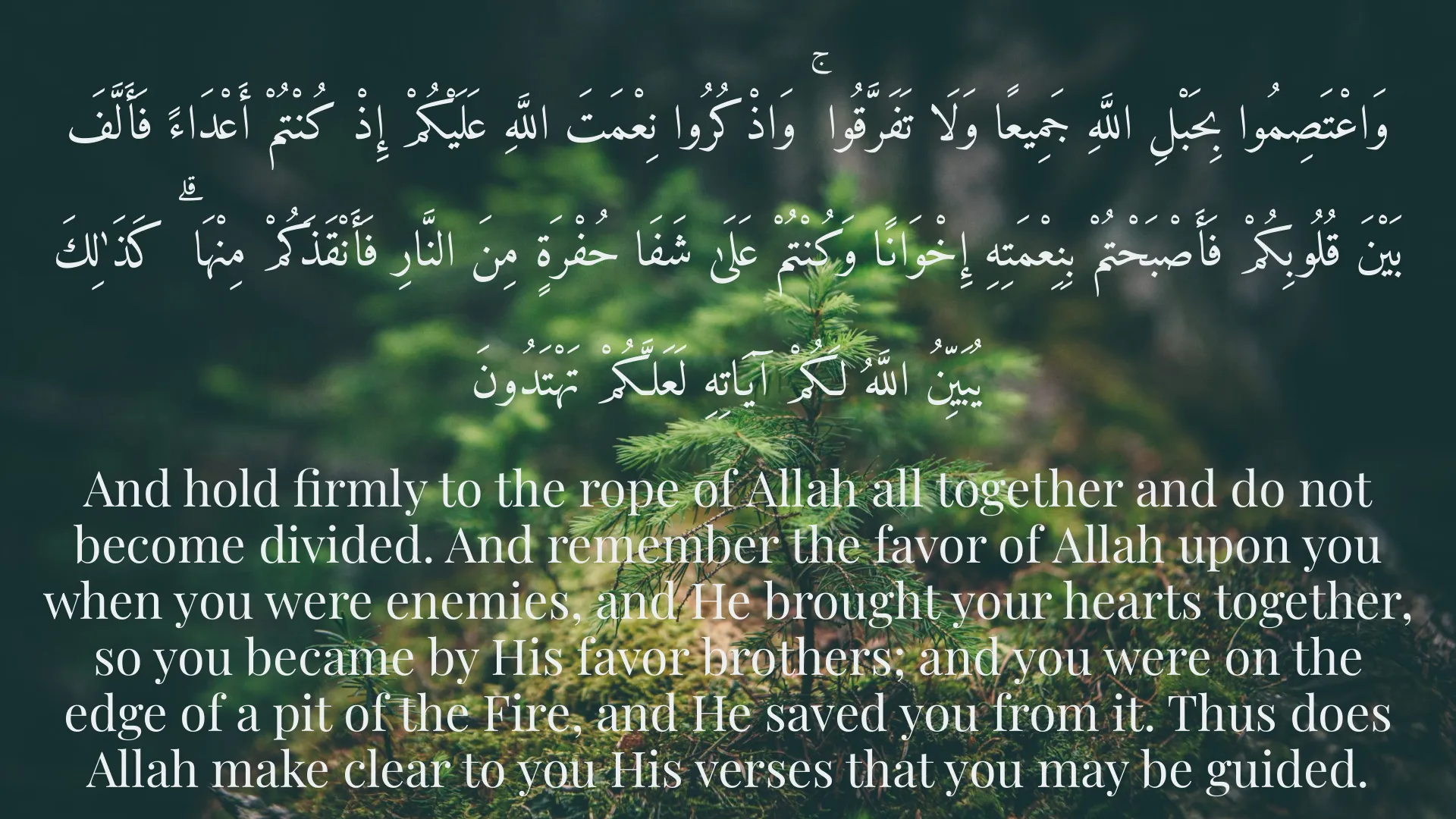
وَاعْتَصِمُوا بِحَبْلِ اللَّهِ جَمِيعًا وَلَا تَفَرَّقُوا ۚ وَاذْكُرُوا نِعْمَتَ اللَّهِ عَلَيْكُمْ إِذْ كُنْتُمْ أَعْدَاءً فَأَلَّفَ بَيْنَ قُلُوبِكُمْ فَأَصْبَحْتُمْ بِنِعْمَتِهِ إِخْوَانًا وَكُنْتُمْ عَلَىٰ شَفَا حُفْرَةٍ مِنَ النَّارِ فَأَنْقَذَكُمْ مِنْهَا ۗ كَذَٰلِكَ يُبَيِّنُ اللَّهُ لَكُمْ آيَاتِهِ لَعَلَّكُمْ تَهْتَدُونَ
And hold firmly to the rope of Allah all together and do not become divided. And remember the favor of Allah upon you when you were enemies, and He brought your hearts together, so you became by His favor brothers; and you were on the edge of a pit of the Fire, and He saved you from it. Thus does Allah make clear to you His verses that you may be guided.
Al-Imran : 103
إِنَّمَا الْمُؤْمِنُونَ إِخْوَةٌ فَأَصْلِحُوا بَيْنَ أَخَوَيْكُمْ ۚ وَاتَّقُوا اللَّهَ لَعَلَّكُمْ تُرْحَمُونَ
The believers are nothing else than brothers. So make reconciliation between your brothers, and be mindful of Allah that you may receive mercy.
Al-Hujurat : 10
وَأَطِيعُوا اللَّهَ وَرَسُولَهُ وَلَا تَنَازَعُوا فَتَفْشَلُوا وَتَذْهَبَ رِيحُكُمْ ۖ وَاصْبِرُوا ۚ إِنَّ اللَّهَ مَعَ الصَّابِرِينَ
And obey Allah and His Messenger, and do not dispute and [thus] lose courage and [then] your strength would depart; and be patient. Indeed, Allah is with the patient.
Al-Anfal : 46
Short Story
It is said that in ancient times, there was a city whose people belonged to various tribes, and each acted independently. One day, strangers attacked them, and each tribe defended itself alone, but being disunited, they were defeated and their city was plundered. A wise man among them arose and said: "O people! Have you not read, 'And hold firmly to the rope of Allah all together and do not become divided'? Your strength lies in unity, not in separation." The people took heed of the wise man's words and pledged to set aside their differences and gather under the banner of solidarity. Thereafter, whenever danger threatened them, they stood as a strong wall against the enemy, and no one was able to defeat them. Thus, they were saved from disunity and attained honor, how sweet is the taste of unity and brotherhood!