Quranic Answer
In the Holy Quran, the concepts of 'Haqq' (Truth) and 'Batil' (Falsehood) are fundamental pillars of divine teachings, discussed repeatedly and with profound depth. The Quran posits that existence revolves around Truth, and anything opposing it is deemed Falsehood. These two concepts are not merely confined to theological matters but permeate the practical, ethical, social, and even natural dimensions of human life. Allah Almighty describes Truth as a stable, enduring, clear, and enlightening reality originating from His essence, signifying justice, reality, and guidance. In contrast, Falsehood possesses a fleeting, deceptive, dark, and misleading quality, stemming from the deceptions of Satan, human whims, and ignorance. These two are perpetually engaged in an overt and subtle struggle, which the Quran explicitly addresses, foretelling the ultimate triumph of Truth. 1. The Nature of Haqq (Truth): Divine Origin and Steadfastness: The Quran explains Haqq in various ways. Foremost, Haqq is pure monotheism (Tawhid), the absolute Oneness of God, which forms the backbone of Islam. Any form of polytheism (shirk), idolatry, or deviation from the path of Truth is branded as Batil. Allah emphasizes in numerous verses that the creation of the heavens and earth is founded upon Truth, serving as proof of a Wise and Just Creator. This implies that the cosmic order, pervasive justice, and eternal divine wisdom are all manifestations of Haqq. Anything that disrupts or negates this order and justice falls under the category of Batil. For instance, in Surah Ibrahim, verse 24, Allah says: "Have you not seen how Allah presents an example: a good word as a good tree, whose root is firmly fixed and its branch is in the sky?" Here, the 'good word' symbolizes Truth, and its stability and permanence signify the very nature of Haqq. 2. The Nature of Batil (Falsehood): Fleeting and Deceptive: To illustrate Batil, the Quran often likens it to scum on the surface of water or smoke and dust. Despite a seemingly impressive appearance, it lacks substance and quickly dissipates, whereas clear water or precious metals (symbols of Truth) remain and benefit people. This powerful analogy is beautifully presented in Surah Ar-Ra'd, verse 17: "He sends down from the sky water, and valleys flow according to their capacity, and the torrent carries a rising foam. And from that [ore] which they heat in the fire, desiring adornments or utensils, is a foam like it. Thus does Allah present [the examples of] truth and falsehood. As for the foam, it vanishes, [being] worthless; but as for that which benefits the people, it remains on the earth. Thus does Allah present examples." This verse clearly shows that while Batil might initially appear loud and striking, it is devoid of content and benefit, destined for decay, while Haqq, serene and fruitful, endures as a source of good and benefit for humanity. 3. The Imperative of Distinguishing and Upholding Truth: The Quran also heavily emphasizes the necessity of not mixing Truth with Falsehood and avoiding the concealment of Truth. In Surah Al-Baqarah, verse 42, it states: "And do not mix truth with falsehood or conceal the truth while you know [it]." This verse, though addressing the People of the Book, carries a universal lesson for all humanity: to consciously distinguish Truth from Falsehood and not to hide or disguise Truth with Falsehood for worldly gains or biases. Doing so not only leads to individual misguidance but also causes societal deviation and the spread of corruption. 4. The Inevitable Triumph of Truth: The Quran's emphasis on the ultimate victory of Truth over Falsehood is a message of hope and reassurance for believers. Verses like "And say, 'Truth has come, and falsehood has vanished. Indeed, falsehood is ever bound to vanish'" (Surah Al-Isra, verse 81) clearly express this reality: Batil is inherently unstable and destined for decay. This verse not only refers to the victory of Islam over disbelief during the time of the Prophet but also articulates a general divine law applicable throughout history and in all aspects of life. Even if Falsehood appears powerful and dominant at certain times, its dominance is temporary, and its nature is ephemeral. This provides reassurance to people to remain steadfast on the path of Truth, even if it entails hardships and challenges, for the ultimate outcome rests with Truth. 5. Practical Application and Moral Responsibility: Finally, the Quran urges humanity to strengthen their ability to discern Truth from Falsehood through contemplation, reflection, study of divine verses, and adherence to the Prophet's tradition. This discernment is crucial not only in matters of belief but also in all daily decisions, social interactions, and judgments. The Quran has clearly shown the path of guidance and warned that after Truth has become manifest, any deviation or misguidance implies following Falsehood, leading to severe consequences. These teachings guide humans toward a life based on divine principles, justice, honesty, and integrity, deterring them from deceit, oppression, and corruption, as worldly and otherworldly success is only attainable through adherence to Truth.
Related Verses
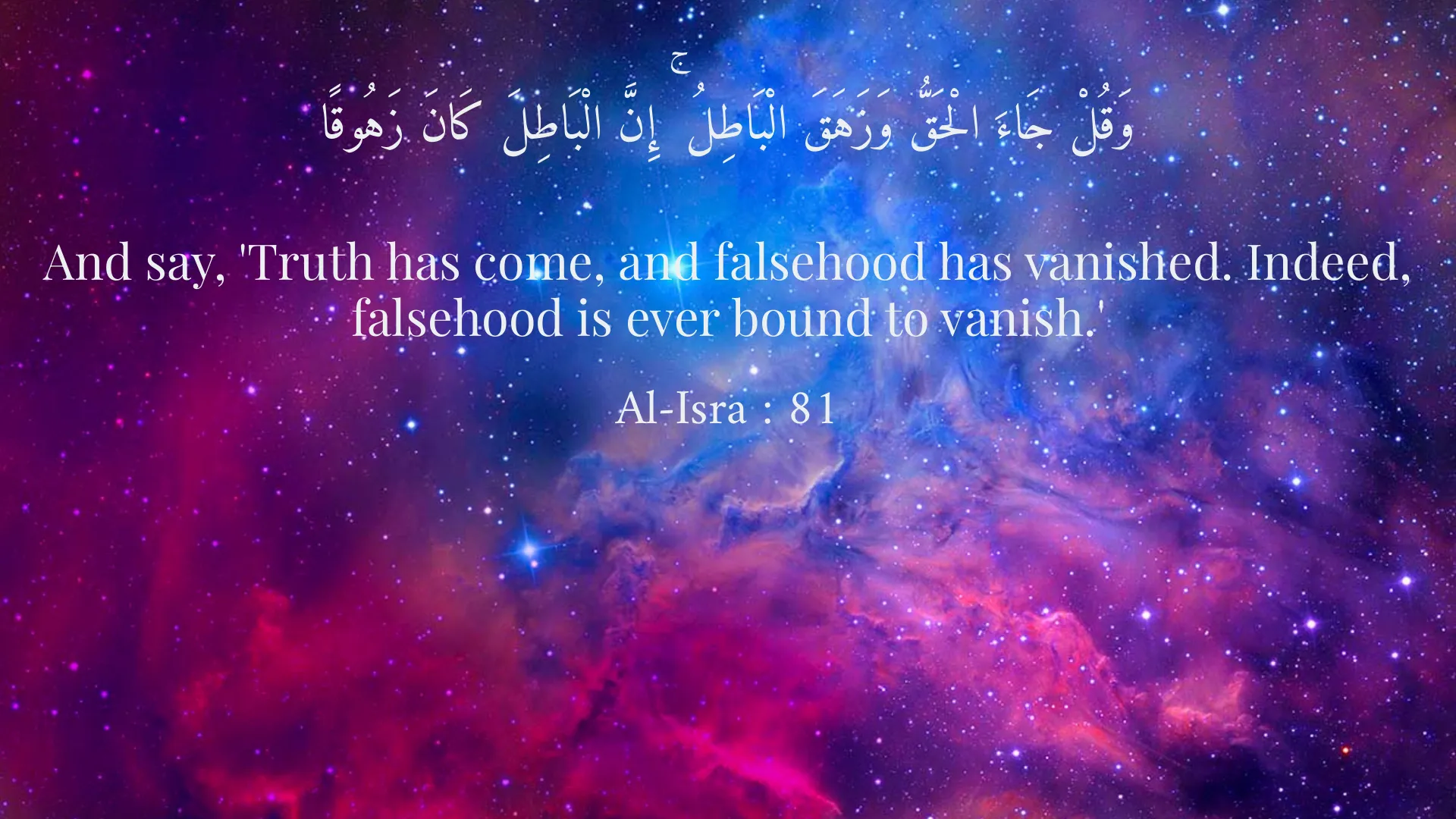
وَقُلْ جَاءَ الْحَقُّ وَزَهَقَ الْبَاطِلُ ۚ إِنَّ الْبَاطِلَ كَانَ زَهُوقًا
And say, 'Truth has come, and falsehood has vanished. Indeed, falsehood is ever bound to vanish.'
Al-Isra : 81
وَلَا تَلْبِسُوا الْحَقَّ بِالْبَاطِلِ وَتَكْتُمُوا الْحَقَّ وَأَنتُمْ تَعْلَمُونَ
And do not mix truth with falsehood or conceal the truth while you know [it].
Al-Baqarah : 42
أَنزَلَ مِنَ السَّمَاءِ مَاءً فَسَالَتْ أَوْدِيَةٌ بِقَدَرِهَا فَاحْتَمَلَ السَّيْلُ زَبَدًا رَّابِيًا ۚ وَمِمَّا يُوقِدُونَ عَلَيْهِ فِي النَّارِ ابْتِغَاءَ حِلْيَةٍ أَوْ مَتَاعٍ زَبَدٌ مِّثْلُهُ ۚ كَذَٰلِكَ يَضْرِبُ اللَّهُ الْحَقَّ وَالْبَاطِلَ ۚ فَأَمَّا الزَّبَدُ فَيَذْهَبُ جُفَاءً ۖ وَأَمَّا مَا يَنفَعُ النَّاسَ فَيَمْكُثُ فِي الْأَرْضِ ۚ كَذَٰلِكَ يَضْرِبُ اللَّهُ الْأَمْثَالَ
He sends down from the sky water, and valleys flow according to their capacity, and the torrent carries a rising foam. And from that [ore] which they heat in the fire, desiring adornments or utensils, is a foam like it. Thus does Allah present [the examples of] truth and falsehood. As for the foam, it vanishes, [being] worthless; but as for that which benefits the people, it remains on the earth. Thus does Allah present examples.
Ar-Ra'd : 17
Short Story
It is said that one day a king asked his ministers to each utter the wisest words. The first minister, with flattery, said: 'O King! You are the sun of justice that shines upon the world.' Another said: 'O King, you are a sea of generosity and bounty.' But among them, there was an old minister who spoke from the heart and said: 'O King, the best word is that which never admits falsehood and is always accompanied by truth, for falsehood is like a bubble on water that soon bursts and vanishes, but truth, like a firm root in the earth, remains steadfast and bears fruit.' The king was initially surprised by this simple statement, but with the passage of time and witnessing the deceptions of falsehood and the endurance of truth, he understood the depth of the minister's words and held him in higher esteem. He realized that stability and glory depend only on truth, not on fleeting splendors.