Quranic Answer
Dealing with individuals who may weaken our faith is a significant challenge on the path of devotion and closeness to God. This issue has long been addressed by Quranic teachings, which offer wise solutions for preserving and strengthening faith against negative external influences. The Holy Quran teaches us that faith (Iman) is a precious jewel that must be protected, and this protection involves both internal strengthening and intelligent strategies in social interactions. First and perhaps most importantly, the step to take when encountering such people is to 'guard one's heart and mind.' The Quran repeatedly advises believers to turn away from gatherings and environments where divine verses are mocked or where vain talk prevails. This turning away does not imply animosity or hatred; rather, it is a defensive strategy to maintain one's spiritual and emotional well-being and faith. In Surah An-Nisa, verse 140, Allah says: "And when you see those who engage in [profane] discourse about Our verses, then turn away from them until they enter into another conversation. And if Satan should cause you to forget, then as soon as you remember, do not remain in the company of the wrongdoing people." This verse clearly outlines the strategy of 'turning away.' It means that when faced with faith-weakening or doubt-inducing speech, one should not engage or participate. Instead, one should either change the subject or leave that gathering. Surah Al-An'am, verse 68, similarly states: "And when you see those who engage in [empty] talk about Our verses, then turn away from them until they enter into another subject. And if Satan should cause you to forget, then as soon as you remember, do not remain in the company of the wrongdoing people." This Quranic emphasis indicates that sitting and listening to words that undermine faith can, over time, have detrimental effects on one's heart and soul. Second, 'strengthening the internal foundations of faith' is crucial. Strong and firm faith is like a tree with deep roots in the soil, not easily swayed by opposing winds. To strengthen these foundations, the Quran offers practical solutions. One of the most important is to "seek help through patience and prayer." In Surah Al-Baqarah, verse 153, we read: "O you who have believed, seek help through patience and prayer. Indeed, Allah is with the patient." Patience (sabr) here means steadfastness and resilience in the face of difficulties, including temptations and doubts. Prayer (Salat) provides a direct connection to Allah, granting peace and spiritual strength. Persistent remembrance (Dhikr) and recitation of the Quran are also vital for internal strengthening, as Allah's word is light and guidance that purifies hearts. The deeper our understanding of the principles of faith and the stronger our connection with the Creator, the less impact the faith-weakening words of others will have. Learning and delving into religious knowledge provide logical answers to doubts and prevent wavering. Third, 'wise and sensible interaction' is sometimes necessary. It is not always possible to completely avoid certain individuals, for instance, in unavoidable work environments, family settings, or social gatherings. In such cases, the Quran guides us to deal with them with "wisdom and good instruction." Surah An-Nahl, verse 125, states: "Invite to the way of your Lord with wisdom and good instruction, and argue with them in a way that is best." Although this verse is about inviting to Islam, its principle applies to any discussion or argument aimed at correction or clarification. Wisdom (Hikmah) implies deep insight and correct understanding, so that words are spoken appropriately and at the right time. Good instruction (Maw'izah Hasanah) means words accompanied by gentleness, kindness, and compassion, not harshness or aggression. And "arguing in a way that is best" implies engaging in debate with strong logic and reasoning, without insult or provocation. In some cases, the best approach is to 'ignore' or 'respond with peace,' as stated in Surah Al-Qasas, verse 55: "And when they hear ill speech, they turn away from it and say, 'To us are our deeds, and to you are your deeds. Peace be upon you. We seek not the ignorant.'" This approach demonstrates spiritual grandeur and avoidance of futile disputes. Fourth, the Quranic advice emphasizes 'choosing righteous companions.' Our environment and the people around us significantly influence our faith and morale. The Quran advises believers to associate with the righteous and those who remember Allah. In Surah Al-Kahf, verse 28, Allah says: "And patiently stick with those who call upon their Lord morning and evening, seeking His countenance; and do not let your eyes pass beyond them, desiring the adornments of the worldly life." This verse underscores that companionship with those who seek Allah's pleasure helps stabilize and strengthen faith, while abandoning them for worldly pleasures and associating with the heedless may weaken faith. Associating with strong and knowledgeable believers not only provides psychological and spiritual support but can also be a source for answering doubts and increasing religious insight. Finally, it must always be remembered that guidance and the strengthening of faith ultimately come from Allah, and one must seek His help. Supplication (Du'a) to Allah for the preservation of faith and protection from the evil of tempters is an inseparable part of the strategy for dealing with those who weaken faith. We should ask Allah to keep our hearts steadfast on the right path and protect us from those who mislead. Thus, by combining intelligent avoidance of negative influences, continuous internal strengthening of faith through worship and knowledge, wise interaction in unavoidable circumstances, and choosing righteous companions, we can preserve and even strengthen our faith against challenges.
Related Verses
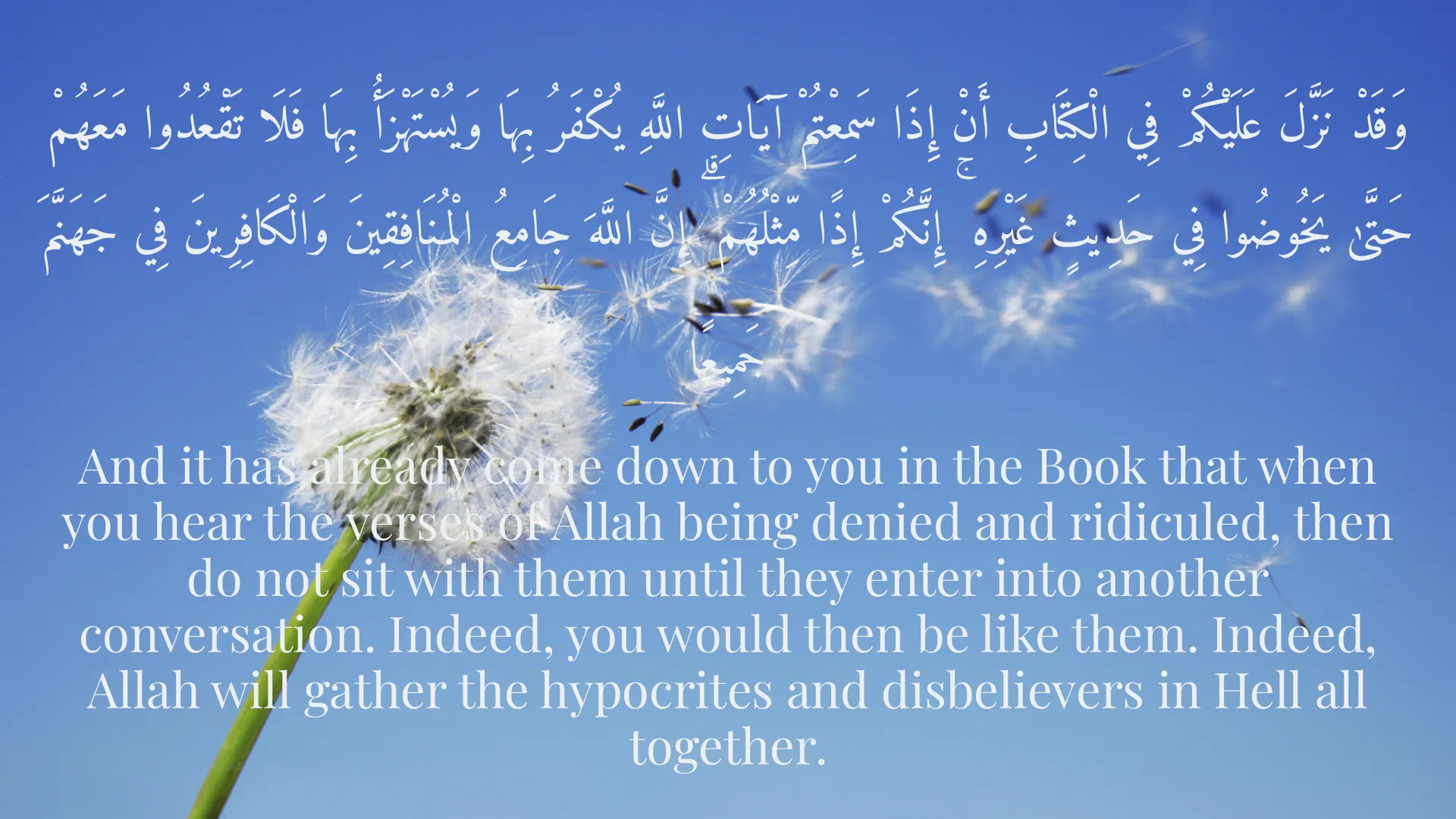
وَقَدْ نَزَّلَ عَلَيْكُمْ فِي الْكِتَابِ أَنْ إِذَا سَمِعْتُمْ آيَاتِ اللَّهِ يُكْفَرُ بِهَا وَيُسْتَهْزَأُ بِهَا فَلَا تَقْعُدُوا مَعَهُمْ حَتَّىٰ يَخُوضُوا فِي حَدِيثٍ غَيْرِهِ ۚ إِنَّكُمْ إِذًا مِّثْلُهُمْ ۗ إِنَّ اللَّهَ جَامِعُ الْمُنَافِقِينَ وَالْكَافِرِينَ فِي جَهَنَّمَ جَمِيعًا
And it has already come down to you in the Book that when you hear the verses of Allah being denied and ridiculed, then do not sit with them until they enter into another conversation. Indeed, you would then be like them. Indeed, Allah will gather the hypocrites and disbelievers in Hell all together.
An-Nisa : 140
وَإِذَا رَأَيْتَ الَّذِينَ يَخُوضُونَ فِي آيَاتِنَا فَأَعْرِضْ عَنْهُمْ حَتَّىٰ يَخُوضُوا فِي حَدِيثٍ غَيْرِهِ ۚ وَإِمَّا يُنسِيَنَّكَ الشَّيْطَانُ فَلَا تَقْعُدْ بَعْدَ الذِّكْرَىٰ مَعَ الْقَوْمِ الظَّالِمِينَ
And when you see those who engage in [empty] talk about Our verses, then turn away from them until they enter into another subject. And if Satan should cause you to forget, then as soon as you remember, do not remain in the company of the wrongdoing people.
Al-An'am : 68
يَاأَيُّهَا الَّذِينَ آمَنُوا اسْتَعِينُوا بِالصَّبْرِ وَالصَّلَاةِ ۚ إِنَّ اللَّهَ مَعَ الصَّابِرِينَ
O you who have believed, seek help through patience and prayer. Indeed, Allah is with the patient.
Al-Baqarah : 153
وَإِذَا سَمِعُوا اللَّغْوَ أَعْرَضُوا عَنْهُ وَقَالُوا لَنَا أَعْمَالُنَا وَلَكُمْ أَعْمَالُكُمْ سَلَامٌ عَلَيْكُمْ لَا نَبْتَغِي الْجَاهِلِينَ
And when they hear ill speech, they turn away from it and say, 'To us are our deeds, and to you are your deeds. Peace be upon you. We seek not the ignorant.'
Al-Qasas : 55
وَاصْبِرْ نَفْسَكَ مَعَ الَّذِينَ يَدْعُونَ رَبَّهُم بِالْغَدَاةِ وَالْعَشِيِّ يُرِيدُونَ وَجْهَهُ ۖ وَلَا تَعْدُ عَيْنَاكَ عَنْهُمْ تُرِيدُ زِينَةَ الْحَيَاةِ الدُّنْيَا ۖ وَلَا تُطِعْ مَنْ أَغْفَلْنَا قَلْبَهُ عَن ذِكْرِنَا وَاتَّبَعَ هَوَاهُ وَكَانَ أَمْرُهُ فُرُطًا
And patiently stick with those who call upon their Lord morning and evening, seeking His countenance; and do not let your eyes pass beyond them, desiring the adornments of the worldly life; and do not obey one whose heart We have made heedless of Our remembrance and who follows his own desire and whose affair has been [marked by] excess.
Al-Kahf : 28
Short Story
It is narrated that in ancient times, a pious and devout worshipper lived in a city. Whenever a certain ill-mannered man saw him, he would try to bother him with stinging words and faith-weakening remarks. People asked the worshipper, 'Why do you not say anything to him? Why don't you answer him?' The worshipper smiled and said, 'Sa'di says: 'Whoever does not speak well, brings upon himself the trouble of responding.' Then he continued: 'A man of great heart once said: If I respond to every stone and arrow thrown at me, I will never reach my destination. I preserve my faith for God, not for the affirmation or denial of others. Let the wind blow, the mountain stands firm.' And so, he continued his path of devotion with peace and steadfastness, while the ill-mannered man gradually grew tired of himself and his words became ineffective, for he found no response to weaken the worshipper's faith.