Quranic Answer
The question of achieving a peace that is not dependent on external conditions is profoundly addressed in the Holy Quran, offering deep insights and guidance. Islam teaches us that true tranquility is not found in accumulating wealth, attaining worldly status, or fulfilling all material desires. Rather, its source lies within the human heart and its connection with the Creator of the universe. The Quran presents several pathways to attain this lasting peace, which we will explore in detail. 1. Remembrance of Allah (Dhikrullah): The Core of Tranquility The most central and powerful factor for achieving inner peace is the constant remembrance of Almighty Allah. The Quran explicitly states in Surah Ar-Ra'd, verse 28: "Those who have believed and whose hearts are assured by the remembrance of Allah. Unquestionably, by the remembrance of Allah hearts are assured." This verse establishes a fundamental and universal principle. True peace, a peace untouched by external fluctuations and changes, is attained only through a deep connection with the absolute source of peace, which is God Himself. Dhikr is not merely the repetition of words; it encompasses reflection on Divine greatness, recitation of the Quran, prayer (Salat), supplication (Du'a), and even maintaining a conscious awareness of God's presence in all aspects of life with a divine intention. When a person remembers that everything is within Allah's power and that not a single leaf falls without His permission, anxieties and worries arising from a lack of control over external circumstances dissipate. This continuous remembrance helps an individual to exercise patience in the face of calamities and show gratitude for blessings, knowing that everything is from God and contains inherent goodness. 2. Reliance on Allah (Tawakkul): Entrusting Affairs to Him Another pillar of lasting peace is genuine reliance upon Allah. Tawakkul does not mean abandoning effort; rather, it signifies exerting all possible human effort and then entrusting the outcome to Allah, with complete trust in His wisdom and divine plan. In Surah Al-Imran, verse 159, we read: "And when you have decided, then rely upon Allah. Indeed, Allah loves those who rely [upon Him]." When a person knows that their sustenance, lifespan, health, and all their affairs are in the hands of an infinite power who desires their ultimate good, a profound peace settles upon them. This reliance liberates the individual from financial, social, or health-related worries, which often stem from fear of the future. They understand that Allah is the best planner, and nothing occurs outside His will, even if it appears undesirable on the surface, it holds an inner good. 3. Patience (Sabr) and Prayer (Salat): Tools for Overcoming Hardships The Holy Quran instructs believers to seek help through patience and prayer when facing challenges and difficulties. In Surah Al-Baqarah, verse 153, it is stated: "O you who have believed, seek help through patience and prayer. Indeed, Allah is with the patient." Patience implies enduring hardships and afflictions without despair or complaint, and controlling negative emotions and anger. Prayer, on the other hand, is a direct and immediate connection with Allah that nourishes the soul and bestows strength and tranquility upon an individual. When a person stands in prayer before the Creator of the universe, feelings of weakness and insignificance in the face of problems vanish, and they are filled with divine energy. These two elements, patience and prayer, act as anchors that keep the ship of human existence steady and stable amidst life's storms, preventing external turbulences from disturbing their inner peace. 4. Contentment and Acceptance of Divine Decree (Qana'ah & Rida bi al-Qada'): Embracing What Is Another aspect of achieving lasting peace is accepting divine decree and being content with what Allah has ordained. Humans often lose their peace when they suffer over what they lack or lament over what they have lost. The Quran invites us to a life of gratitude and contentment. Although there isn't a specific verse using the exact word "qana'ah," the spirit of numerous verses emphasizing gratitude for blessings (Ibrahim 7), avoiding greed and covetousness (At-Takathur 1-2), and prioritizing the Hereafter over this world (Al-A'la 16-17), underscore this concept. When a person is pleased with Allah's decree and knows that every event, even if seemingly unpleasant, holds wisdom within it, they are no longer enslaved by external fluctuations. This state of contentment frees them from endless comparisons and futile regrets, enabling them to experience peace in any circumstance. 5. Belief in the Hereafter (Iman bi al-Ma'ad): A Perspective Beyond This World Peace that is independent of conditions requires a broader perspective than just worldly life. Firm belief in life after death and accountability for deeds in the Hereafter helps an individual to place worldly matters and problems in their proper perspective. The Quran consistently refers to the transient nature of this world and the permanence of the Hereafter. For example, in Surah Al-A'la, verses 16 and 17, it states: "But you prefer the worldly life, while the Hereafter is better and more enduring." When a person understands that this world is temporary and the main purpose of life is to prepare for eternity, worldly events can no longer completely disrupt their peace. Calamities and hardships are viewed as divine tests for which reward is preserved in the Hereafter, and successes as opportunities for gratitude and good deeds. This perspective provides a strong anchorage for inner peace in all circumstances. In conclusion, a peace that is independent of conditions stems from a deep faith in Allah, complete reliance upon Him, seeking refuge in remembrance and prayer, exercising patience, and adopting an afterlife-oriented perspective. These are concepts that liberate the human heart from the slavery of worldly desires and the fear of external changes, connecting it to the eternal source of peace. This peace is a divine gift that can be attained by adhering to these Quranic principles, and it can be found within oneself at all times and in all places.
Related Verses
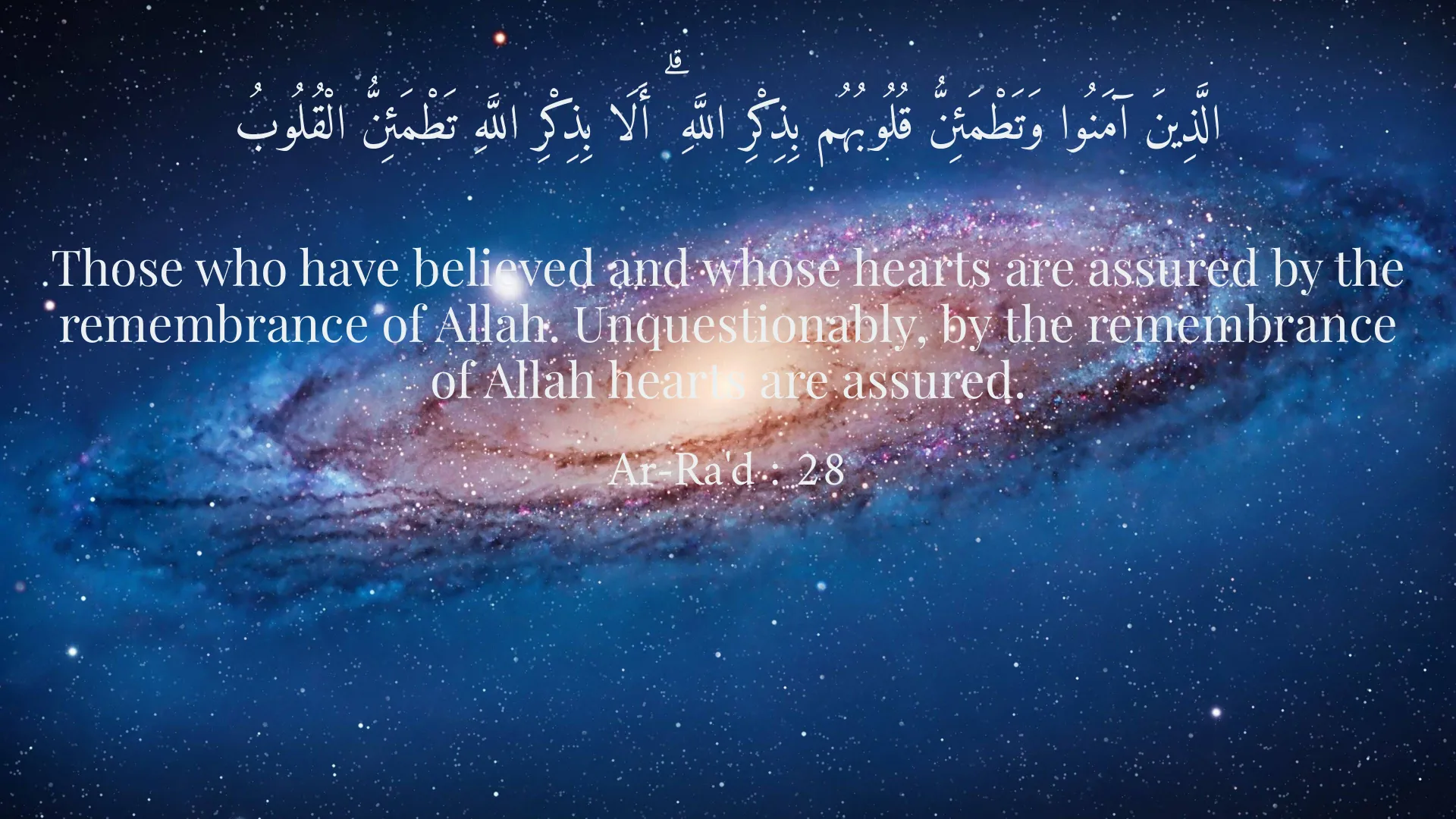
الَّذِينَ آمَنُوا وَتَطْمَئِنُّ قُلُوبُهُم بِذِكْرِ اللَّهِ ۗ أَلَا بِذِكْرِ اللَّهِ تَطْمَئِنُّ الْقُلُوبُ
Those who have believed and whose hearts are assured by the remembrance of Allah. Unquestionably, by the remembrance of Allah hearts are assured.
Ar-Ra'd : 28
فَإِذَا عَزَمْتَ فَتَوَكَّلْ عَلَى اللَّهِ ۚ إِنَّ اللَّهَ يُحِبُّ الْمُتَوَكِّلِينَ
And when you have decided, then rely upon Allah. Indeed, Allah loves those who rely [upon Him].
Al-Imran : 159
يَا أَيُّهَا الَّذِينَ آمَنُوا اسْتَعِينُوا بِالصَّبْرِ وَالصَّلَاةِ ۚ إِنَّ اللَّهَ مَعَ الصَّابِرِينَ
O you who have believed, seek help through patience and prayer. Indeed, Allah is with the patient.
Al-Baqarah : 153
بَلْ تُؤْثِرُونَ الْحَيَاةَ الدُّنْيَا
But you prefer the worldly life,
Al-A'la : 16
وَالْآخِرَةُ خَيْرٌ وَأَبْقَىٰ
while the Hereafter is better and more enduring.
Al-A'la : 17
Short Story
It is narrated that there was a dervish known for his contentment, whose heart was always submitted to God's will. One day, he passed by the marketplace and saw a wealthy merchant sitting amidst his precious goods, his face clouded with worry. The dervish greeted him with a smile. The merchant replied impatiently, saying, 'O dervish, you are always at ease, while we are constantly burdened by sorrow and grief. What is the secret to this?' The dervish replied, 'The secret is this: you ponder what you lack, while I give thanks for what I possess. You are bound by the market and its profits and losses, while my heart is engrossed in the remembrance of God. Whoever entrusts their heart to the Truth and turns away from the transient world, will find that peace never abandons them, whether in poverty or in wealth.' The merchant reflected and realized that peace is not found in abundant possessions, but in the purity of heart and detachment from worldly affairs.