Quranic Answer
Cultivating certainty (Yaqin) and inner conviction in supplication (Dua) is a precious jewel in the path of servitude, requiring a deep understanding of God's nature, His established customs in creation, and His responsiveness to His servants. The Holy Quran serves as an unparalleled guide for nurturing this certainty, as it lays the foundational ground for complete trust in divine power and mercy. The first step in achieving certainty in Dua is a genuine understanding and belief in Allah's attributes of Al-Sami' (The All-Hearing) and Al-Mujib (The Responder). Allah explicitly describes Himself as being near and responsive in the Quran. In Surah Al-Baqarah, verse 186, He states: “And when My servants ask you, [O Muhammad], concerning Me – indeed I am near. I respond to the invocation of the supplicant when he calls upon Me. So let them respond to Me [by obedience] and believe in Me that they may be [rightly] guided.” This verse forms the backbone of certainty in Dua. Allah Himself guarantees that He responds to the supplicant's invocation. This is not merely a hope, but a divine promise. This belief must be deeply rooted in our hearts: every whisper, every sigh, and every desire we express reaches His All-Hearing and infinitely Merciful ear directly, and He is ready to answer. The second step is 'Ikhlas' (sincerity) in Dua. This means that the supplication is solely and purely for the sake of Allah's pleasure, not for gaining attention from others or for purely worldly motives. The Quran places great emphasis on sincerity in worship. Dua must arise purely from the depths of one's soul, accompanied by repentance, turning to Allah, and acknowledging one's servitude and need. When a person turns to God with their whole being and with a pure intention, their sense of certainty in His response is amplified, knowing that Allah pays special attention to sincere hearts. The third pillar is complete 'Tawakkul' (reliance) upon Allah. Tawakkul means entrusting one's affairs to God after fulfilling necessary duties and efforts. In Surah At-Talaq, verse 3, we read: “And He will provide for him from where he does not expect. And whoever relies upon Allah – He is sufficient for him. Indeed, Allah will accomplish His purpose. Allah has already set for everything a [decreed] extent.” This verse assures us that if we rely on Him with all our being, He will suffice for our affairs. This reliance should not only be present during Dua but throughout all moments of life to strengthen one's sense of certainty. When a person is certain that their good and well-being are solely in God's hands, they pray with greater peace and assurance, entrusting the outcomes to Him. The fourth factor is 'Sabr' (patience) and perseverance in Dua. Sometimes, the answer to a Dua does not come immediately. This delay can be due to various reasons: divine wisdom, the supplicant's readiness, or the Dua being transformed into a better form (e.g., averting harm or being stored for the Hereafter). In such circumstances, the Quran advises us to be patient. In Surah Al-Baqarah, verse 153, we read: “O you who have believed, seek help through patience and prayer. Indeed, Allah is with the patient.” Patience in Dua means not despairing or losing hope, even if the response is not immediate. Certainty in Dua means believing that Allah has heard our supplication and will respond to it in the best possible way at His appointed time, even if that response differs from our exact request. This patience itself is a form of certainty; certainty in divine planning and wisdom. The fifth point is 'Tawassul' (seeking nearness) through Allah's Names and Attributes. The Holy Quran is replete with Allah's Most Beautiful Names (Asma-ul-Husna), each manifesting one of His attributes. When we supplicate with “Ya Rahman, Ya Rahim,” we appeal to His boundless mercy; when we call with “Ya Qawiy, Ya Qadir,” we seek refuge in His absolute power. This knowledge and seeking nearness through His Names increase one's connection and closeness to Allah, thereby strengthening the certainty of response in the heart. Every one of Allah's Names is a gateway to a deeper understanding of God, and the greater the understanding, the deeper the reliance and certainty will be. Finally, it is essential to understand that the answer to a Dua does not always mean the fulfillment of our apparent wish. Sometimes, Allah answers the servant's Dua by averting harm, or by storing reward for the Hereafter, or by granting something better than what was requested. This too is part of certainty: certainty in Allah's absolute benevolence and that He desires the best for His servants, even if we do not fully comprehend His wisdom. This perspective not only prevents despair but also elevates the level of contentment and submission to the divine will, extending certainty to all aspects of life. Certainty in Dua is not just a state of mind, but the fruit of a monotheistic life and deep faith in Almighty Allah.
Related Verses
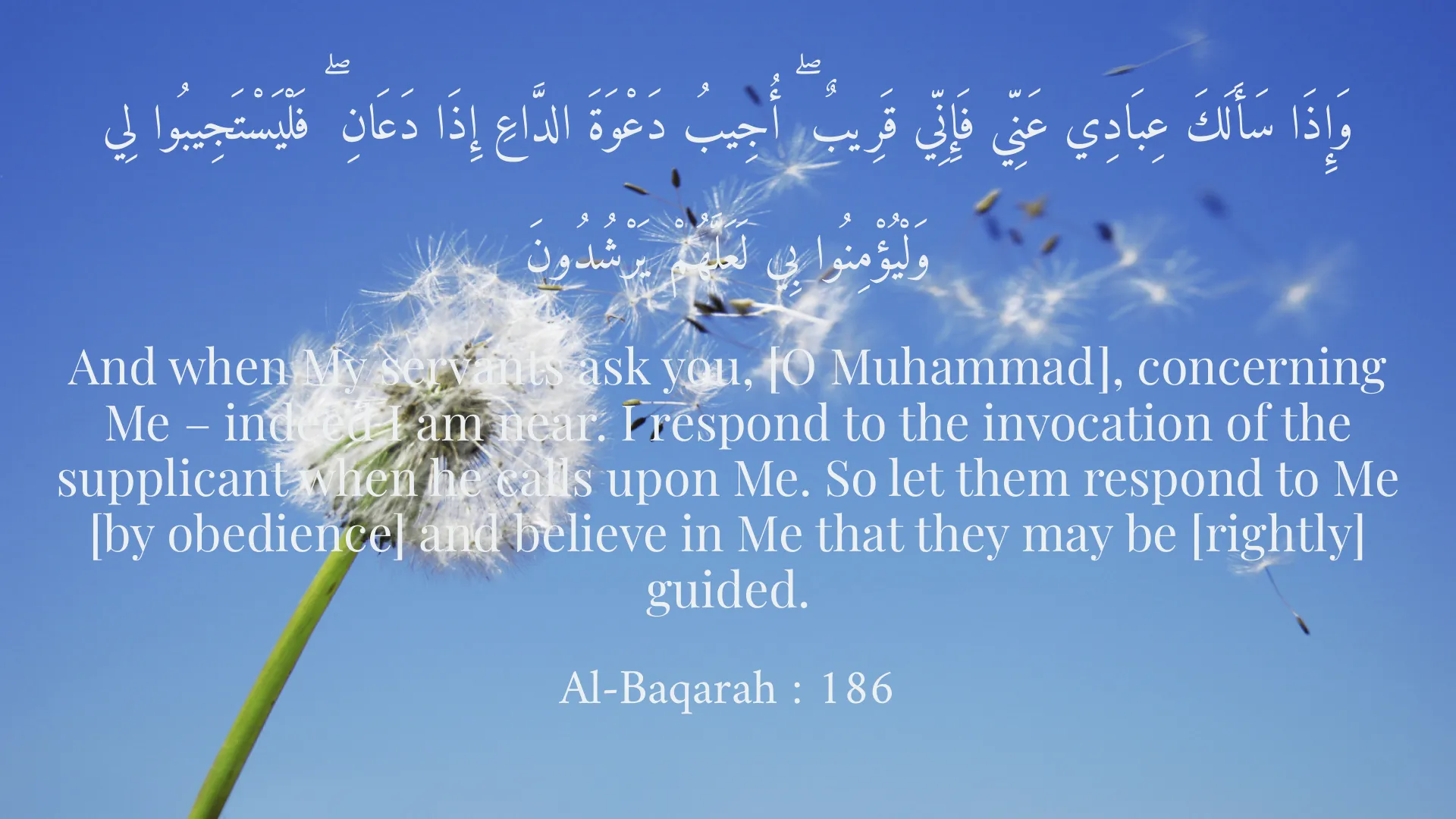
وَإِذَا سَأَلَكَ عِبَادِي عَنِّي فَإِنِّي قَرِيبٌ ۖ أُجِيبُ دَعْوَةَ الدَّاعِ إِذَا دَعَانِ ۖ فَلْيَسْتَجِيبُوا لِي وَلْيُؤْمِنُوا بِي لَعَلَّهُمْ يَرْشُدُونَ
And when My servants ask you, [O Muhammad], concerning Me – indeed I am near. I respond to the invocation of the supplicant when he calls upon Me. So let them respond to Me [by obedience] and believe in Me that they may be [rightly] guided.
Al-Baqarah : 186
وَقَالَ رَبُّكُمُ ادْعُونِي أَسْتَجِبْ لَكُمْ ۚ إِنَّ الَّذِينَ يَسْتَكْبِرُونَ عَنْ عِبَادَتِي سَيَدْخُلُونَ جَهَنَّمَ دَاخِرِينَ
And your Lord says, 'Call upon Me; I will respond to you.' Indeed, those who disdain My worship will enter Hell [rendered] contemptible.
Ghafir : 60
وَيَرْزُقْهُ مِنْ حَيْثُ لَا يَحْتَسِبُ ۚ وَمَن يَتَوَكَّلْ عَلَى اللَّهِ فَهُوَ حَسْبُهُ ۚ إِنَّ اللَّهَ بَالِغُ أَمْرِهِ ۚ قَدْ جَعَلَ اللَّهُ لِكُلِّ شَيْءٍ قَدْرًا
And will provide for him from where he does not expect. And whoever relies upon Allah – He is sufficient for him. Indeed, Allah will accomplish His purpose. Allah has already set for everything a [decreed] extent.
At-Talaq : 3
Short Story
A story from Saadi's Golestan recounts: “I saw a pious man by the seashore who had a leopard's wound that no medicine could cure. He suffered for a long time. I said, 'O Sheikh, would that you go to a place where they might treat your pain.' He replied, 'I have made a covenant with my God that as long as there is life in my body, I will not ask anything from Him and will not seek refuge in anyone but Him. I am certain that the same God who gave me this pain, if He wills, will also send its cure.'” This heartwarming story teaches us that true certainty lies in complete reliance upon God and accepting His will, even in the hardest of circumstances, for He is capable of all things, and whatever He does is good.