Quranic Answer
Love, in its deepest and most sublime sense, is the backbone of existence and the essence of humanity's relationship with its Creator and with other beings. Achieving healthy and divine love is a profound and multifaceted process rooted in understanding and acting upon Quranic teachings. The Holy Quran not only addresses the love between the Creator and the created but also establishes strong frameworks for human relationships based on affection, mercy, and justice. To attain this exalted form of love, one must begin with the fundamental point: knowing and loving Almighty God. 1. Love for God, the Source of All Love: The Quran explicitly states that the most intense love should be for Allah. In Surah Al-Baqarah, verse 165, we read: "But those who believe are stronger in love for Allah." This foundational love is the cornerstone of every healthy love. When a person's heart becomes filled with affection for the One Creator, their entire perception of existence changes. This love leads to obedience, gratitude, glorification, and supplication to the Divine Presence. Acts of worship such as prayer, fasting, charity (zakat), and pilgrimage (Hajj) are practical manifestations of this love that draw a person closer to God. Constant remembrance of God (Dhikr), both mentally and verbally, is also a way to cultivate this love. The more we ponder upon Allah's greatness, kindness, sustenance, and wisdom, the deeper our love for Him will become. This love liberates individuals from transient material attachments and guides them towards enduring and eternal values. Once the love for God takes root in the heart, nothing else can truly replace it, and this itself guarantees the spiritual and psychological well-being of the individual. This divine love provides a stable anchor in a world of flux, ensuring that our affections are directed towards that which is truly lasting and beneficial, both in this life and the hereafter. It fosters a sense of contentment and peace that worldly pursuits can never fully provide. 2. Love for the Prophet and Following His Sunnah: In Surah Al-Imran, verse 31, the Quran states: "Say, [O Muhammad], 'If you should love Allah, then follow me; Allah will love you and forgive you your sins. And Allah is Forgiving and Merciful.'" Love for the Prophet Muhammad (peace be upon him) and his pure household (Ahl al-Bayt) is an inseparable part of divine love. This affection is not merely an emotional sentiment; it is accompanied by a commitment to follow his conduct (Seerah) and traditions (Sunnah). The Prophet (PBUH) is the perfect example of a human being whose entire life was a manifestation of divine love. Emulating his ethics, behavior, and teachings paves our way to achieving healthy and divine love. This practical adherence deepens our love for God, and consequently, divine love also encompasses us. Following the Prophet's Sunnah means disciplining the self, abstaining from sins, respecting people's rights, and striving for justice and benevolence. It means embodying the virtues he taught, such as humility, compassion, patience, and generosity, in all aspects of our daily lives. This practical implementation transforms love from a mere concept into a living reality, affecting our interactions and choices in every moment. 3. Love in Human Relationships (Based on Affection and Mercy): The Holy Quran considers human relationships, especially marital ones, as signs of Allah's creation and a manifestation of healthy love. In Surah Ar-Rum, verse 21, it says: "And of His signs is that He created for you from yourselves mates that you may find tranquility in them; and He placed between you affection and mercy. Indeed, in that are signs for a people who give thought." "Mawaddah" (affection) and "Rahmah" (mercy) are two fundamental pillars of healthy love in marital relationships. Mawaddah refers to overt love and friendship, while Rahmah signifies kindness and compassion, even when affection might wane. These two qualities ensure the stability and growth of the relationship. Healthy love in human relationships extends beyond marital bonds to include love for parents, children, relatives, friends, and even all humanity. This love is based on Quranic principles such as justice, benevolence, forgiveness, empathy, and cooperation. Love for parents is accompanied by respect and kindness, as emphasized in Surah Al-Isra, verse 23. Love for children is expressed through proper upbringing and tenderness. Love for fellow human beings is realized by helping the needy, fairness in dealings, avoiding backbiting and slander, and striving for peace and tranquility in society. This comprehensive approach to love ensures that our affections are not limited to a narrow circle but extend to encompass all those around us, reflecting the vastness of divine mercy and compassion. It’s a love that seeks the good for others, even strangers, fostering a sense of universal brotherhood and sisterhood. 4. Purification of the Heart and Soul: To receive and cultivate divine love, the human heart must be pure and free from material and spiritual impurities. Sins, envy, malice, arrogance, greed, and stinginess are veils that prevent the heart from perceiving and experiencing true love. Repentance (Tawbah), seeking forgiveness (Istighfar), self-reckoning, and purification (Tazkiyah) are essential steps for cleansing the heart. When the heart is purified, it reflects divine light like a mirror, and its capacity to receive divine love increases. Practicing patience (Sabr), gratitude (Shukr), reliance on God (Tawakkul), and contentment (Rida) are other tools that help purify and strengthen the heart. This inner cleansing prepares the vessel of the heart to be filled with divine grace and love, making it receptive to higher spiritual realities. It involves a continuous struggle against one's lower self (nafs) and its negative inclinations, aiming to elevate the soul towards its pristine, pure state. 5. Righteous Deeds and Service to Creation: Divine love is not merely an internal state; it must manifest in action. Serving creation, showing benevolence to the poor and needy, establishing justice, and striving to alleviate oppression are all practical expressions of love for God and humanity. When a person does good to others, they are essentially responding to divine love, and these righteous deeds attract Allah's affection. The Quran emphasizes that Allah loves those who do good. This service also helps deepen positive emotions and constructive love within, as a person tastes the true essence of humanity by helping others and finds profound satisfaction. This holistic approach ensures that love is not confined to personal feelings but extends to active participation in making the world a better place, embodying the divine attributes of mercy and justice. It is through these outward expressions of love that our inward transformation becomes complete and our connection with the Divine becomes truly tangible.
Related Verses
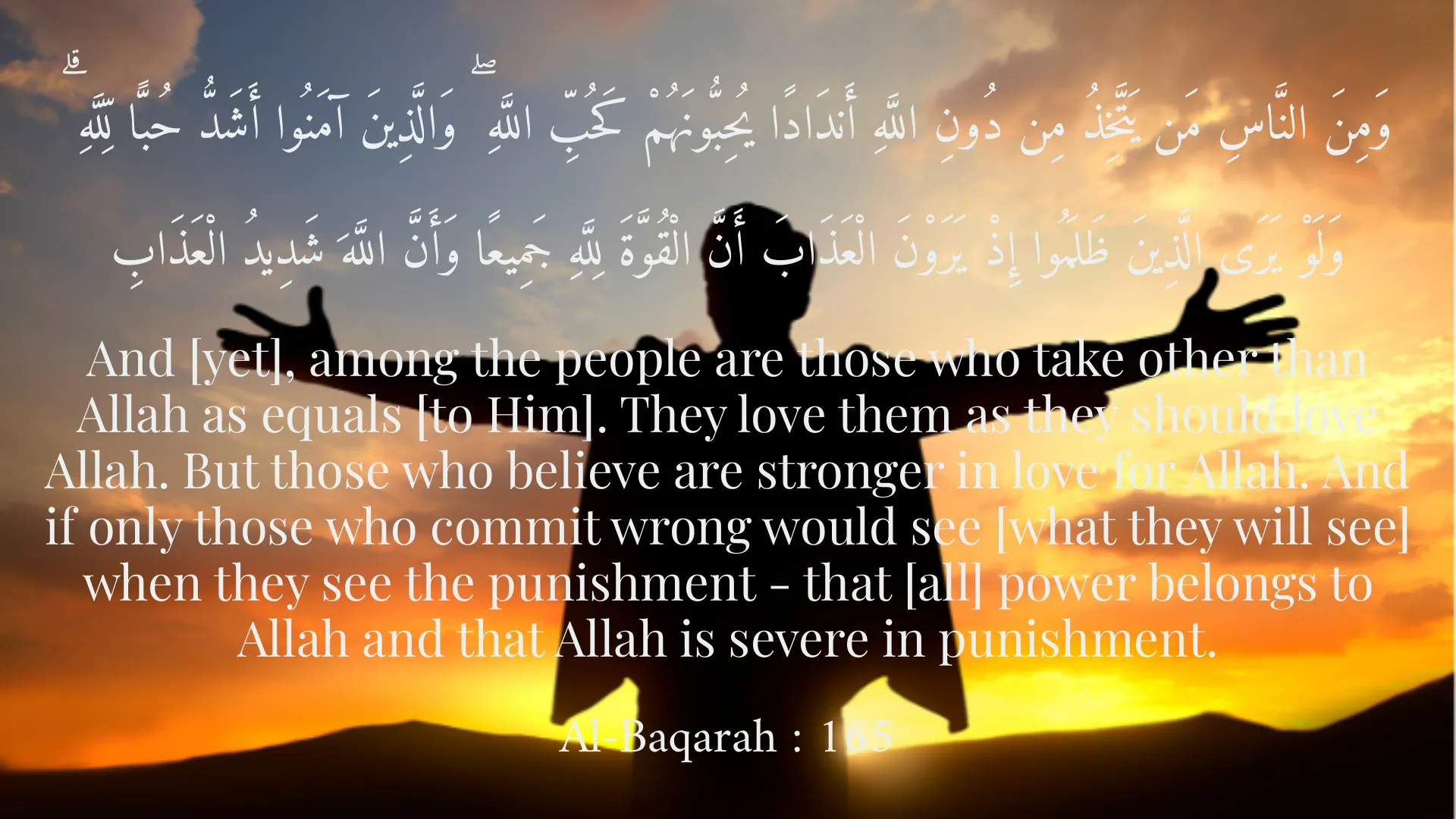
وَمِنَ النَّاسِ مَن يَتَّخِذُ مِن دُونِ اللَّهِ أَندَادًا يُحِبُّونَهُمْ كَحُبِّ اللَّهِ ۖ وَالَّذِينَ آمَنُوا أَشَدُّ حُبًّا لِّلَّهِ ۗ وَلَوْ يَرَى الَّذِينَ ظَلَمُوا إِذْ يَرَوْنَ الْعَذَابَ أَنَّ الْقُوَّةَ لِلَّهِ جَمِيعًا وَأَنَّ اللَّهَ شَدِيدُ الْعَذَابِ
And [yet], among the people are those who take other than Allah as equals [to Him]. They love them as they should love Allah. But those who believe are stronger in love for Allah. And if only those who commit wrong would see [what they will see] when they see the punishment - that [all] power belongs to Allah and that Allah is severe in punishment.
Al-Baqarah : 165
قُلْ إِن كُنتُمْ تُحِبُّونَ اللَّهَ فَاتَّبِعُونِي يُحْبِبْكُمُ اللَّهُ وَيَغْفِرْ لَكُمْ ذُنُوبَكُمْ ۗ وَاللَّهُ غَفُورٌ رَّحِيمٌ
Say, [O Muhammad], 'If you should love Allah, then follow me; Allah will love you and forgive you your sins. And Allah is Forgiving and Merciful.'
Al-Imran : 31
وَمِنْ آيَاتِهِ أَنْ خَلَقَ لَكُم مِّنْ أَنفُسِكُمْ أَزْوَاجًا لِّتَسْكُنُوا إِلَيْهَا وَجَعَلَ بَيْنَكُم مَّوَدَّةً وَرَحْمَةً ۚ إِنَّ فِي ذَٰلِكَ لَآيَاتٍ لِّقَوْمٍ يَتَفَكَّرُونَ
And of His signs is that He created for you from yourselves mates that you may find tranquility in them; and He placed between you affection and mercy. Indeed in that are signs for a people who give thought.
Ar-Rum : 21
Short Story
It is narrated that in ancient times, there was a wealthy merchant deeply attached to worldly possessions, who spent every day accumulating more and more wealth. He believed that affection and tranquility could only be attained through riches. In the same city lived a simple dervish whose heart was full of love for God and service to creation. One day, the merchant saw the dervish, with a cheerful face and a serene heart, helping people and living kindly with his family. The merchant asked in surprise, "How is it that with all this wealth, I still seek tranquility, and you, with apparent poverty, are so at peace?" The dervish smiled and said, "My friend, you have attached your heart to what is fleeting, and your love is built upon things that will one day leave you. But I have set my heart upon the Eternal, and my love is connected to a Creator who neither perishes nor changes. All that comes from Him is beautiful and lasting; that is why my affection for my wife, children, and fellow human beings also springs from that pure source and is accompanied by affection and mercy. When your heart is tied to divine love, you no longer need worldly means for happiness, for connection itself is perfection." The merchant was moved by the dervish's words and gradually changed his life's path, realizing that true love is not in accumulating wealth, but in the richness of the soul and the connection with the Creator and His creation.