Quranic Answer
Choosing a life partner is undoubtedly one of the most significant decisions a person can make throughout their lifetime. This decision not only impacts the individual’s happiness but also their overall quality of life. In many cultures, particularly within the Islamic faith, the foundations laid by the Holy Quran provide crucial insights into the qualities that one should seek in a spouse. This article aims to elaborate on the guidelines provided in the Quran regarding selecting a life partner, focusing on the importance of faith, piety, and ethics, while emphasizing that a profound understanding of these principles fosters healthier and more fulfilling relationships. One of the pivotal themes stressed in the Quran is the importance of commitment to faith and piety in a partner. In Surah An-Nur, verse 26, it is mentioned, 'The good women are for the good men and the good men are for the good women.' This powerful assertion signifies that virtuous individuals are meant to unite with those who share similar values and moral standings. Hence, prior to entering the sacred bond of marriage, one must assess their compatibility in terms of faith and righteousness. The essence of this guideline is rooted in the understanding that a shared belief system acts as a guiding force in marriage. When both partners are committed to the same religious principles, it leads to enhanced mutual respect and understanding. For instance, spouses who fear Allah and strive to adhere to Islamic teachings tend to hold each other accountable in their moral and spiritual growth. This strengthened bond can positively impact various aspects of life, including family dynamics, child upbringing, and resilience in facing challenges together. Moreover, the Quran further emphasizes the avoidance of unions that could potentially disrupt one's spiritual journey. In Surah Al-Baqarah, verse 221, believers are advised against forming close associations with those who do not adhere to the tenets of the faith. This directive serves as a profound reminder that the choices we make in our personal relationships can either uplift or hinder our spiritual and emotional growth. Associating with a partner who does not prioritize religious values may lead to discord and disunity, potentially taking one away from their faith rather than bringing them closer. The Quran also lays out specific characteristics that should be considered when searching for a life partner. In Surah Al-Ahzab, verse 35, Allah mentions essential traits of believers that are desirable in a marriage. These include fear of Allah, truthfulness, and righteousness. By seeking a partner who embodies these traits, an individual sets the stage for a relationship built on trust, accountability, and moral integrity. Such qualities are crucial for overcoming the inevitable challenges faced in marital life and for nurturing a loving and supportive environment. On the other hand, the pressures of societal norms often lead individuals to focus primarily on superficial attributes when considering a partner. As common as this pitfall may be, the Quranic perspective encourages individuals to delve deeper than mere physical appearance or material wealth. While attraction is an undeniable component of relationships, lasting partnerships are underpinned by shared values, mutual respect, and emotional support. A spouse who shares one's commitment to faith and morality nurtures an environment conducive to personal growth and collective progress. In the modern context, navigating the journey of finding a life partner can be fraught with complications and distractions. Social media, dating apps, and the rapid pace of life can often overshadow important considerations that should govern this critical choice. Yet, the fundamental Islamic teachings regarding the selection of a spouse must not be forgotten. For instance, when individuals engage in the dating culture, it is essential to remain anchored in personal faith and the teachings of the Quran. Compatibility based on ethical and spiritual grounds is essential for fostering a successful union that glorifies the principles of Islam. Additionally, discussions surrounding marriage tend to highlight the significance of love and romantic attraction. However, it is vital to remember that these feelings can evolve and deepen when rooted in shared values and religious commitment. Marriage is not solely about emotional connection; it also encompasses a beautiful partnership that thrives on mutual faith, ethics, and purpose. As such, approaching marriage with this holistic perspective allows for a dynamic and fulfilling bond, enriched by shared endeavors, mutual support, and a united commitment to serve their Creator. Moreover, within the confines of Islamic teachings, mutual consultation and dialogue between partners are encouraged. Marriage is a partnership that requires both individuals to actively participate and contribute. Open discussions that address religious observance, finances, family plans, and future aspirations are pertinent to successful marriages. This forthright communication cultivates respect and understanding, establishing a stronger foundation upon which the marriage can thrive. In conclusion, choosing a life partner is a decision that requires careful consideration and reflection. The guidance offered in the Holy Quran emphasizes the importance of faith, piety, and ethics as key criteria for selecting a spouse. It is imperative to seek a partner who aligns with one's spiritual values while also embodying the qualities defined by the Quran. By prioritizing these elements, individuals can embark on a marital journey that is not only fulfilling on a personal level but also conducive to spiritual growth and communal harmony. As the saying goes, a strong marriage is built on a solid foundation of shared faith, mutual respect, and a genuine commitment to elevate each other towards a greater purpose.
Related Verses
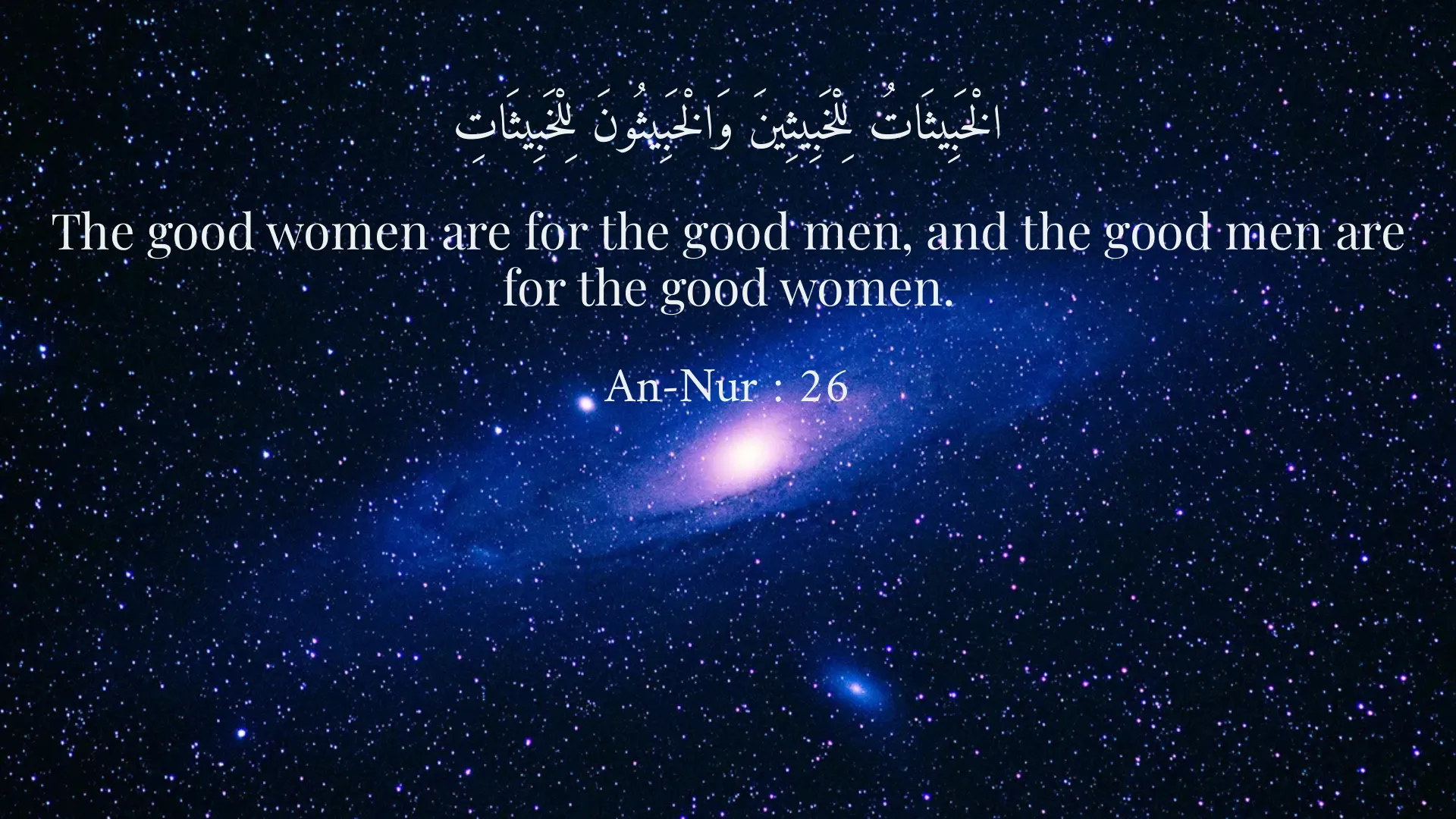
الْخَبِيثَاتُ لِلْخَبِيثِينَ وَالْخَبِيثُونَ لِلْخَبِيثَاتِ
The good women are for the good men, and the good men are for the good women.
An-Nur : 26
وَلَا تَنْكِحُوا الْمُشْرِكِينَ حَتَّى يُؤْمِنُوا
And do not marry the polytheists until they believe.
Al-Baqarah : 221
إِنَّ الْمُسْلِمِينَ وَالْمُسْلِمَاتِ وَالْمُؤْمِنِينَ وَالْمُؤْمِنَاتِ
Indeed, the Muslim men and women and the believing men and women.
Al-Ahzab : 35
Short Story
One day, a young man named Mahdi pondered how to find a suitable wife for himself. He decided to refer to the verses of the Quran for guidance. After studying, he realized he needed to focus on the person's faith and character while freeing himself from material attachments. Mahdi first worked on himself in faith and piety, and gradually he met someone who was also on the path of moral uprightness. The two married and began a joyful shared life.