Quranic Answer
The Holy Quran places immense emphasis on the profound importance of a person's inner self and spiritual core over their external appearance and worldly displays. Achieving a pure inner self and a sound soul is the fundamental purpose of human creation and the journey towards Allah. This inner purity naturally leads to simplicity and unpretentiousness in one's outward manifestation. These two aspects, inner purity and outer simplicity, are not contradictory; rather, they are complementary, stemming from a single source: Taqwa (God-consciousness) and true knowledge of Allah. Allah Almighty emphasizes the purification of the soul (tazkiyah) from moral vices in numerous verses. Tazkiyah signifies the cultivation of virtues and the removal of impurities from the soul. In Surah Ash-Shams, verses 9 and 10, Allah states: "Qad aflaha man zakkaaha wa qad khaaba man dassaaha" (He has succeeded who purifies it [the soul], and he has failed who corrupts it). This verse clearly indicates that human salvation and success depend on the purification and cultivation of one's self. This inner purity encompasses sincerity, honesty in intention, humility, and freedom from envy, arrogance, stinginess, and hypocrisy. A "sound heart" (Qalb-e-Saleem) is one that is free from any polytheism, hypocrisy, and moral contamination. The Quran, in Surah Ash-Shu'ara, verse 89, states: "Illaa man atal laaha bi qalb-in-saleem" (Except him who comes to Allah with a sound heart [free from polytheism, disbelief, and sins]). This pure heart is the center of faith, knowledge, and love for Allah. To achieve inner purity, the Holy Quran outlines several paths. The first and most crucial step is "Taqwa," or God-consciousness. Taqwa is not merely fear but a comprehensive concept encompassing self-restraint and adherence to divine limits, which prevents one from committing sins and guides them towards good deeds. In Surah Al-Baqarah, verse 2, it states: "Dhaalikal kitaabu laa rayba feeh; hudallil muttaqeen" (This is the Book about which there is no doubt, a guidance for those conscious of Allah). The muttaqeen (pious) are those whose hearts find tranquility in the remembrance of Allah and who constantly monitor their actions and intentions. Dhikr (remembrance of Allah), Salat (prayer), Sawm (fasting), Sadaqah (charity), and recitation of the Quran are all tools for strengthening Taqwa and purifying the inner self. The more an individual connects with Allah and adheres to His commands, the more illuminated and purified their heart becomes. Alongside inner purity, the Quran also emphasizes simplicity and avoiding extravagance and excessive adornment. Simplicity in outward appearance is a manifestation of inner humility and detachment from the deceptive allurements of this world. In Surah Al-A'raf, verse 31, we read: "Ya bani Adama khudu zeenatakum inda kulli masjidin wakuluu washrabuu walaa tusrifuu; innahu laa yuhibbul musrifeen" (O children of Adam, take your adornment at every place of prayer, and eat and drink, but be not excessive. Indeed, He likes not those who commit excess). This verse, while permitting the use of adornments, immediately follows with a warning against extravagance. Extravagance is not limited to eating and drinking but also applies to clothing, decoration, and any form of wasteful spending or unnecessary luxury. The Holy Quran strongly emphasizes avoiding arrogance and boasting, both internally and externally. In Surah Luqman, verse 18, Luqman the Wise advises his son: "Walaa tusa''ir khaddaka lin naasi walaa tamshi fil ardi marahan; innal laaha laa yuhibbu kulla mukhtaalin fakhoor" (And do not turn your cheek [in contempt] toward people and do not walk through the earth exultantly. Indeed, Allah does not like every self-deluded exultant). This verse explicitly prohibits an arrogant demeanor and boastful behavior, which stem from a diseased heart corrupted by pride. Simplicity in appearance does not mean being unkempt or neglecting personal hygiene and neatness. Instead, it means refraining from excessive adornments, showing off, and wearing expensive clothes with the intention of boasting or attracting attention. A true Muslim cares for their cleanliness and appearance but never allows this neatness to lead to arrogance, extravagance, or ostentation. Ultimately, achieving a pure inner self and a simple outer appearance is a comprehensive journey that requires continuous effort. This journey begins with contemplation and reflection on divine verses, constant self-assessment of actions and intentions, and abstaining from sins. The more an individual purifies their heart from material and spiritual impurities, the less they need external displays, and they find true peace and contentment in simplicity. Simplicity in appearance is a reflection of inner richness; the truly wealthy person is one whose heart is pure from arrogance and greed and who is content and grateful for what Allah has provided, rather than seeking to accumulate and display wealth. This balance between the inner and outer self is a cornerstone of an ideal Islamic life, leading to success in both this world and the hereafter. To further cultivate this path, it is essential for Muslims to continuously engage in self-purification (tazkiyah an-nafs). This includes daily self-accounting (muhasabat an-nafs), which involves evaluating one's actions and intentions at the end of each day to identify weaknesses and strive to overcome them. Furthermore, contemplation on death and the afterlife, reminding oneself of the ephemeral nature of this world and the limited human lifespan, plays a significant role in reducing attachment to worldly glitters and focusing on eternal values. Continuous learning of Quranic teachings and the Sunnah of Prophet Muhammad (peace be upon him) and his household also grants insight to understand the difference between reality and illusion, and permanence versus transience. When a person fills their deepest being with the remembrance of Allah and love for Him, they no longer need external validation through outward displays. They understand that true worth lies in the sight of Allah, not in the eyes of people. Regarding outer simplicity, this does not mean that one should deprive themselves of Allah's blessings or shun lawful beauties. Rather, it means moderation and avoiding extremism in all forms. Wearing appropriate and clean clothes, having a comfortable and tidy home, and enjoying life's permissible amenities are all permissible and even recommended in some cases. However, the line between lawful use and extravagance, or neatness and showing off, is very fine. The Quran teaches us to always be moderate and avoid any form of excess. For example, concerning dress, the primary goal is modesty and preserving dignity, not competing in luxury or flaunting wealth. This simplicity and moderation in appearance help individuals free themselves from material bondage and liberate their hearts to embrace spiritual truths. A simple life provides more opportunities for contemplation, worship, and service to humanity, reducing unnecessary preoccupations. Thus, outer simplicity is not merely an ethical choice but a way of life that leads to spiritual well-being and peace of mind. This harmony between the inner and outer self portrays a balanced character committed to divine values, destined for success in both this world and the hereafter.
Related Verses
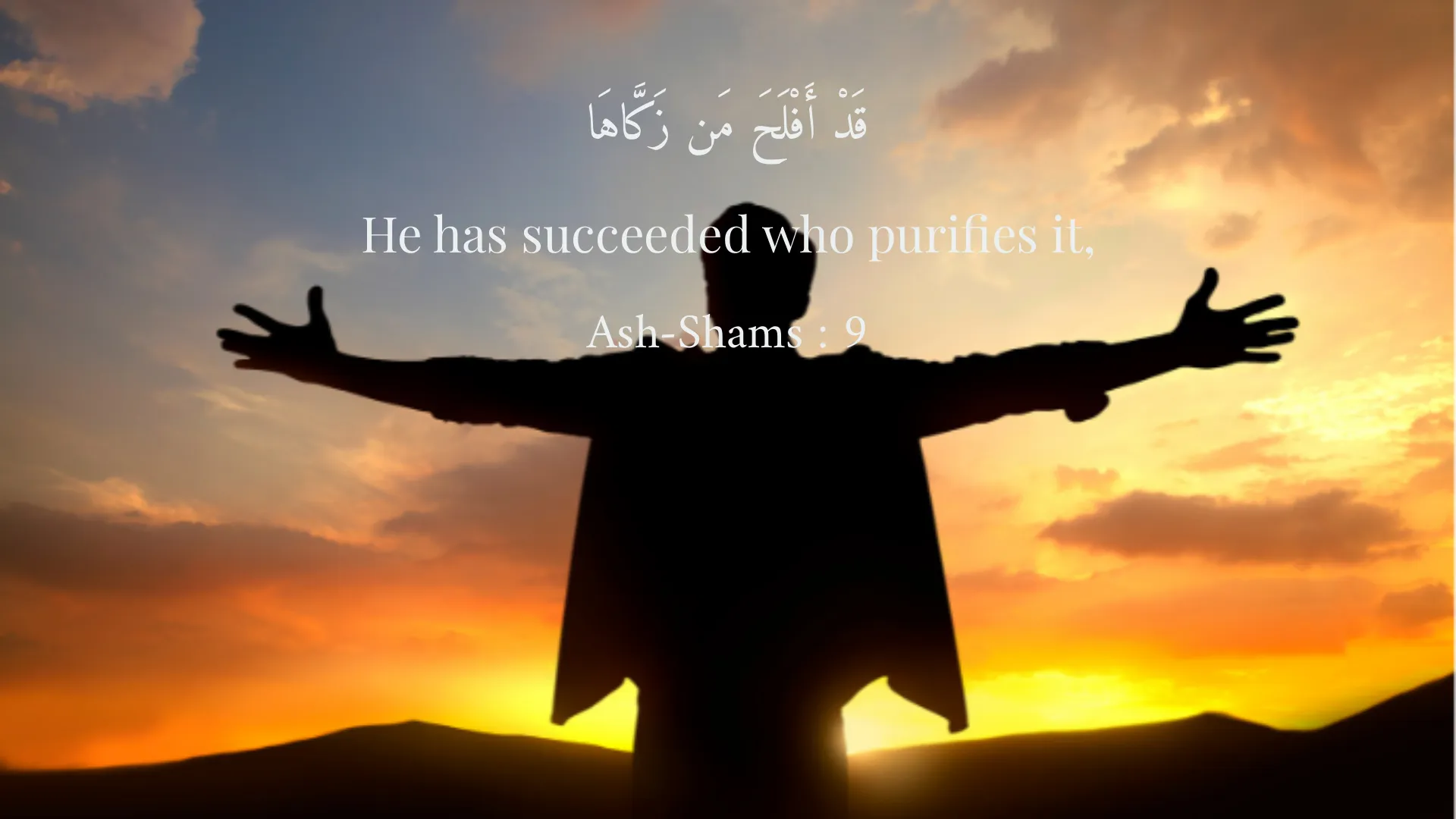
قَدْ أَفْلَحَ مَن زَكَّاهَا
He has succeeded who purifies it,
Ash-Shams : 9
وَقَدْ خَابَ مَن دَسَّاهَا
And he has failed who corrupts it.
Ash-Shams : 10
يَا بَنِي آدَمَ خُذُوا زِينَتَكُمْ عِندَ كُلِّ مَسْجِدٍ وَكُلُوا وَاشْرَبُوا وَلَا تُسْرِفُوا ۚ إِنَّهُ لَا يُحِبُّ الْمُسْرِفِينَ
O children of Adam, take your adornment at every place of prayer, and eat and drink, but be not excessive. Indeed, He likes not those who commit excess.
Al-A'raf : 31
وَلَا تُصَعِّرْ خَدَّكَ لِلنَّاسِ وَلَا تَمْشِ فِي الْأَرْضِ مَرَحًا ۖ إِنَّ اللَّهَ لَا يُحِبُّ كُلَّ مُخْتَالٍ فَخُورٍ
And do not turn your cheek [in contempt] toward people and do not walk through the earth exultantly. Indeed, Allah does not like every self-deluded exultant.
Luqman : 18
Short Story
Once upon a time, in ancient days, a renowned ruler was sitting by a river. At that moment, a humble dervish, clad in simple, patched garments but with a radiant and serene face, passed by and, without any display, sat beside the ruler. The ruler, who was adorned in luxurious and ornamental clothes, looked at the dervish with astonishment and asked him, "O man of God, what has befallen you that you live in such a state with these patched clothes and such a simple appearance? Do you not know that this world is full of beauties and one can enjoy them?" The dervish, with a calm smile and a heart full of tranquility, looked at the ruler and said, "O esteemed ruler, my state is better than yours! You are bound by this world and its fleeting adornments, and your heart is preoccupied with preserving these appearances. But I have freed my heart from these bondages and filled it with the remembrance of God and true knowledge. My clothes may be old, but my heart is new and pure, free from any material impurity. What holds value and importance for me is the satisfaction of the Lord and inner peace, not the gaze of people or the admiration of the world. My outward simplicity is a reflection of my inner purity." The ruler, deeply impressed by the dervish's profound and wise words, pondered for a long moment. He realized that the true worth of a human being lies in an inner self that is free from arrogance and greed, and detached from worldly attachments, not in expensive clothes, status, or wealth. From that day forward, the ruler gave more importance to inner purity and outer simplicity and learned that a simple appearance can cloak a rich heart full of wisdom and piety, which is more valuable in the sight of Allah. This story serves as a reminder that the true essence of a person lies in their heart and soul, not in their external display, and true happiness depends on inner purification and avoidance of ostentation.