Quranic Answer
During times of hardship, when the human heart is burdened and the soul experiences anxiety, the innate desire to find a safe refuge and an infinite power becomes more pronounced than ever. The Holy Quran, as the divine word and a complete guide for life, offers numerous strategies for drawing closer to God during these difficult periods. These teachings are not only comforting but also pave the way for spiritual growth and the strengthening of faith. Perhaps the most crucial initial step to drawing closer to God in adversity is through 'patience' (Sabr) and 'prayer' (Salat). In Surah Al-Baqarah, verse 153, Allah Almighty explicitly states: “O you who have believed, seek help through patience and prayer. Indeed, Allah is with the patient.” Patience here does not merely imply passive endurance of problems; rather, it signifies steadfastness and resilience in the face of adversities, without losing hope and faith in God. Prayer, too, is the pillar of religion and the ascension of the believer; it is a comforting sanctuary that directly connects a person to their Creator. In moments of prostration, one comprehends the utmost humility and need before the infinite richness of the Divine, and it is here that a profound sense of closeness and tranquility descends upon them. Prolonging prostrations, paying greater attention to the performance of prayer, and having a humble heart during it can deepen this connection. Secondly, a vital means is the 'remembrance of Allah' (Dhikr). The Quran states: “Those who have believed and whose hearts are assured by the remembrance of Allah. Unquestionably, by the remembrance of Allah hearts are assured.” (Surah Ar-Ra’d, verse 28). In times of hardship, the human mind can become overwhelmed with negative thoughts and despair. Constant remembrance of Allah, through reciting the Quran, saying Tasbihat (glorifications), uttering “La ilaha illa Allah” (There is no god but Allah), “Subhan Allah” (Glory be to Allah), “Alhamdulillah” (All praise is due to Allah), “Allahu Akbar” (Allah is the Greatest), and sending blessings upon the Prophet and his family, purifies the heart from temptations and illuminates it with divine light. This remembrance, like a cool breeze, soothes the flames of anxiety and brings forth tranquility. Even the utterance of “Hasbunallahu wa ni’mal Wakeel” (Allah is sufficient for us, and He is the best Disposer of affairs) in the midst of extreme difficulties, grants a person strength and reliance. 'Supplication and prayer' (Du’a) is the third direct path to God. Du’a is the essence of worship and a way for human beings to express their weakness and need before the absolute power of Allah. In hardships, one needs Du’a more than ever. Allah states in Surah Ghafir, verse 60: “And your Lord says, 'Call upon Me; I will respond to you.'” This divine promise is the greatest reassurance for believers. Du’a not only brings peace but also strengthens the feeling of dependence on and trust in supernatural power. Praying with sincere intention, tears, and humility, especially in the depths of the night and in solitude, can untie knots and open closed paths. 'Reliance on Allah' (Tawakkul) is the fourth factor for closeness. Tawakkul means complete trust in divine wisdom and planning. In Surah At-Talaq, verse 3, it is stated: “And whoever relies upon Allah – He is sufficient for him. Indeed, Allah will accomplish His purpose. Allah has already set for everything a [decreed] extent.” During times of difficulty, one may feel that control of the situation is slipping away. In such circumstances, entrusting matters to Allah and believing that He is the best disposer of affairs removes a heavy burden from a person's shoulders and brings peace of mind. This reliance does not mean abandoning effort, but rather exerting effort accompanied by trust in divine assistance. 'Repentance and seeking forgiveness' (Tawbah and Istighfar) is the fifth effective way to draw near to God. Hardships sometimes serve as a wake-up call for individuals to reflect on their weaknesses and sins. Turning back to Allah with sincere repentance not only cleanses sins but also opens the doors of divine mercy. In Surah Hud, verse 52, it is stated: “And O my people, ask forgiveness of your Lord and then repent to Him. He will send [rain from] the sky upon you in showers and add strength to your strength. And do not turn away, being criminals.” Istighfar helps a person free themselves from material and spiritual bonds and return to God with a purer heart. 'Reflection and contemplation on divine verses and signs of creation' is the sixth step. Sometimes hardships cause a person to ponder more deeply on the meaning of life and the purpose of creation. Studying and contemplating the Holy Quran brings many lessons for overcoming crises and strengthening faith. The verses of the Quran are full of stories of prophets and saints who, in the midst of extreme difficulties, sought refuge in Allah and were saved by His help. These stories are not only inspiring but also a reminder that trials and tribulations are part of Allah's divine tradition for testing His servants and for their spiritual growth. Finally, let us remember that hardships are opportunities for purifying the soul and deepening one's relationship with God. As emphasized twice in Surah Al-Inshirah, verses 5-6: “For indeed, with hardship [will be] ease. Indeed, with hardship [will be] ease.” These verses are a promise of hope and tranquility, assuring humanity that no difficulty is permanent and that after every challenging period, there will be relief from Allah. Drawing closer to God in hardships is not only a way to overcome them but also a journey towards discovering inner strengths and a deeper faith, realized under divine grace.
Related Verses
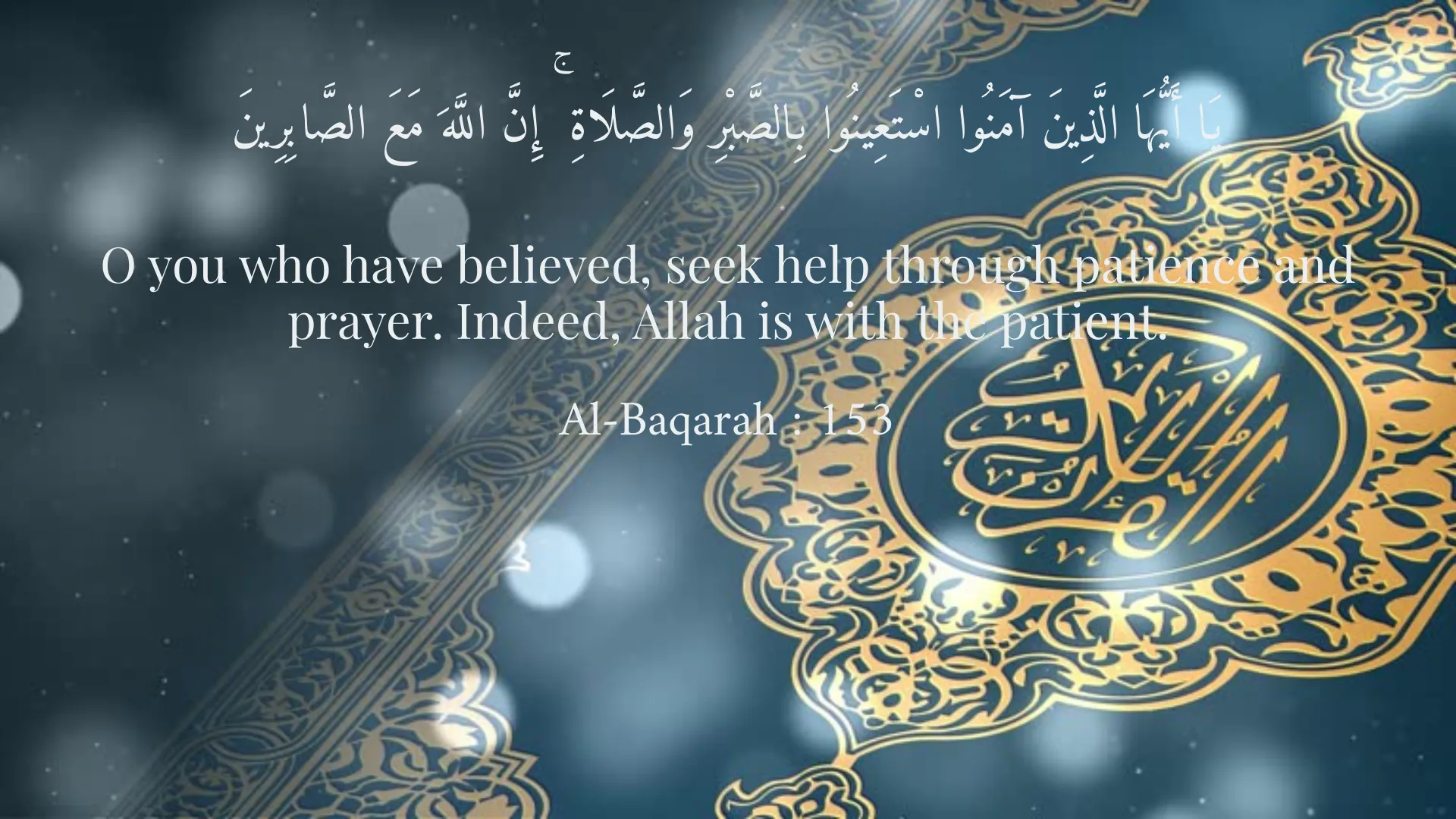
يَا أَيُّهَا الَّذِينَ آمَنُوا اسْتَعِينُوا بِالصَّبْرِ وَالصَّلَاةِ ۚ إِنَّ اللَّهَ مَعَ الصَّابِرِينَ
O you who have believed, seek help through patience and prayer. Indeed, Allah is with the patient.
Al-Baqarah : 153
فَإِنَّ مَعَ الْعُسْرِ يُسْرًا
For indeed, with hardship [will be] ease.
Al-Inshirah : 5
إِنَّ مَعَ الْعُسْرِ يُسْرًا
Indeed, with hardship [will be] ease.
Al-Inshirah : 6
الَّذِينَ آمَنُوا وَتَطْمَئِنُّ قُلُوبُهُم بِذِْرِ اللَّهِ ۗ أَلَا بِذِكْرِ اللَّهِ تَطْمَئِنُّ الْقُلُوبُ
Those who have believed and whose hearts are assured by the remembrance of Allah. Unquestionably, by the remembrance of Allah hearts are assured.
Ar-Ra'd : 28
Short Story
It is narrated that in ancient times, there was a Dervish who lost everything he owned in a fire. His home turned to ashes, his worldly possessions vanished, and nothing remained for him but his very soul. Friends and acquaintances came to offer condolences, all sharing in his sorrow and grief. Yet, instead of lamenting, the Dervish raised his hands to the sky with a smile on his lips. One of his friends, astonished, asked: "O man of God, how is it that in this immense calamity, you wear a smile?" The Dervish replied: "O friend, this was a tribulation that, had it afflicted my faith and belief, I would never have endured. But since it fell upon worldly possessions, I knew that God loves me and desires for me to have a heart free from worldly attachments, so that I may draw closer only to Him. Now, I am no longer a slave to fleeting possessions, but free to be His servant, who never perishes. In this hardship, God brought me closer to Himself." After that, people learned from his tranquility and reliance, understanding that hardships are sometimes gateways to divine knowledge and closeness to God.