Quranic Answer
Dear brothers and sisters, the spiritual journey towards God is a profound and intricate path. One of the lesser-known but highly powerful avenues on this journey is silence. However, silence here does not merely mean refraining from speech; rather, it signifies a deeper state of inner and outer tranquility that paves the way for hearing the divine call and connecting with the source of existence. In Quranic and Islamic teachings, although the word “silence” (samt) is not explicitly mentioned as a direct obligation or path to divine proximity, several deeply related concepts are repeatedly emphasized. These include contemplation (tafakkur, tadabbur), remembrance of God (dhikr al-qalbi), listening attentively to the Quran (istimāʿ), and guarding the tongue from idle talk (ḥifẓ al-lisān). All these elements lay the groundwork for a fruitful and meaningful spiritual silence. The first aspect of spiritual silence is “inner silence” or “silence of the mind.” Our modern world is filled with noise and clamor; the noise of cities, social media, and even the myriad of scattered thoughts swirling in our minds. To draw closer to God, we need to reduce this internal din. The Holy Quran invites us to contemplate and reflect upon God’s signs in the horizons (āfāq) and within ourselves (anfus), meaning the signs of God in the universe and within our own being. This contemplation and reflection are impossible without inner peace and mental silence. When the mind settles, we can look deeper into existence with greater focus and observe the Creator’s grandeur in every particle of creation. This profound observation is itself a form of remembrance (dhikr) that brings the heart closer to God. Imam Ali (AS) states: “Blessed is he whose silence is thought, and whose gaze is a lesson.” This saying highlights the value of silence accompanied by contemplation, showing that true silence is not an empty void but a space for profound internal work. Secondly, there is “outer silence” or “guarding the tongue” (ḥifẓ al-lisān). The tongue is a small but highly influential organ that can elevate a person to the pinnacle of virtue or drag them to the depths of degradation. The Holy Quran places great emphasis on avoiding idle talk, backbiting, slander, and lies. Surah Al-Mu'minun, verse 3, states: “And they who turn away from ill speech.” Abstaining from idle talk (laghw) and refraining from useless conversations not only purifies the soul and brings peace to the heart but also frees up one's time and energy to engage in spiritual and beneficial matters. When we speak less, we create more opportunities to listen – to listen to the voice of truth, the voice of conscience, and the divine call. This silence of the tongue sets the stage for focusing on internal remembrance (dhikr al-qalbi). The remembrance of God, whether verbal or silent, is the primary way to draw near to Him. In silence, the inner dhikr becomes stronger and more enduring because external distractions are minimized, allowing for a deeper, more sustained connection with the Divine presence. This discipline fosters a state of constant awareness, making one’s heart a sanctuary for God’s remembrance. The third aspect of silence is “silence for listening.” One of the most important manifestations of this type of silence is listening attentively to the Holy Quran. Allah says in Surah Al-A’raf, verse 204: “And when the Qur’an is recited, then listen to it and pay attention (be silent) that you may receive mercy.” The word “anṣitū” (أنصتوا) means to be silent with full attention and concentration. This verse teaches us that to receive divine mercy and understand the messages of the Quran, we must quiet our minds and tongues and listen with our whole being to the divine word. This type of silence is an active silence, one in which the heart and mind are opened to receive divine light. Beyond the Quran, we must also be silent to hear God’s signs in nature, in life events, and even in our inner inspirations. This profound listening opens the doors of wisdom to us and helps us feel God’s presence everywhere. It enables us to perceive the subtle messages and guidance that are constantly being sent our way, but which often get drowned out by our own internal and external noise. In summary, spiritual silence in Islam is not an end in itself but a powerful means to achieve higher goals: deep contemplation, heartfelt remembrance, purity of speech, and comprehension of divine words and signs. This silence separates us from the clamor of the material world and guides us to the inner world and the realm of meaning. By practicing inner silence, outer silence, and silence for listening, we can prepare our hearts to receive divine light and gradually step by step draw closer to our Creator. This path is one of peace, insight, and increasing proximity to the Holy Divine Essence, which brings true tranquility and contentment. This silence is the solitude of the heart in which one communes with their Creator and finds themselves embraced by His mercy and forgiveness. In this state of silence, veils are lifted, and an unmediated connection with the Lord is established, which is the ultimate aspiration of every spiritual seeker (salik) on the path to God.
Related Verses
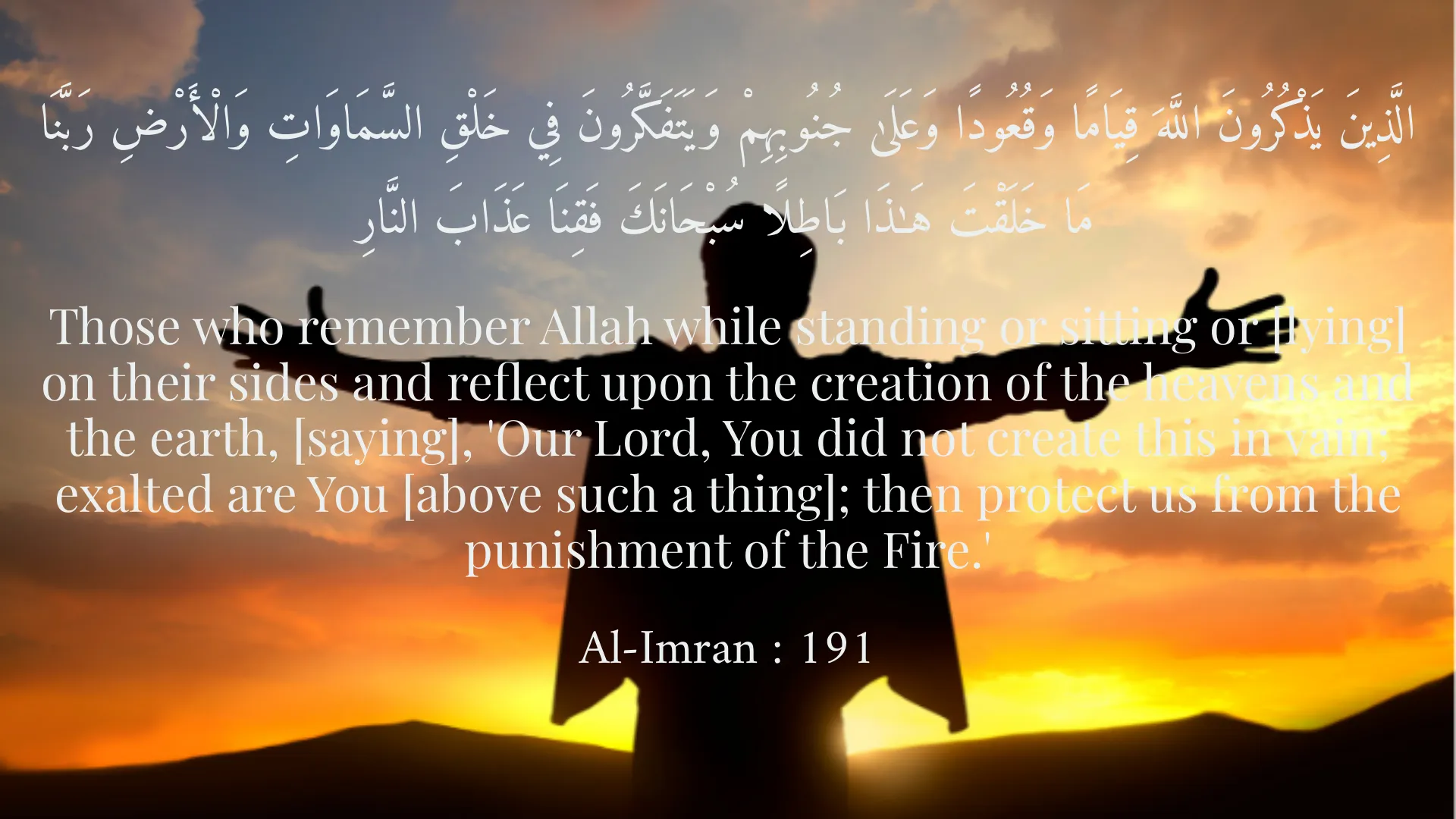
الَّذِينَ يَذْكُرُونَ اللَّهَ قِيَامًا وَقُعُودًا وَعَلَىٰ جُنُوبِهِمْ وَيَتَفَكَّرُونَ فِي خَلْقِ السَّمَاوَاتِ وَالْأَرْضِ رَبَّنَا مَا خَلَقْتَ هَٰذَا بَاطِلًا سُبْحَانَكَ فَقِنَا عَذَابَ النَّارِ
Those who remember Allah while standing or sitting or [lying] on their sides and reflect upon the creation of the heavens and the earth, [saying], 'Our Lord, You did not create this in vain; exalted are You [above such a thing]; then protect us from the punishment of the Fire.'
Al-Imran : 191
وَإِذَا قُرِئَ الْقُرْآنُ فَاسْتَمِعُوا لَهُ وَأَنصِتُوا لَعَلَّكُمْ تُرْحَمُونَ
So when the Qur'an is recited, then listen to it and pay attention that you may receive mercy.
Al-A'raf : 204
وَالَّذِينَ هُمْ عَنِ اللَّغْوِ مُعْرِضُونَ
And they who turn away from ill speech [i.e., idle talk, vain talk, falsehood].
Al-Mu'minun : 3
Short Story
It is narrated that a wise mystic was asked: “How did you reach this level of tranquility and knowledge?” He smiled and said: “Because I have more ear than tongue. I listen to hear the call of existence, I open my eyes to see the signs of truth, and I surrender my heart to ponder the wonders of creation. I speak only when there is no other way but silence, and I choose silence when I wish to avoid idle talk. Through this method, wherever I looked, I found a sign of the Beloved, and in every silence I embraced, I heard the hidden voice of existence and drew closer.” He understood that sometimes the best answer is silence, and in the depths of silence, the most beautiful sounds are heard.