Quranic Answer
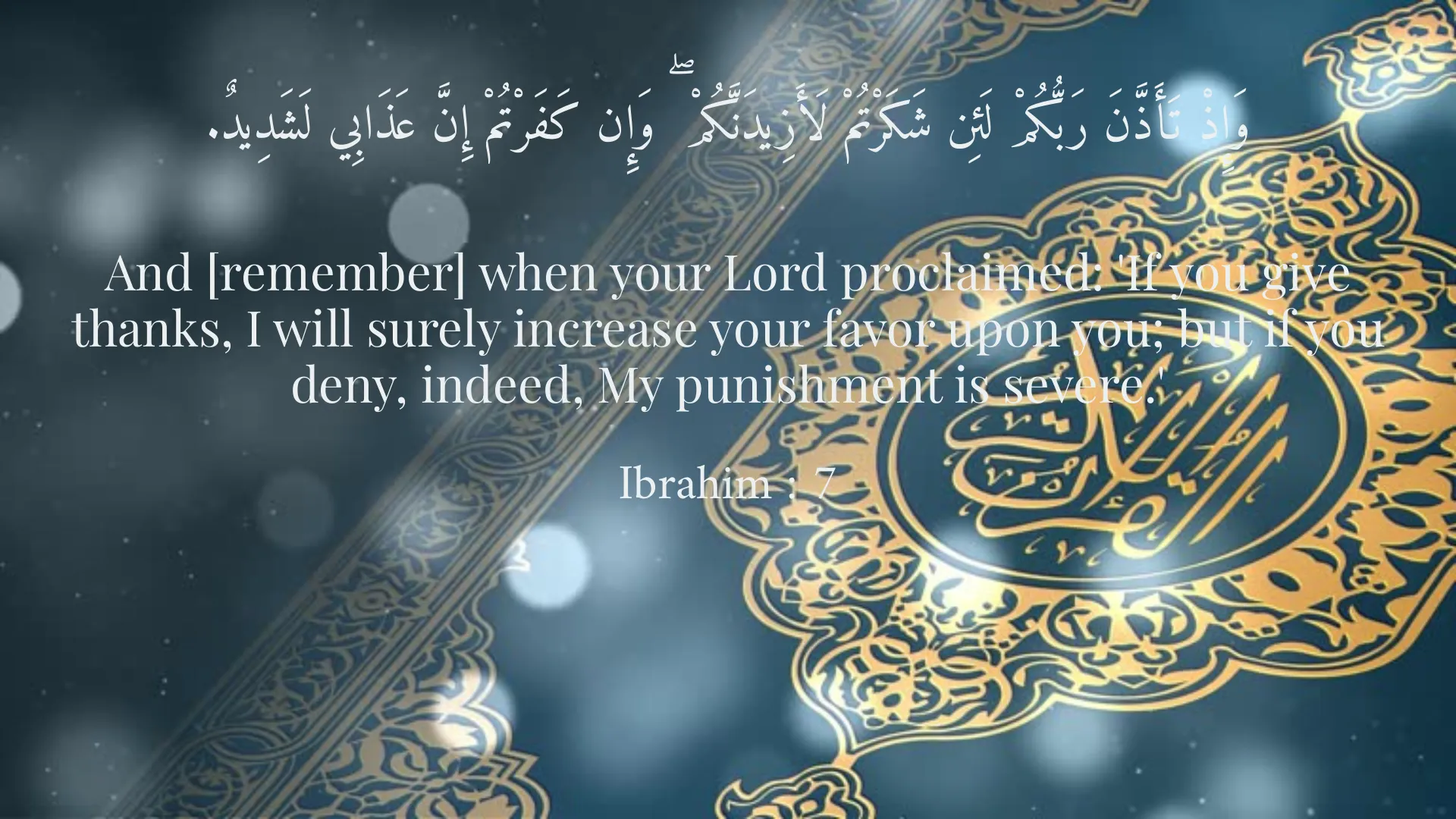
Gratitude is a profound and transformative emotion that serves as a bridge connecting individuals not only to their Creator but also to their fellow human beings. It goes beyond mere acknowledgment and appreciation of what one has received; it pushes us towards action and encourages us to engage in behaviors that reflect our thankfulness. In the realm of spirituality, particularly within the framework provided by the Holy Quran, gratitude is emphasized as a pivotal concept that shapes one's relationship with Allah. Surah Ibrahim, verse 7, encapsulates this idea succinctly: 'And [remember] when your Lord proclaimed: If you give thanks, I will surely increase your favor upon you; but if you deny, indeed, My punishment is severe.' This verse articulates a fundamental principle of faith: recognizing and appreciating blessings can lead to further blessings from God, while ingratitude has dire consequences. To delve deeper into the implications of gratitude as highlighted in the Quran, one must understand that gratitude is not simply a passive emotion; it necessitates action. It encourages individuals to embody their appreciation in a way that is observable and impactful. The Quran asserts that the manifestation of gratitude should extend beyond internal acknowledgment to include tangible expressions through our deeds in the world. It fosters a sense of responsibility toward one another and propels us towards altruism. Surah Al-Mu'minun, verse 60 also contributes a vital perspective: 'And those who give what they give while their hearts are trembling because they will be returning to their Lord.' This statement reveals that the act of giving, particularly in the context of helping others, is deeply intertwined with the concept of gratitude. It signifies that true gratitude may often be accompanied by an understanding of our imperfection and a conscious awareness of our ultimate accountability to God. Those who recognize their blessings are naturally inclined to share them with others, thus reinforcing the cycle of goodness and gratitude. The connection between gratitude and altruistic behavior is further accentuated by the social and communal responsibilities embedded within the principles of Islam. When individuals express their thankfulness through acts of kindness and community service, they are deepening their own faith while positively influencing the lives of others. This spiraling effect creates a culture of gratitude, compassion, and interconnectedness, reminding society that we are not merely recipients of Allah's blessings but also His agents in this world, expected to distribute these blessings generously. The philosophy of gratitude becomes even more compelling when one considers its implications for personal development and spiritual growth. Engaging in acts of goodness not only helps those in need but also cultivates a sense of fulfillment within the giver. This is a powerful dynamic: the more we give, the more we receive – not just materially but emotionally and spiritually as well. Acts of charity, loving others, and engaging in community service reflect our commitment to gratitude and embody our acknowledgment of the blessings we have received. Additionally, gratitude fosters resilience. Life is rife with challenges and obstacles, and maintaining a grateful disposition can empower individuals to navigate these hardships with grace. By focusing on what one has instead of what one lacks, individuals can shift their perspective and develop a more positive outlook on life. Gratitude cultivates contentment, allowing individuals to find peace amid turbulence and chaos, grounding them in their faith and trust in God’s overall plan. Moreover, a society that embraces gratitude tends to foster stronger connections, empathy, and support systems. When individuals actively express their gratitude through actions, they create an environment where kindness flourishes. People are more likely to engage in mutually supportive relationships, bolstering community ties and enhancing collective well-being. The Quran implores believers not only to recognize the gifts bestowed upon them but also to act in accordance with that recognition. It teaches us that gratitude is a pathway to deeper faith and commitment to God. The act of helping those around us becomes a reflection of our understanding of how blessed we are. Thus, we see that gratitude is intricately linked with our purpose in life – to worship God and to serve humanity. As we navigate through our daily lives, we must remember that gratitude is not a one-time event but a continuous journey. It is an ongoing process that challenges us to reflect, act, and positively impact those around us. It invites us to be mindful of the resources at our disposal, urges us to help the marginalized and the dispossessed, and calls us to be active participants in our communities. In conclusion, gratitude for blessings is a profound obligation that extends beyond verbal expression. It must manifest in our actions, serve as a means of providing for others, and reinforce our relationship with the Almighty God. By practicing gratitude through virtuous acts and charity, we not only enhance our own spiritual growth but also contribute to the well-being of the community at large. Ultimately, gratitude requires a genuine commitment to embodying these principles in our everyday lives, reminding us that it synonymous with both the acknowledgment of our blessings and the responsibility to live in a manner that reflects that appreciation.
Related Verses
وَإِذْ تَأَذَّنَ رَبُّكُمْ لَئِن شَكَرْتُمْ لَأَزِيدَنَّكُمْ ۖ وَإِن كَفَرْتُمْ إِنَّ عَذَابِي لَشَدِيدٌ.
And [remember] when your Lord proclaimed: 'If you give thanks, I will surely increase your favor upon you; but if you deny, indeed, My punishment is severe.'
Ibrahim : 7
وَالَّذِينَ يُؤْتُونَ مَا آتَوْا وَقُلُوبُهُمْ وَجِلَةٌ أَنَّهُمْ إِلَى رَبِّهِمْ رَاجِعُونَ.
And those who give what they give while their hearts are trembling because they will be returning to their Lord.
Al-Mu'minun : 60
Short Story
One day, a man named Hassan was seeking ways to express gratitude for his blessings. He said to himself, 'Just saying thank you is not enough!' So, he made a commitment. Hassan started helping the needy in his neighborhood, and his greatest joy came when he saw the smiles on their faces, filling his heart with happiness. He knew that by sharing his blessings, he was both grateful to God and sowing love in the hearts of others.