Quranic Answer
The quest for inner security is a profound human desire, especially in today's tumultuous world. This security is not found in wealth, status, power, or fame; rather, it resides deep within a person's being and their connection with the Creator of the universe. The Holy Quran, as a divine guide, offers profound and practical solutions to achieve this tranquility and inner peace. From a Quranic perspective, the primary source of inner insecurity and anxiety stems from a distance from God and a lack of genuine reliance upon Him. The further one moves away from the central axis of existence, which is Almighty Allah, the more exposed they become to the storms of insecurity and apprehension. One of the most central Quranic teachings for attaining inner security is 'Dhikr Allah,' or the constant remembrance and recollection of Him. In Surah Ar-Ra'd, verse 28, Allah explicitly states: "الَّذِينَ آمَنُوا وَتَطْمَئِنُّ قُلُوبُهُم بِذِكْرِ اللَّهِ ۗ أَلَا بِذِكْرِ اللَّهِ تَطْمَئِنُّ الْقُلُوبُ" which means, "Those who have believed and whose hearts are assured by the remembrance of Allah. Unquestionably, by the remembrance of Allah hearts are assured." This verse reveals a fundamental truth: the true peace of hearts, which is inner security, is attained only through the remembrance of Allah. Dhikr is not merely the repetition of words; it is a state of mindfulness and continuous awareness of Allah's existence, His power, His wisdom, and His mercy. When a person remembers Allah in every moment and every situation—whether in joy or sorrow, ease or hardship—and perceives Him as present and watchful, feelings of loneliness and helplessness dissipate. This continuous remembrance acts like an anchor, keeping the ship of human existence stable and firm in the turbulent ocean of life. Dhikr Allah enables a person to lean on the infinite divine power and to know that a support stronger than anything in the world accompanies them. This certainty in Allah's absolute power and unfailing support is itself the greatest source of inner security. Indeed, remembering Allah elevates one's perspective beyond minor worldly problems, directing it towards the vast horizons of divine mercy and wisdom, thereby rendering anxieties and fears ineffective. Another principle strongly emphasized in the Quran for inner security is 'Tawakkul,' or complete reliance on Allah. Tawakkul means that after exerting necessary effort, a person entrusts the outcome to Allah, leaning on His power and wisdom. In Surah At-Tawbah, verse 51, we read: "قُل لَّن يُصِيبَنَا إِلَّا مَا كَتَبَ اللَّهُ لَنَا هُوَ مَوْلَانَا ۚ وَعَلَى اللَّهِ فَلْيَتَوَكَّلِ الْمُؤْمِنُونَ" meaning, "Say, 'Never will we be struck except by what Allah has decreed for us; He is our protector.' And upon Allah let the believers rely." This verse teaches us that whatever happens to us in life, whether good or bad, occurs by Allah's will and decree. This perspective does not imply fatalism or passivity; rather, it means that a person strives with all their being and then, with a peaceful heart, leaves the result to Allah. When one understands that Allah is their Lord and Protector, and that no harm or benefit occurs without His will, they are freed from the fear of the future, the fear of failure, the fear of loss, and the fear of others' judgment. This profound reliance removes the burden of excessive control from a person's shoulders, granting them tranquility and certainty that even in the most difficult circumstances, Allah has ordained the best path for them. Tawakkul fosters patience in adversity and prevents arrogance in success, as one perceives everything as coming from Allah, and this very outlook provides inner security and stability. Furthermore, the Quran introduces the practical solution of 'Sabr' (patience) and 'Salat' (prayer) for achieving inner peace and security. In Surah Al-Baqarah, verse 153, it states: "يَا أَيُّهَا الَّذِينَ آمَنُوا اسْتَعِينُوا بِالصَّبْرِ وَالصَّلَاةِ ۚ إِنَّ اللَّهَ مَعَ الصَّابِرِينَ" meaning, "O you who have believed! Seek help through patience and prayer. Indeed, Allah is with the patient." Patience implies steadfastness in the face of difficulties, self-control against temptations, and perseverance in the path of truth. When a person adopts patience in hardships and does not succumb to despair, an inner power awakens within them, protecting them from any wavering. Patience not only helps us endure challenges but also enables us to grow and learn from them. Prayer, too, is the pillar of religion and the ascension of the believer. Prayer is a direct and immediate connection with Allah. During prayer, a person detaches from all worldly concerns and turns their entire being towards their Creator. This deep connection is an infinite source of positive energy, tranquility, and security. With every bowing and prostration, the worshipper seems to shed the heavy burdens of life and finds refuge in Allah's infinite power. This feeling of refuge and spiritual connection calms anxieties and instills a sense of divine security and support in the heart. Prayer is a constant reminder of the purpose of creation, the afterlife, and the insignificance of this world compared to the Hereafter, providing a broader perspective that prevents worldly adversities from overwhelming one's inner security. Moreover, a deep understanding of divine decree ('Qada' and 'Qadar') significantly contributes to inner security. When a person firmly believes that nothing happens in the universe without Allah's knowledge and will, and that every destiny decreed for them is accompanied by Allah's wisdom and benevolence, apprehension and worry about the future dissipate. This perspective frees a person from unfounded fears and grants them the peace that whatever may come is part of a larger wisdom ordained by Allah. Additionally, living according to ethical principles, performing good deeds, and refraining from sins profoundly affect inner security. Sin is often accompanied by guilt, remorse, and fear of consequences, all of which are sources of inner insecurity. In contrast, performing righteous deeds, helping others, acting justly, and being truthful bring inner satisfaction and a clear conscience, which are strong foundations for inner security. In summary, the Holy Quran provides a comprehensive roadmap, teaching us that inner security is not a destination but a journey. A journey paved by strengthening faith, constant remembrance of Allah, genuine reliance on Him in all matters, and seeking assistance through patience and prayer. By following these teachings, a person can, under any circumstances, even amidst the most severe crises, possess a tranquil heart and a peaceful soul, feeling that they are under the protection of an eternal power from which nothing can separate them. This is the true peace that enables a person to navigate life with steadfastness, hope, and contentment.
Related Verses
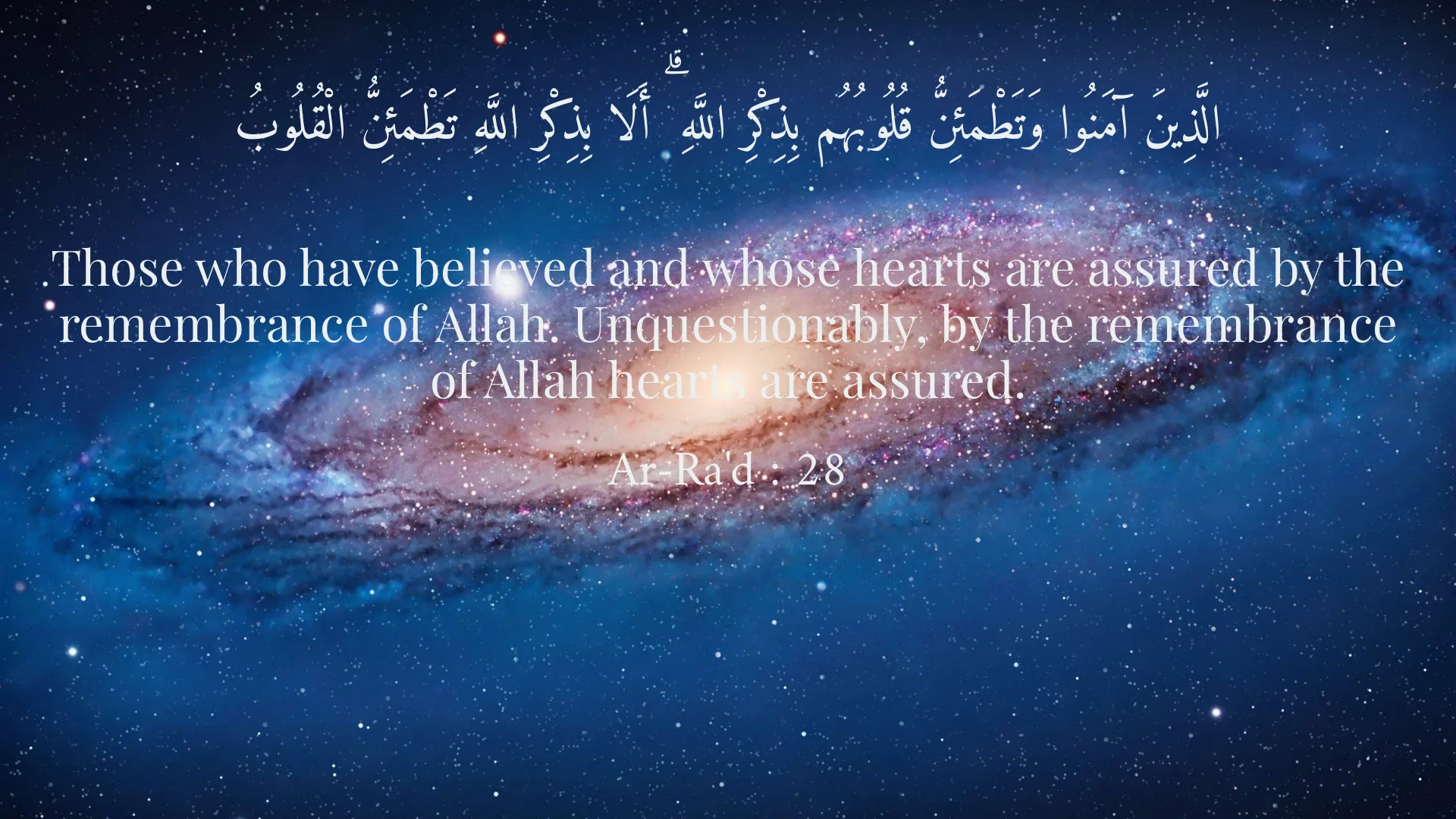
الَّذِينَ آمَنُوا وَتَطْمَئِنُّ قُلُوبُهُم بِذِكْرِ اللَّهِ ۗ أَلَا بِذِكْرِ اللَّهِ تَطْمَئِنُّ الْقُلُوبُ
Those who have believed and whose hearts are assured by the remembrance of Allah. Unquestionably, by the remembrance of Allah hearts are assured.
Ar-Ra'd : 28
قُل لَّن يُصِيبَنَا إِلَّا مَا كَتَبَ اللَّهُ لَنَا هُوَ مَوْلَانَا ۚ وَعَلَى اللَّهِ فَلْيَتَوَكَّلِ الْمُؤْمِنُونَ
Say, 'Never will we be struck except by what Allah has decreed for us; He is our protector.' And upon Allah let the believers rely.
At-Tawbah : 51
يَا أَيُّهَا الَّذِينَ آمَنُوا اسْتَعِينُوا بِالصَّبْرِ وَالصَّلَاةِ ۚ إِنَّ اللَّهَ مَعَ الصَّابِرِينَ
O you who have believed! Seek help through patience and prayer. Indeed, Allah is with the patient.
Al-Baqarah : 153
Short Story
It is narrated that a dervish, despite his poverty and hardship, was always joyful and serene. One day, a king passed by him and saw the dervish sitting on the ground with a cheerful face, free from any worries or sorrows. The king, surprised, asked: "O man, in this world full of concerns and anxieties, how is it that you are so carefree and tranquil? You possess neither wealth nor position, so what is the reason for this peace?" The dervish smiled and replied: "O King! My peace comes from not attaching my heart to anything other than God. I know that what is destined for me will reach me, and what is not my portion, I will not attain even with a thousand efforts. So why should I exhaust myself with worries that will not change my destiny? My reliance is on Him who provides for all creatures, and for this reason, my heart is in security and ease." The king was touched by the dervish's wise words and truly understood that true security lies in trusting and remembering God, not in possessing wealth and power.