Quranic Answer
In today's world, where the pace of life is bewildering, and a deluge of information and challenges engulfs us from all directions, feelings of anxiety and worry have become one of the most prevalent psychological states. Many people are relentlessly searching for true peace, a tranquility that external changes and the passage of time cannot erode. The Holy Quran, as the divine word and a complete guide for humanity, offers profound and fundamental answers to this significant concern. This celestial book not only recognizes anxiety as an understandable phenomenon but also teaches us practical and spiritual ways to overcome it and achieve inner serenity. The essence of peace, according to the Quranic perspective, lies in establishing a deep and continuous connection with the Creator, because the primary root of anxiety often stems from feelings of loneliness, aimlessness, or a lack of control over affairs. It is precisely here that the role of the unique Creator becomes paramount and illuminating. One of the most central verses in the Quran regarding this matter is Surah Ar-Ra'd, verse 28, which states: "الَّذِينَ آمَنُوا وَتَطْمَئِنُّ قُلُوبُهُم بِذِكْرِ اللَّهِ ۗ أَلَا بِذِكْرِ اللَّهِ تَطْمَئِنُّ الْقُلُوبُ" (Those who have believed and whose hearts are assured by the remembrance of Allah. Unquestionably, by the remembrance of Allah hearts are assured). This verse clearly indicates that the key to lasting peace is Dhikr (remembrance) of Allah. Dhikr is not merely the repetition of words; rather, it is the constant presence of Allah in one's mind and heart, contemplating His grandeur, and recalling His infinite power, mercy, and wisdom. When a person remembers that there is an All-Knowing, All-Powerful Creator in control of all affairs, worries diminish significantly. The five daily prayers (Salat), recitation of the Quran, supplication (Du'a) and communion, and even contemplating the signs of Divine power in nature, are all forms of Dhikr that help individuals detach from worldly clamor and connect with the source of eternal peace. Each time a person turns to their Lord with a humble heart, it is as if they receive a fresh spirit, and the dust of distress and anxiety is wiped clean from the mirror of their heart. In addition to Dhikr, the Quran emphasizes the role of 'Sabr' (patience) and 'Salat' (prayer) as two powerful tools for confronting difficulties and finding tranquility. In Surah Al-Baqarah, verse 153, we read: "يَا أَيُّهَا الَّذِينَ آمَنُوا اسْتَعِينُوا بِالصَّبْرِ وَالصَّلَاةِ ۚ إِنَّ اللَّهَ مَعَ الصَّابِرِينَ" (O you who have believed, seek help through patience and prayer. Indeed, Allah is with the patient). Patience here means enduring difficulties with steadfastness and without despair, relying on Allah. This patience is not born of indifference, but from a deep faith in Divine wisdom and providence. When a person knows that every hardship and tribulation carries a purpose and is an opportunity for growth and divine test, they are less prone to anxiety. Prayer, likewise, is not just a religious obligation but an opportunity for solitude with God, psychological release, and rejuvenation. With every prostration and every bowing, a person lays down the heavy burden of their worries and rises with a lighter spirit. Prayer, as a spiritual backbone in the lives of Muslims, establishes a routine that itself helps reduce anxiety, as one knows that at any moment, they can return to the safe refuge of the Lord. Another principle emphasized in the Quran for achieving peace is 'Tawakkul' (reliance on Allah). Surah At-Talaq, verse 3, states: "وَمَن يَتَوَكَّلْ عَلَى اللَّهِ فَهُوَ حَسْبُهُ" (And whoever relies upon Allah - then He is sufficient for him). Tawakkul signifies complete trust in Allah after exerting all possible efforts. This concept teaches individuals that while they must strive to achieve their goals, the ultimate outcome should be left to Allah. This liberation from the bondage of 'complete control' and the acceptance that some matters are beyond our will removes a heavy burden from a person's shoulders. Anxiety often arises from the attempt to control all aspects of life, many of which are not within our power. Tawakkul instills a sense of assurance and security that even if things do not go as desired, Allah has decreed what is best. This trust in Divine decree bestows deep tranquility and prevents one from drowning in negative thoughts and fear of the future. Understanding that this world is a temporary abode and a place of test, rather than a final destination, also plays a significant role in reducing anxiety. The Quran repeatedly emphasizes the fleeting nature of worldly pleasures and hardships, calling humanity towards the Hereafter and the eternal Divine rewards. When one's attachment to wealth, status, and the ephemeral beauties of this world diminishes, so does the worry of losing these things. Furthermore, showing gratitude for blessings and recognizing the abundance of Divine favors shifts one's perspective from negativity to positivity, strengthening feelings of contentment and peace. The Quran says: "لَئِن شَكَرْتُمْ لَأَزِيدَنَّكُمْ" (If you are grateful, I will surely increase you [in favor]). Gratitude not only sustains blessings but also opens the heart to Divine beauty and mercy. Ultimately, true peace in an anxious world is achieved not by escaping problems, but by changing one's perspective and strengthening one's connection with Allah. The Holy Quran teaches us that our hearts were created to connect with an infinite power, and only through this connection can they find stillness and tranquility. By practicing constant remembrance (Dhikr), seeking help through patience and prayer when facing challenges, completely relying on Divine providence (Tawakkul), and accepting one's role as a traveler in this transient world, a person can find a safe anchor in their heart even amidst life's fiercest storms and attain true, lasting peace. This peace is a divine gift bestowed upon servants through faith and righteous deeds, and it will never be taken away from them.
Related Verses
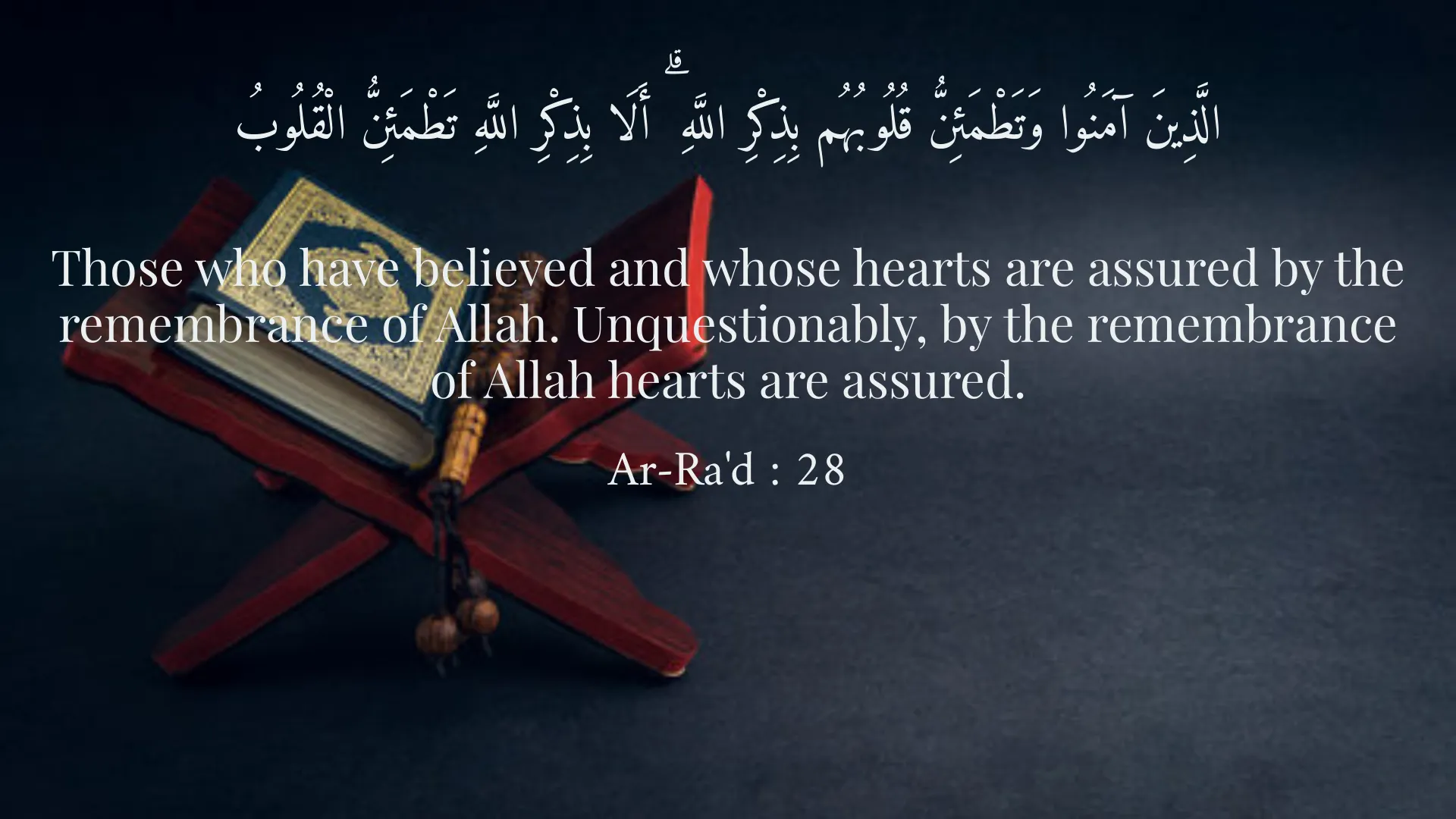
الَّذِينَ آمَنُوا وَتَطْمَئِنُّ قُلُوبُهُم بِذِكْرِ اللَّهِ ۗ أَلَا بِذِكْرِ اللَّهِ تَطْمَئِنُّ الْقُلُوبُ
Those who have believed and whose hearts are assured by the remembrance of Allah. Unquestionably, by the remembrance of Allah hearts are assured.
Ar-Ra'd : 28
يَا أَيُّهَا الَّذِينَ آمَنُوا اسْتَعِينُوا بِالصَّبْرِ وَالصَّلَاةِ ۚ إِنَّ اللَّهَ مَعَ الصَّابِرِينَ
O you who have believed, seek help through patience and prayer. Indeed, Allah is with the patient.
Al-Baqarah : 153
وَمَن يَتَوَكَّلْ عَلَى اللَّهِ فَهُوَ حَسْبُهُ ۚ إِنَّ اللَّهَ بَالِغُ أَمْرِهِ ۚ قَدْ جَعَلَ اللَّهُ لِكُلِّ شَيْءٍ قَدْرًا
And whoever relies upon Allah - then He is sufficient for him. Indeed, Allah will accomplish His purpose. Allah has already set for everything a [decreed] extent.
At-Talaq : 3
Short Story
It is said that a powerful and magnificent king, yet constantly troubled by worries and anxieties, once approached an old and wise sage who lived in a quiet corner of the city with indescribable contentment. The king asked him, "O sage, I possess immense wealth and grandeur, I have armies and a kingdom, yet day and night I am restless about state affairs, fearful of enemies, and terrified of losing what I have. How is it that you live so carefree and cheerful, though you possess nothing?" The sage smiled and said, "O King, the tranquility of the heart comes neither from abundant wealth nor from spacious dwellings; rather, it comes from freeing the heart from the bonds of attachments and relying on the Creator who provides sustenance for all. Because I know that my provision, yours, and that of all creation rests with Him, my heart is not attached to anything and fears nothing. Every bird that rises from its nest on an empty stomach in the morning, by His grace, returns with a full stomach at night, without possessing any treasure or savings. Therefore, surrender your heart to His providence, for He is the Best of Planners." Upon hearing these words, the king pondered deeply and realized that true peace lies in detachment from the world and reliance on the Creator, not in accumulating worldly possessions. From then on, though the king continued to rule his kingdom, he entrusted his heart to God and tasted true peace, being freed from many of his anxieties.