Quranic Answer
The Holy Quran, the central religious text of Islam, serves as a comprehensive guide for Muslims around the world, outlining a path towards both spiritual and moral development. Among the many teachings found within its verses, one of the most emphasized principles is the importance of aiding those who are less fortunate—specifically, the poor and the needy. This moral imperative forms a significant aspect of Islamic teachings and reflects the values that are deeply embedded in the fabric of Muslim communities. One of the most poignant verses that highlight this duty is found in Surah Al-Baqarah, verse 177. In this verse, Allah articulates that righteousness is not confined merely to acts of worship such as prayer and fasting; rather, it encompasses a holistic approach to life that includes benevolence toward others. The verse reiterates that true faith must translate into action, and one of the most essential actions is to 'feed the poor and the needy.' This directive serves as a powerful reminder that spiritual well-being must harmonize with social responsibility, asserting that caring for the less fortunate is not just an optional act of kindness, but a foundational aspect of one's faith. Moreover, the concept of zakat, which is one of the Five Pillars of Islam, further underscores the significance of helping the impoverished. In Surah Al-Ma'idah, verse 55, Allah states, 'Your ally is Allah and His Messenger and those who have believed - those who establish prayer and give zakah while they bow.' This verse is instrumental in emphasizing that zakat is intrinsically linked with worship practices. The act of giving zakat—not only fulfills a religious requirement but also acts as a mechanism for purifying one’s wealth, thereby fostering a sense of community and solidarity among believers. This establishes a reciprocal relationship between the affluent and the impoverished, where the wealthy are encouraged to share their blessings to ensure that no one suffers from hunger or poverty. In Surah At-Tawbah, verse 60, Allah outlines the specific categories of individuals who are entitled to receive zakat. Among these groups are the poor and needy, highlighting the central role they play in the zakat system. This categorization reveals that providing assistance to these individuals is not merely an act of charity but rather a structured obligation that necessitates thoughtful consideration and action. In many ways, zakat functions as an equalizer, redistributing wealth within society and promoting economic justice. By fulfilling this religious duty, Muslims are not only adhering to divine commandments but also contributing to the overall welfare of their communities, thereby fostering unity and social cohesion. Furthermore, the Holy Quran extends the call to assist the poor and needy beyond just financial aid. Surah Al-Insan, verses 8 and 9, provide a more profound insight into the intentions behind charitable acts. In these verses, believers are instructed to assist those in need, emphasizing that the act should be performed solely for the sake of Allah. This aspect of selflessness is pivotal; it transforms the act of giving into a spiritual practice—a means of drawing closer to the divine. By focusing on the intention behind charitable deeds, the Quran emphasizes that the moral imperative to help others is not simply about the act itself but the spirit in which it is performed. In drawing lessons from these Quranic teachings, it becomes clear that helping the poor and needy is a moral and religious duty that transcends mere obligation. It embodies compassion, humility, and a sense of social responsibility that should permeate the daily lives of practicing Muslims. The Quran encourages a culture of giving and empathy, advocating for a society where every individual actively takes part in uplifting those who are struggling. This message is particularly relevant in today’s world, where socioeconomic disparities continue to widen, and the plight of the impoverished often gets overlooked. In conclusion, the Holy Quran places a profound emphasis on assisting the poor and the needy as a fundamental duty of faith. Through verses that call for compassion and social justice, it urges individuals to not only engage in prayer and fasting but also to enact their beliefs through tangible actions that seek to alleviate suffering. As Muslims reflect on these teachings, they are reminded that their spiritual fulfillment is intricately tied to their engagement with the community. Helping those in need is not merely an act of charity but an essential component of Islam that fosters both individual righteousness and collective prosperity. By committing to this cause, believers can create a more equitable and compassionate world, embodying the values espoused in the Holy Quran.
Related Verses
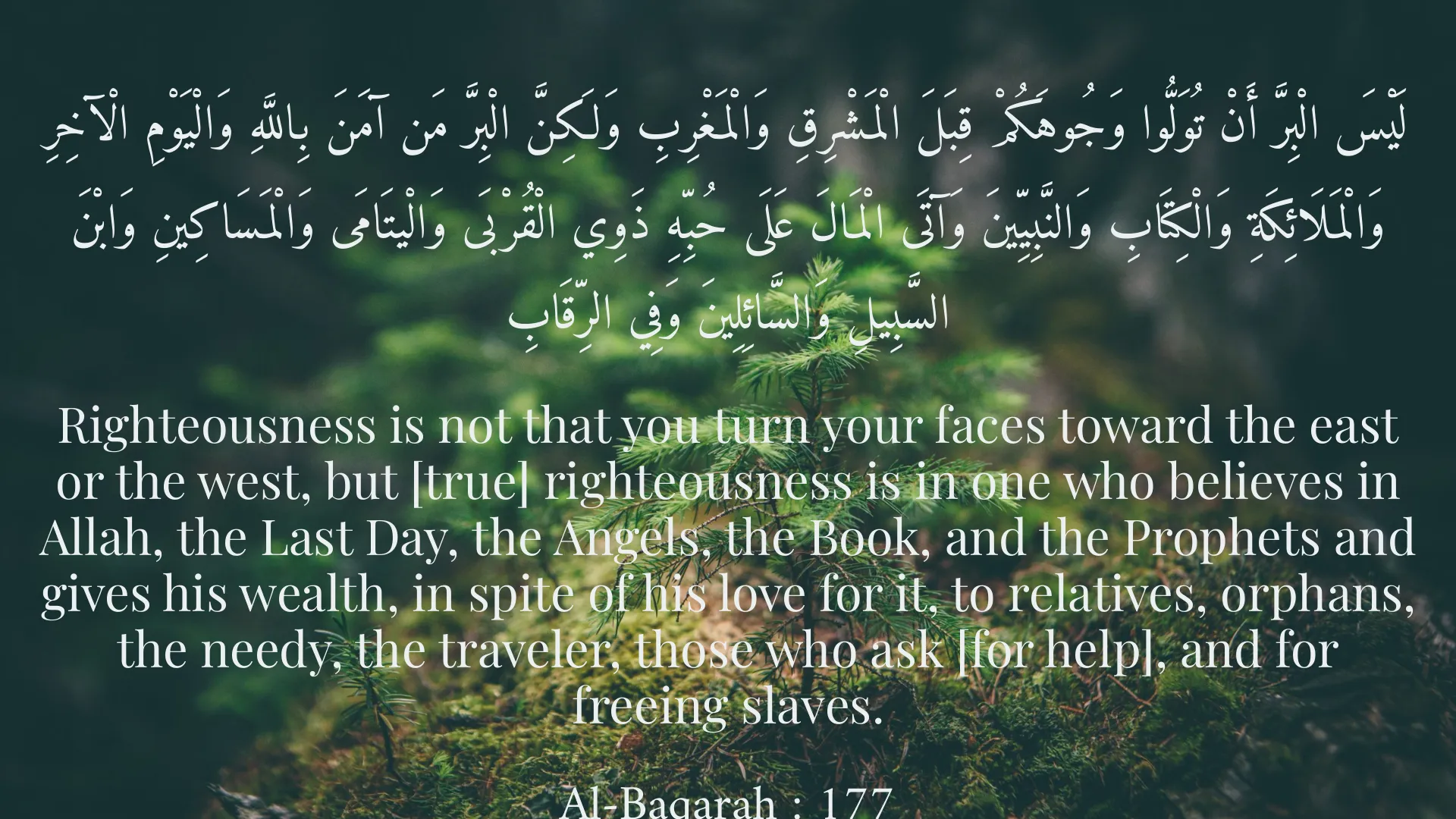
لَيْسَ الْبِرَّ أَنْ تُوَلُّوا وَجُوهَكُمْ قِبَلَ الْمَشْرِقِ وَالْمَغْرِبِ وَلَكِنَّ الْبِرَّ مَن آمَنَ بِاللَّهِ وَالْيَوْمِ الْآخِرِ وَالْمَلَائِكَةِ وَالْكِتَابِ وَالنَّبِيِّينَ وَآتَى الْمَالَ عَلَى حُبِّهِ ذَوِي الْقُرْبَى وَالْيتَامَى وَالْمَسَاكِينِ وَابْنَ السَّبِيلِ وَالسَّائِلِينَ وَفِي الرِّقَابِ
Righteousness is not that you turn your faces toward the east or the west, but [true] righteousness is in one who believes in Allah, the Last Day, the Angels, the Book, and the Prophets and gives his wealth, in spite of his love for it, to relatives, orphans, the needy, the traveler, those who ask [for help], and for freeing slaves.
Al-Baqarah : 177
إنما وليّكم الله ورسوله والذين آمنوا الذين يقيمون الصلاة ويقيمون الزكاة وهم راكعون.
Your ally is Allah and His Messenger and those who have believed - those who establish prayer and give zakah while they bow.
Al-Ma'idah : 55
إنما الصدقات للفقراء والمساكين والعاملين عليها والمؤلفة قلوبهم وفي الرقاب والغارمين وفي سبيل الله وابن السبيل فريضة من الله.
The alms are only for the poor and the needy and those employed to collect [them] and for bringing hearts together and for freeing slaves and for those in debt and for the cause of Allah and for the stranded traveler. An obligation [imposed] by Allah.
At-Tawbah : 60
وَيُطْعِمُونَ الطَّعَامَ عَلَى حُبِّهِ مِسْكِينًا وَيَتِيمًا وَأَسِيرًا
And they give food in spite of love for it to the needy, the orphan, and the captive.
Al-Insan : 8
إِنَّمَا نُطْعِمُكُمْ لِوَجْهِ اللَّهِ لَا نُرِيدُ مِنكُمْ جَزَاءً وَلَا شُكُورًا
Indeed, we feed you only for the countenance of Allah. We wish not from you reward or gratitude.
Al-Insan : 9
Short Story
One day, a man named Salim was walking home when he noticed a poor person sitting on the street, suffering from the pain of poverty. Salim remembered the Quranic verses that urged him to help the needy. He decided to give a few coins to the man. As he handed the coins to the poor man, a smile appeared on the man's face, and Salim felt his spirit uplifted. He realized that helping others not only brings comfort to them but also brings peace to himself.