Quranic Answer
In the comprehensive teachings of the Holy Quran, there is no separation between material and spiritual life, or between pragmatism and spiritual essence. On the contrary, these two aspects of human existence are intricately and profoundly intertwined, so much so that one is incomplete without the other, and true perfection cannot be attained. Islam teaches us that this world (dunya) is the sowing ground for the Hereafter (akhirah); meaning, our actions, efforts, and decisions in this world have a direct impact on our eternal destiny. Therefore, pragmatism is not only not condemned but, when practiced with proper intentions and within divine guidelines, can itself transform into a deep and meaningful act of worship. This holistic perspective allows individuals to maintain their connection with the Creator in all moments of life, including work, family, education, and social interactions, and to direct all their activities towards gaining His pleasure. One of the most fundamental Quranic concepts in this regard is that of "balance." The Quran does not encourage extremism or negligence in any area. Verse 77 of Surah Al-Qasas beautifully illustrates this balance: "But seek, through that which Allah has given you, the home of the Hereafter; and [yet], do not forget your portion of the world..." This verse clearly states that while seeking the abode of the Hereafter and God's pleasure, we should not forget our share of this world. This means that we are obligated to be active in this world, to work, to learn, to benefit from its blessings, and to contribute to its development. However, all these activities must be aligned with the ultimate goal of achieving spiritual perfection and eternal felicity. Pragmatism, in this context, does not mean obsession with worldly gains and forgetting God, but rather the proper and responsible utilization of the opportunities and resources that God has provided for our growth and advancement. For example, a Muslim engineer intending to build a safe and beneficial structure for people, or a doctor intending to heal the sick and serve humanity, is, in essence, engaged in a profound act of worship, even if their actions appear entirely worldly. It is this pure intention that imbues worldly actions with spiritual significance, transforming them from merely material activities into righteous deeds that bring one closer to God. Islam reminds us that this world and what is in it are tools to achieve a greater goal, which is proximity to God, not the ultimate aim itself. Spiritual essence in Islam does not imply withdrawal from the world or excessive asceticism; rather, it means having mindfulness and remembrance of God in all moments of life, even during the peak of worldly activities. Verse 10 of Surah Al-Jumu'ah is a prime example of this integration: "And when the prayer has been concluded, disperse within the land and seek from the bounty of Allah, and remember Allah often that you may succeed." This verse, immediately after commanding the establishment of prayer (which is the pinnacle of a spiritual act of worship), invites believers to spread out in the land and seek sustenance from God's bounty. This direct link demonstrates that economic and livelihood activities are not only not in contradiction with spiritual essence but are complementary to it, and if accompanied by the remembrance of God, they lead to success. A Muslim merchant, while engaging in trade and seeking profit, can adhere to principles of honesty, fairness, and respecting customer rights. This adherence not only contributes to his worldly success but also makes his actions valuable in the sight of Almighty God. Indeed, working and striving for a lawful livelihood itself is considered a great act of worship, and it is highly emphasized in Islamic narrations. One who strives to provide for their family earns the reward of a mujahid (one who strives in the path of God), as this effort represents responsibility and servitude to God concerning family and society. "Intention" (Niyyah) in Islam is the cornerstone for transforming worldly actions into acts of the Hereafter. The Prophet Muhammad (peace be upon him) said: "Indeed, actions are by intentions..." This noble Hadith is the master key to combining pragmatism with spirituality. You could be working in a factory, studying for an exam, exercising, or even resting, but if your intention is to please God, serve humanity, acquire knowledge for the betterment of society, or maintain good health to better fulfill your divine duties, then your worldly action will be recorded in the scale of good deeds. This means that every good deed, if done with the right intention, can become an act of worship. Therefore, spirituality is not something separate from life; rather, it is the spirit that flows through the entire body of daily activities, giving them meaning and direction. This pure intention elevates the action from mere superficiality and materialism to depth and spirituality. "Trust in God" (Tawakkul) is also of great importance in this regard. Tawakkul does not mean abandoning effort and struggle; rather, it means exerting utmost effort and then entrusting the outcome to divine planning. This spiritual outlook helps individuals, while being pragmatic and planning meticulously, to free themselves from undue anxiety and worry, knowing that the ultimate outcome is not in their hands and that God is the best disposer of affairs. This reliance provides peace of mind, enabling individuals to exhibit greater patience and perseverance when facing practical challenges and not to become disheartened by setbacks. For example, a farmer exerts maximum effort in cultivating and planting, prepares the land, sows seeds, and irrigates, but entrusts the rainfall and crop growth to God, relying on His wisdom. This balance between human effort and reliance on divine will is the essence of combining pragmatism and spirituality, demonstrating a profound insight into the cosmic order and humanity's role within it. Another significant aspect of this integration is the concept of "Ihsan" (doing good) and "Amal Salih" (righteous deeds). The Quran repeatedly emphasizes performing "Amal Salih." Verse 97 of Surah An-Nahl states: "Whoever does righteousness, whether male or female, while he is a believer - We will surely cause him to live a good life, and We will surely give them their reward [in the Hereafter] according to the best of what they used to do." This verse promises a "Tayyibah Hayah" (a good and pure life) in this world to those who perform righteous deeds, provided they also have faith. Righteous deeds are not limited to specific acts of worship; rather, they encompass every good, beneficial, and constructive action that is for the welfare of society and the pleasure of God. Justice in trade, honesty in speech, helping the needy, imparting beneficial knowledge, preserving the environment – all are righteous deeds that stem from a spiritual essence and are manifestations of pragmatism. When pragmatism is carried out with such intentions and goals, it not only leads individuals to their material objectives but also advances them on the path of spiritual growth and proximity to God. This intelligent integration ensures stability and blessing in all aspects of life. In conclusion, the Quranic model for combining pragmatism with spiritual essence is a comprehensive and practical framework that invites humanity to balance, responsibility, and purposefulness. This model, instead of creating a dichotomy between this world and the Hereafter, places them on a single, synergistic path. The true believer is one who works for their worldly life as if they will never die, and also acts for their Hereafter as if they will die tomorrow. They neither abandon this world nor are they heedless of the Hereafter. Through the remembrance of God, pure intention, and reliance, they transform all their daily activities into means of achieving eternal bliss and experience a meaningful, blessed, and balanced life. This is the path that leads to salvation in both this world and the Hereafter, and it is the embodiment of the "Tayyibah Hayah" that the Quran promises. Every action, from the smallest to the largest, if infused with the light of faith and a divine purpose, is no longer merely a worldly act but a bridge to the spiritual realm and a path to drawing closer to the Creator of existence. This way of life not only removes the psychological burden of material and spiritual dualities but also grants humans peace, contentment, and endless motivation to continue their journey and succeed in both abodes.
Related Verses
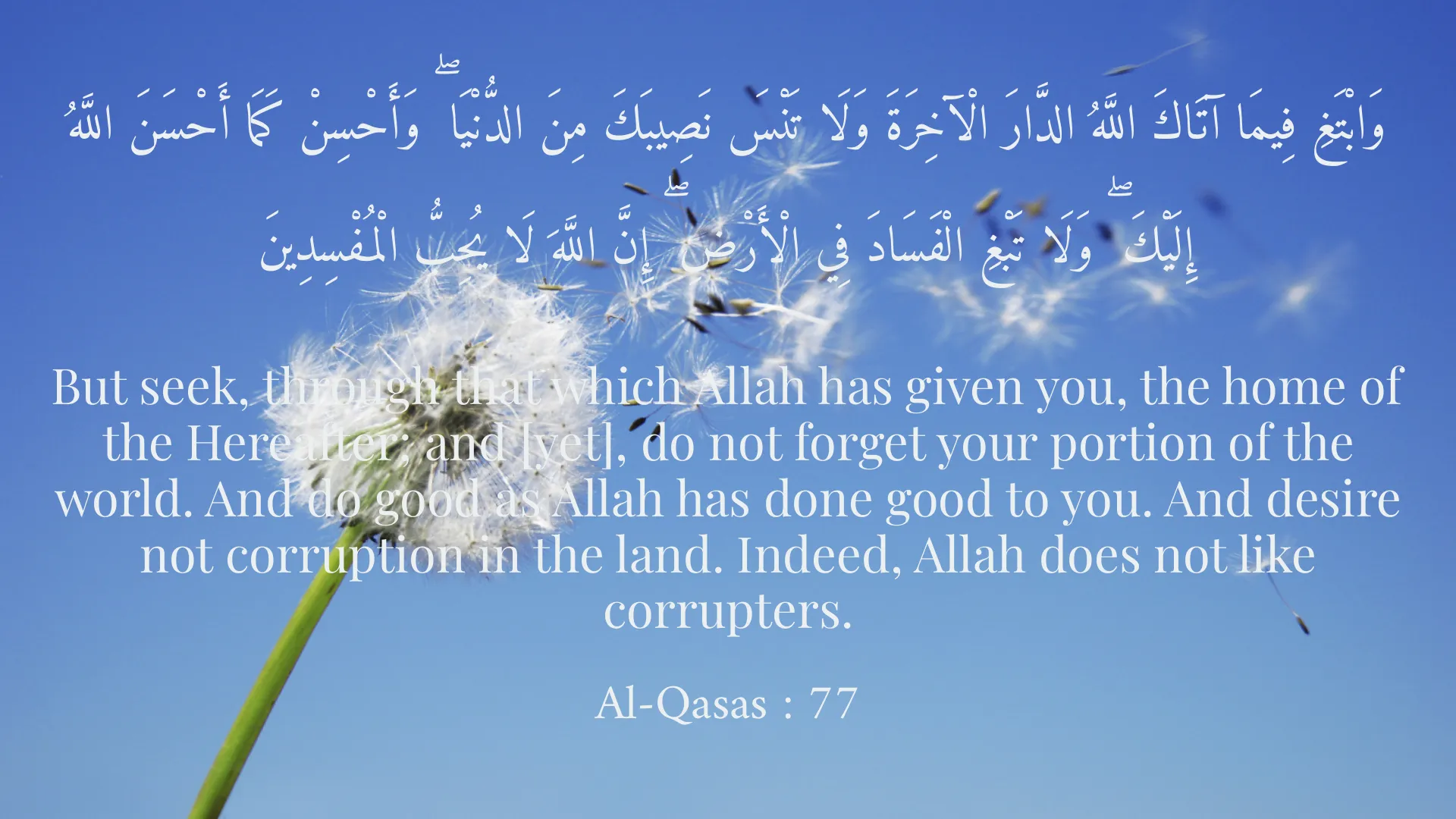
وَابْتَغِ فِيمَا آتَاكَ اللَّهُ الدَّارَ الْآخِرَةَ وَلَا تَنْسَ نَصِيبَكَ مِنَ الدُّنْيَا ۖ وَأَحْسِنْ كَمَا أَحْسَنَ اللَّهُ إِلَيْكَ ۖ وَلَا تَبْغِ الْفَسَادَ فِي الْأَرْضِ ۖ إِنَّ اللَّهَ لَا يُحِبُّ الْمُفْسِدِينَ
But seek, through that which Allah has given you, the home of the Hereafter; and [yet], do not forget your portion of the world. And do good as Allah has done good to you. And desire not corruption in the land. Indeed, Allah does not like corrupters.
Al-Qasas : 77
فَإِذَا قُضِيَتِ الصَّلَاةُ فَانْتَشِرُوا فِي الْأَرْضِ وَابْتَغُوا مِنْ فَضْلِ اللَّهِ وَاذْكُرُوا اللَّهَ كَثِيرًا لَعَلَّكُمْ تُفْلِحُونَ
And when the prayer has been concluded, disperse within the land and seek from the bounty of Allah, and remember Allah often that you may succeed.
Al-Jumu'ah : 10
مَنْ عَمِلَ صَالِحًا مِنْ ذَكَرٍ أَوْ أُنْثَىٰ وَهُوَ مُؤْمِنٌ فَلَنُحْيِيَنَّهُ حَيَاةً طَيِّبَةً ۖ وَلَنَجْزِيَنَّهُمْ أَجْرَهُمْ بِأَحْسَنِ مَا كَانُوا يَعْمَلُونَ
Whoever does righteousness, whether male or female, while he is a believer - We will surely cause him to live a good life, and We will surely give them their reward [in the Hereafter] according to the best of what they used to do.
An-Nahl : 97
Short Story
It is said that in ancient times, there was a man named 'Hakim' (the Wise). He was a farmer, cultivating his land with utmost care and diligence. He meticulously planted every seed and tenderly nurtured every seedling. One day, a friend of his, who was devout and inclined towards asceticism, said to him: 'O Hakim, how hardworking and determined you are! Every day, from sunrise to sunset, you are busy with worldly work. Do you not fear that your efforts might be in vain, and all this toil is for the trivial gains of this world?' Hakim smiled and replied: 'My dear friend, I sow the seeds, plow the land, irrigate, and remove weeds; this is my pragmatism and diligence in utilizing God's blessings. But after performing these tasks, I entrust the growth and bounty entirely to the all-knowing and provider Lord; this is my spiritual essence and profound reliance on Him. Has not God said in the Quran that after the prayer (worship) is concluded, you should disperse in the land and seek His bounty? Whenever your heart is connected to the Truth and your intention is good, your hands will not be idle from action, and every worldly deed of yours will take on the color of the Hereafter and earn spiritual reward.' And Hakim continued his work, striving for this world with his hands while relying on God with his heart. Blessing in his work and life became abundant, and he became an example for others on how to integrate this world and the Hereafter.