Quranic Answer
In today's world, where the speed of information transfer is dizzying and social media platforms have become virtual public courts, the concept of 'cancel culture' has become a prevalent phenomenon. In this environment, an individual or organization can quickly face public attack and boycott due to a perceived or actual misstep, their reputation, career, or even life potentially being destroyed in the blink of an eye. In such a climate, a fundamental question arises: How can we uphold the principles of kindness, justice, and compassion, which are deeply rooted in our religious teachings, and avoid falling into the trap of hasty and merciless judgments? The Holy Quran, though it doesn't directly mention 'cancel culture,' provides comprehensive guidance for human interactions, speech, judgment, and reactions to others' mistakes, serving as a beacon for us in these modern complexities. These teachings not only invite us to kindness and compassion but also emphasize the necessity of justice, verification, and avoiding ill-conjecture. Adhering to these principles not only helps us resist this destructive culture but also transforms us into constructive elements within society. One of the most crucial principles emphasized by the Quran is 'Tahqeeq and Tabayyun,' or verification and clarification. In Surah Al-Hujurat, verse 6, Allah states: "O you who have believed, if there comes to you a disobedient one with information, investigate, lest you harm a people out of ignorance and become, over what you have done, regretful." This verse establishes a golden rule: before accepting any news or making any judgment, especially concerning others, its authenticity must be verified. In the era of 'cancel culture,' where information goes viral rapidly and is often disseminated without verification, this Quranic warning becomes even more critical. Lack of verification can lead to the unwarranted destruction of individuals' reputations and create an atmosphere of distrust and hostility. True kindness here means refraining from rushed judgments and providing others an opportunity to explain and defend themselves. The second principle is 'Afw and Safh,' or forgiveness and overlooking, coupled with 'Kindness and Compassion.' The Quran repeatedly encourages believers to be kind, forgiving, and to overlook the faults of others. In Surah Al-Imran, verse 134, Allah praises those who "...pardon the people." Similarly, in Surah Al-A'raf, verse 199, Allah says: "Take what is given freely, enjoin what is good, and turn away from the ignorant." These verses teach us that even when faced with others' ignorance or mistakes, the best approach is forgiveness and kindness. This does not imply indifference to injustice but rather choosing a path that brings hearts together and provides an opportunity for rectification. Against the wave of anger and ostracization in 'cancel culture,' Quranic kindness offers a way to rebuild and repair human relationships, rather than completely destroying them. Furthermore, 'Justice and Fairness' are fundamental pillars of Quranic teachings. In Surah Al-Ma'idah, verse 8, Allah states: "O you who have believed, be persistently Qawwameen (maintainers of justice) for Allah, witnesses in justice, and let not the hatred of a people prevent you from being just. Be just; that is nearer to righteousness." This verse is profoundly significant because it reminds us that even if we harbor resentment or dislike towards someone, it should never deter us from upholding justice and fairness. In 'cancel culture,' it is often observed that individuals make judgments based on emotions and personal grievances without considering all facets of a situation. Islam calls us to justice and to consider all dimensions of a matter, even if we do not like the other party or disagree with them. Remaining kind here means accepting the truth that every individual has the right to be judged fairly, and every mistake should be responded to proportionally, not excessively. Finally, the Quran strictly forbids 'Gheebah (backbiting), Buhtan (slander), and Su' al-Dhann (ill-conjecture).' In Surah Al-Hujurat, verse 12, it is stated: "O you who have believed, avoid much [negative] assumption. Indeed, some assumption is sin. And do not spy or backbite each other." This verse directly addresses the nature of many attacks in 'cancel culture,' which often relies on ill-conjecture, prying into private lives, and backbiting by spreading negative information. Remaining kind in this space means refraining from participating in such activities and avoiding the tarnishing of others' reputations. If a mistake has occurred, the Islamic solution is to invite to correction and private counsel, not public shaming that leads to an individual's ruin. Furthermore, Islam always keeps the door of repentance and return open and advises society to provide individuals with the opportunity to make amends, rather than branding someone with an eternal label for a single mistake and expelling them from society. Ultimately, true kindness in this culture hinges on responsible, informed, and compassionate behavior; behavior in which every individual is considered with respect, fairness, and compassion, and given the opportunity to correct and grow, just as Allah is the Most Merciful and always leaves the door open for His servants to return. In summary, to remain kind in cancel culture, one must adhere to Quranic teachings: investigate before judging, act with kindness and forgiveness, uphold justice and fairness, and avoid backbiting and slander. These principles not only prevent us from participating in harming others but also help us maintain our own inner peace and integrity, sowing seeds of peace and mercy instead of spreading animosity. Ultimately, it is through this approach that we can both preserve our kindness and contribute to improving the public sphere, creating an environment where mutual respect and opportunities for growth and correction are provided, rather than endless destruction and ostracism.
Related Verses
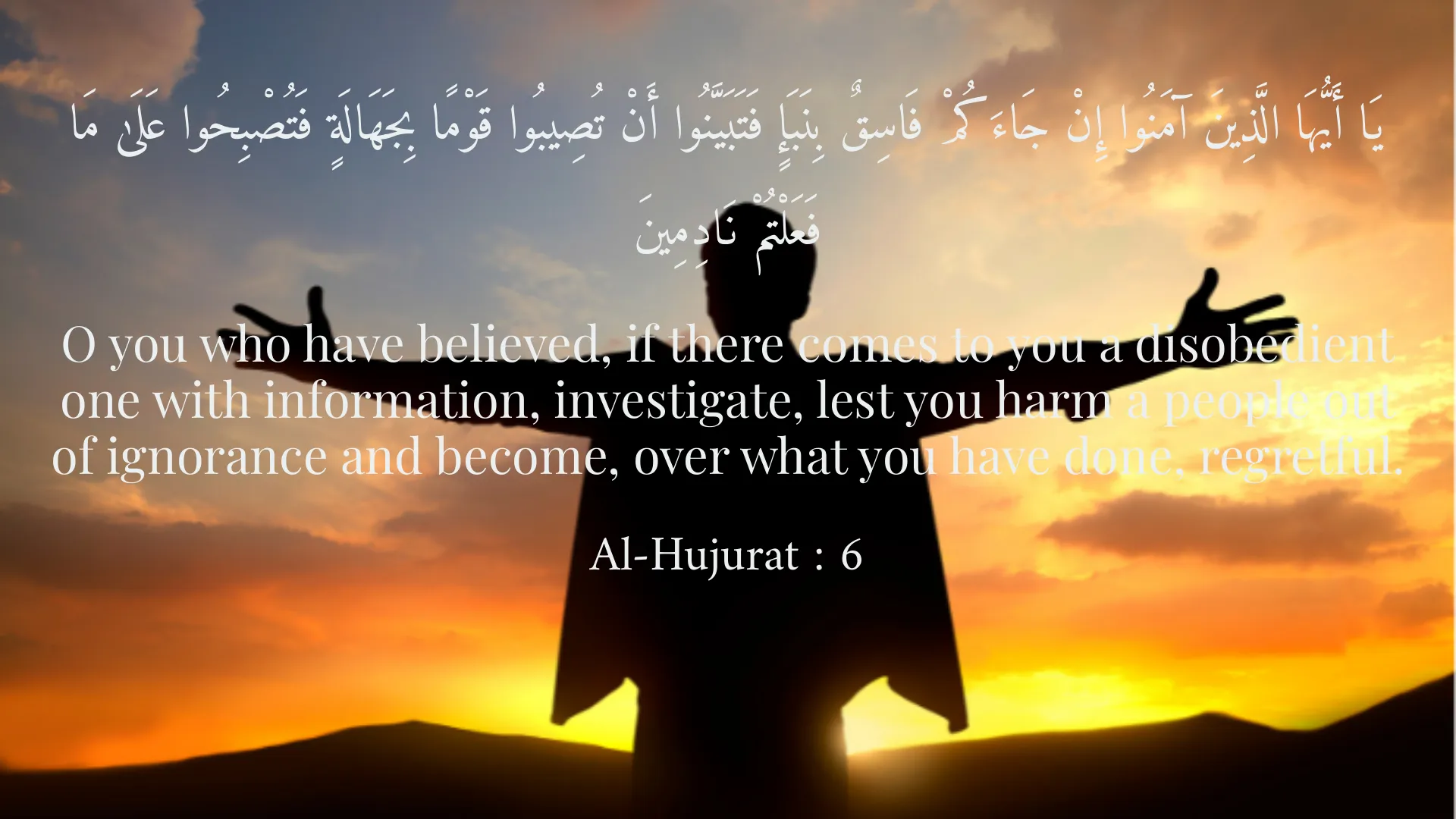
يَا أَيُّهَا الَّذِينَ آمَنُوا إِنْ جَاءَكُمْ فَاسِقٌ بِنَبَإٍ فَتَبَيَّنُوا أَنْ تُصِيبُوا قَوْمًا بِجَهَالَةٍ فَتُصْبِحُوا عَلَىٰ مَا فَعَلْتُمْ نَادِمِينَ
O you who have believed, if there comes to you a disobedient one with information, investigate, lest you harm a people out of ignorance and become, over what you have done, regretful.
Al-Hujurat : 6
الَّذِينَ يُنفِقُونَ فِي السَّرَّاءِ وَالضَّرَّاءِ وَالْكَاظِمِينَ الْغَيْظَ وَالْعَافِينَ عَنِ النَّاسِ ۗ وَاللَّهُ يُحِبُّ الْمُحْسِنِينَ
Who spend [in the cause of Allah] during ease and hardship and who restrain anger and who pardon the people - and Allah loves the doers of good.
Al-Imran : 134
خُذِ الْعَفْوَ وَأْمُرْ بِالْعُرْفِ وَأَعْرِضْ عَنِ الْجَاهِلِينَ
Take what is given freely, enjoin what is good, and turn away from the ignorant.
Al-A'raf : 199
يَا أَيُّهَا الَّذِينَ آمَنُوا كُونُوا قَوَّامِينَ لِلَّهِ شُهَدَاءَ بِالْقِسْطِ وَلَا يَجْرِمَنَّكُمْ شَنَآنُ قَوْمٍ عَلَىٰ أَلَّا تَعْدِلُوا ۚ اعْدِلُوا هُوَ أَقْرَبُ لِلتَّقْوَىٰ ۖ وَاتَّقُوا اللَّهَ ۚ إِنَّ اللَّهَ خَبِيرٌ بِمَا تَعْمَلُونَ
O you who have believed, be persistently Qawwameen [maintainers of justice] for Allah, witnesses in justice, and let not the hatred of a people prevent you from being just. Be just; that is nearer to righteousness. And fear Allah; indeed, Allah is Acquainted with what you do.
Al-Ma'idah : 8
يَا أَيُّهَا الَّذِينَ آمَنُوا اجْتَنِبُوا كَثِيرًا مِنَ الظَّنِّ إِنَّ بَعْضَ الظَّنِّ إِثْمٌ ۖ وَلَا تَجَسَّسُوا وَلَا يَغْتَب بَّعْضُكُم بَعْضًا ۚ أَيُحِبُّ أَحَدُكُمْ أَن يَأْكُلَ لَحْمَ أَخِيهِ مَيْتًا فَكَرِهْتُمُوهُ ۚ وَاتَّقُوا اللَّهَ ۚ إِنَّ اللَّهَ تَوَّابٌ رَّحِيمٌ
O you who have believed, avoid much [negative] assumption. Indeed, some assumption is sin. And do not spy or backbite each other. Would one of you like to eat the flesh of his brother when dead? You would detest it. And fear Allah; indeed, Allah is Accepting of repentance and Merciful.
Al-Hujurat : 12
Short Story
It is said that one day in the city of Baghdad, a benevolent scholar was unjustly slandered and spoken ill of by a group of people. Sharp tongues quickly defamed him among the populace, as if he had never done any good. His friends abandoned him, and the townsfolk, as if suddenly, turned their backs on him. The scholar, instead of anger and retaliation, remained silent and spoke nothing but kindness and gentleness to the people. He continued to help the needy and responded softly to anyone who spoke harshly to him. Some time passed. Those who had initially attacked him relentlessly gradually realized their mistake. They saw that the more they slandered him, the more the scholar showed nothing but kindness and nobility. Eventually, one of the leaders in the ill-speaking came to the scholar and apologized. The scholar, with a kind smile, said: 'I hold no grudge against anyone. I ask God to forgive you too, for it is ignorance that darkens hearts and leads tongues to sin. In this path, there is no cure but kindness and patience.' Thus, the scholar not only freed himself from the bonds of slander but also guided many hearts to the right path with his patience and kindness.