Quranic Answer
Unhealthy environments can manifest in various forms, from moral and social corruption to intellectually and spiritually polluted spaces that endanger one's inner peace and well-being. The Holy Quran, as a book of guidance, offers profound and practical strategies for maintaining an individual's spiritual, intellectual, and psychological health in such conditions. These teachings instruct us on how to remain immune to environmental harms while still being present in society, and even how to become a beacon of goodness and positive influence for others. One of the most crucial Quranic principles for staying healthy in an unhealthy environment is strengthening one's connection with God and relying upon Him. This reliance, encapsulated in the concept of 'Tawakkul' (trust in God), provides an individual with peace of mind and assurance that they possess a firm anchor against the turbulent waves of the environment. In Surah Al-Imran, verse 160, Allah states: "If Allah should aid you, no one can overcome you; but if He should forsake you, then who is there that can aid you after Him? And upon Allah let the believers rely." This reliance eliminates feelings of loneliness and vulnerability to the environment, strengthening the individual from within. Indeed, it is this deep faith and belief in Allah's infinite power that grants a person inner strength to resist temptations, pressures, and environmental corruptions. Another fundamental principle is 'Sabr' (patience) and 'Steadfastness'. In the Quran, patience is not merely passive endurance but an active perseverance and resilience in the path of truth. In Surah Al-Baqarah, verse 153, it is stated: "O you who have believed, seek help through patience and prayer. Indeed, Allah is with the patient." Patience helps individuals avoid despair and inaction in the face of environmental anomalies and negative pressures, preventing them from deviating from the right path. This steadfastness includes adherence to moral principles, even when the majority of society has turned away from them. This not only preserves the individual's mental health but also makes them an example for others. 'Salat' (prayer) and 'Dhikr' (remembrance of Allah) are also among the most vital tools for spiritual health in an unhealthy environment. Prayer is the pillar of faith and the believer's ascension; it is an opportunity for direct communication with the Creator and purification of the soul. Constant remembrance of Allah also calms the heart. In Surah Ar-Ra'd, verse 28, we read: "Those who have believed and whose hearts are assured by the remembrance of Allah. Unquestionably, by the remembrance of Allah hearts are assured." This inner tranquility acts as a strong shield against nervous pressures and anxieties stemming from unhealthy environments, helping individuals to shift their focus from external impurities to inner purity and truth. Moreover, the Quran emphasizes 'avoiding association with evildoers' and 'turning away from the ignorant'. While this does not mean isolation, it implies consciously choosing companions and avoiding gatherings that lead one to sin and heedlessness. In Surah Al-Furqan, verse 63, the characteristics of 'Ibad ar-Rahman' (servants of the Most Gracious) are described, among them: "And when the ignorant address them [harshly], they say [only], 'Peace.'" This avoidance of conflict and vain talk helps maintain inner peace and keeps the soul unblemished. Furthermore, in Surah An-Nisa, verse 140, it states: "So do not sit with them until they engage in another conversation; [for if you do], then indeed, you would be like them." This verse clearly underlines the importance of avoiding gatherings where Allah's verses are ridiculed or where sin is indulged. Perhaps the most crucial Quranic strategy for maintaining individual well-being in an unhealthy environment is 'focusing on personal responsibility and self-improvement'. In Surah Al-Ma'idah, verse 105, Allah says: "O you who have believed, upon you is [the responsibility of] your own souls. Those who have erred will not harm you when you have been guided. To Allah is your return all together; then He will inform you of what you used to do." This verse explicitly states that an individual's spiritual health and guidance are immune to the misguidance and corruption of others in their surrounding environment. This means that each person's primary responsibility is to preserve their own inner health and purity. If one correctly fulfills their duty towards their own guidance, even a multitude of misguided individuals cannot harm them. This concept empowers the individual with an inner strength that external environments cannot shake. In summary, the Quran provides a comprehensive strategy for maintaining health in unhealthy environments, built upon the pillars of reliance on God, patience and steadfastness, consistent prayer and remembrance, wise selection of companions, and a focus on self-improvement and individual responsibility. These teachings empower the believer not only to remain immune to environmental impurities and corruption but also to serve as a guiding light in the darkness, ultimately achieving true peace and well-being.
Related Verses
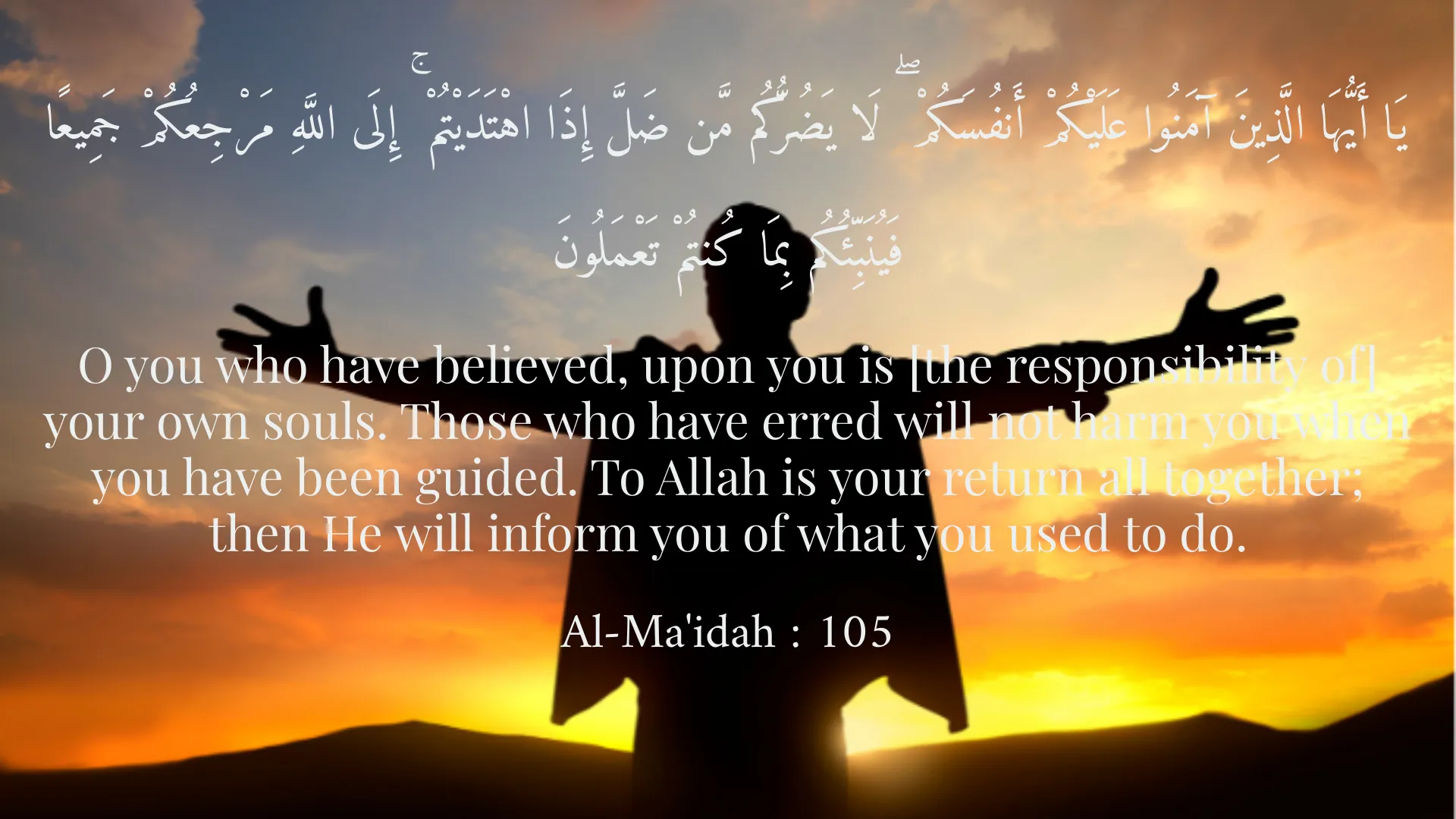
يَا أَيُّهَا الَّذِينَ آمَنُوا عَلَيْكُمْ أَنفُسَكُمْ ۖ لَا يَضُرُّكُم مَّن ضَلَّ إِذَا اهْتَدَيْتُمْ ۚ إِلَى اللَّهِ مَرْجِعُكُمْ جَمِيعًا فَيُنَبِّئُكُم بِمَا كُنتُمْ تَعْمَلُونَ
O you who have believed, upon you is [the responsibility of] your own souls. Those who have erred will not harm you when you have been guided. To Allah is your return all together; then He will inform you of what you used to do.
Al-Ma'idah : 105
يَا أَيُّهَا الَّذِينَ آمَنُوا اسْتَعِينُوا بِالصَّبْرِ وَالصَّلَاةِ ۚ إِنَّ اللَّهَ مَعَ الصَّابِرِينَ
O you who have believed, seek help through patience and prayer. Indeed, Allah is with the patient.
Al-Baqarah : 153
يَا بُنَيَّ أَقِمِ الصَّلَاةَ وَأْمُرْ بِالْمَعْرُوفِ وَانْهَ عَنِ الْمُنكَرِ وَاصْبِرْ عَلَى مَا أَصَابَكَ ۖ إِنَّ ذَٰلِكَ مِنْ عَزْمِ الْأُمُورِ
O my son, establish prayer, enjoin what is right, forbid what is wrong, and be patient over what befalls you. Indeed, that is of the matters [requiring] determination.
Luqman : 17
Short Story
In the city of Babel, where many people were drowned in heedlessness and frivolous pursuits, there lived a wise scholar whose heart remained pure like a gem, far from any defilement. One of his disciples asked him, "O master, how is it that your heart remains tranquil and your spirit pure amidst such a turbulent and distracted populace?" The master smiled gently and replied, "My dear son, just as a duck swims upon the water yet its feathers remain dry, so too can a believer navigate the currents of this world without becoming submerged by its impurities. The secret lies not in fleeing the world, but in carrying within one's heart a lamp of remembrance (dhikr) and a shield of steadfastness (sabr). When the heart is anchored to the Divine, the storms of the world may rage, but they cannot extinguish its light." The disciple pondered these words and understood that true health in any environment begins from within.