Quranic Answer
Trusting God in critical moments, known in Islamic teachings as 'Tawakkul,' is not merely a theological concept but a practical and psychological strategy to overcome challenges and find peace amidst life's storms. The Holy Quran repeatedly emphasizes the importance of Tawakkul and seeking refuge in the Divine Essence. This trust does not mean abandoning effort or struggle; rather, it implies that after exerting all human capabilities and wisdom, the ultimate outcome is entrusted to God's wisdom and will, with the conviction that Allah desires the best for His servants, even if, on the surface, the outcome doesn't align with our wishes. This profound sense of Tawakkul not only alleviates burdens but also imbues an individual with a strong and resilient spirit in the face of adversities. In critical moments, the human mind is often consumed by anxiety, fear, and despair. This is where the role of faith and Tawakkul becomes more prominent. The first step towards trusting God in such circumstances is to remember His boundless power and absolute knowledge. Allah says in the Quran: "And whoever relies upon Allah – He is sufficient for him. Indeed, Allah will accomplish His purpose. Allah has already set for everything a [decreed] extent." (Al-Talaq, 65:3). This verse clearly states that whoever relies on Allah, Allah is sufficient for him. This means Allah suffices for those who trust Him, and there is no power above Him that can impede His will. By relying on this truth, we can find peace, knowing that even in the most complex and difficult situations, Allah is our supporter and guide. The second step is to seek refuge through patience and prayer. The Holy Quran states: "O you who have believed, seek help through patience and prayer. Indeed, Allah is with the patient." (Al-Baqarah, 2:153). Patience here does not mean passive endurance but active resilience in the face of difficulties; that is, despite pain and suffering, not giving up effort and remaining hopeful in God's mercy. Prayer, as the pillar of religion and the believer's ascension, is the strongest means of communication with the Creator. In prayer, one turns to God with all their being, acknowledges their weakness before His power, and seeks His help. This spiritual connection calms the heart and dispels fear. One of the most crucial aspects of Tawakkul is understanding that Allah knows what is good or bad for us better than we do ourselves. Sometimes, events that appear unfavorable to us outwardly contain immense good and wisdom that only become clear in the future. "But perhaps you hate a thing and it is good for you; and perhaps you love a thing and it is bad for you. And Allah Knows, while you know not." (Al-Baqarah, 2:216). This verse teaches us to change our perspective on events and to trust in divine wisdom even in hardships. This deep belief prevents absolute despair and opens a window of hope in the heart. Furthermore, Tawakkul should not be confused with abandoning means or neglecting planning. True Tawakkul only comes into play after exerting all one's efforts and logical, legitimate endeavors. It is like a farmer who plows the land, sows seeds, and waters them, but leaves the ultimate growth and harvest to God's will. Prophet Muhammad (peace be upon him) also associated Tawakkul with effort and planning in his sayings. For instance, he told a person who had left his camel untied, relying on God, "Tie your camel and then rely on Allah." This indicates that Tawakkul is a higher stage than simply fulfilling duties and utilizing reason and knowledge. Fulfilling duties is a step taken by humans, and Tawakkul is the stage where the outcome is entrusted to God. In the history of prophets and saints, there are numerous examples of Tawakkul in critical moments. Prophet Musa (AS), when faced with Pharaoh and his army and the sea before him, said to his people with reliance on God: "He said, 'No! Indeed, with me is my Lord; He will guide me.'" (Ash-Shu'ara, 26:62). He was certain that his Lord was with him and would guide him. Or Prophet Ibrahim (AS), who was thrown into Nimrod's fire, found peace only by uttering "Hasbiyallahu wa Ni'mal Wakeel" (Allah is sufficient for me, and He is the best Disposer of affairs), and Allah made the fire cool and safe for him. These stories teach us that even when facing the greatest dangers and threats, if there is a true heartfelt connection and reliance on God, one can expect divine help and grace. To strengthen this Tawakkul in critical moments, daily practices are beneficial: persistence in remembrance (dhikr) and supplication (dua), recitation and contemplation of Quranic verses, and reflection on God's blessings and His infinite power. The deeper one's connection with God is in ordinary days, the stronger their roots of faith will be in difficult days, and they will possess a greater ability to rely on Him. Remember that Allah is the Most Merciful and never abandons His servants in hardships. Sometimes crises are tests for our spiritual growth and elevation, and Tawakkul is the best key to successfully pass these tests and attain lasting peace and countless blessings. Tawakkul not only solves problems but also calms hearts and opens the doors of divine mercy.
Related Verses
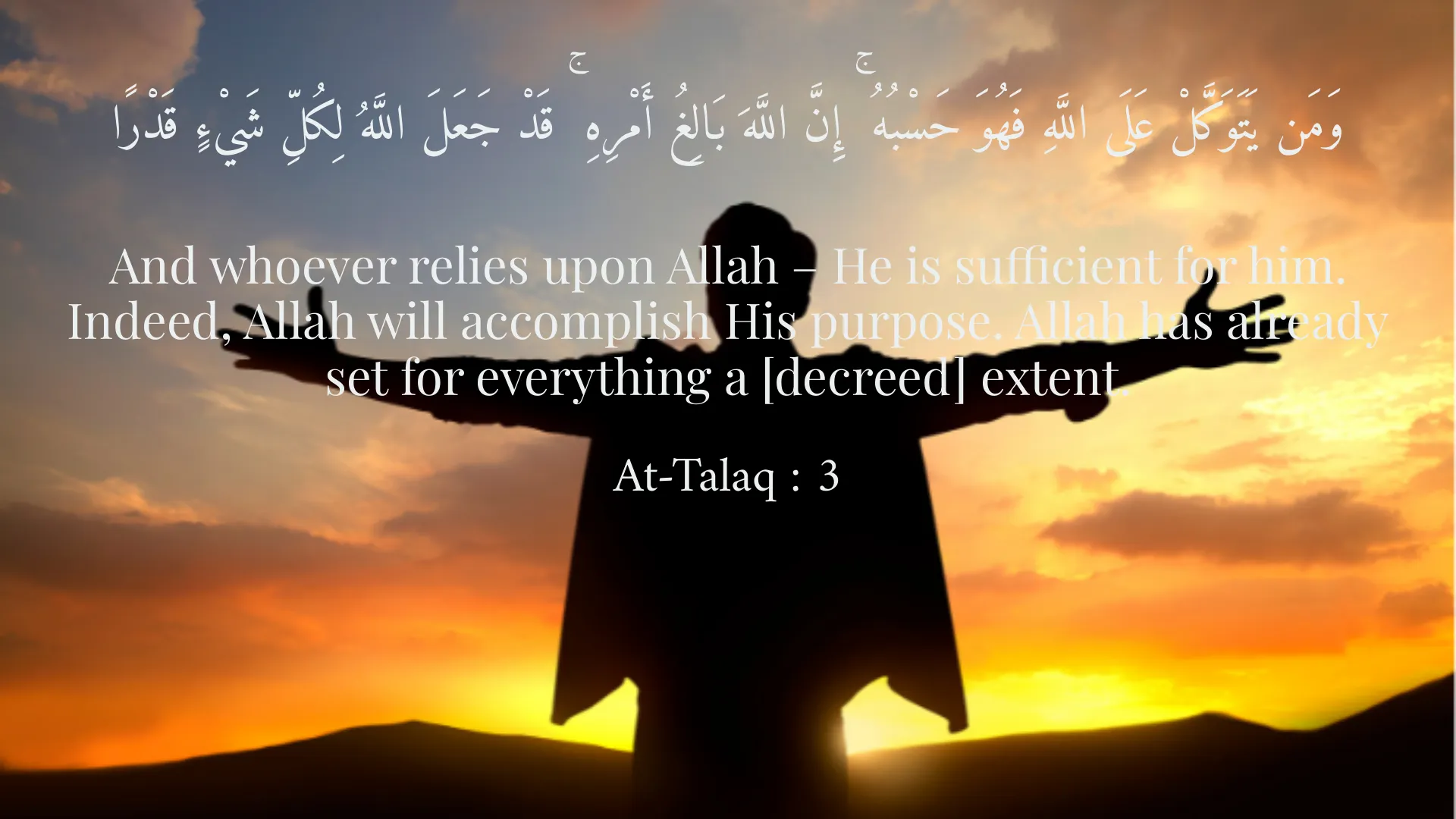
وَمَن يَتَوَكَّلْ عَلَى اللَّهِ فَهُوَ حَسْبُهُ ۚ إِنَّ اللَّهَ بَالِغُ أَمْرِهِ ۚ قَدْ جَعَلَ اللَّهُ لِكُلِّ شَيْءٍ قَدْرًا
And whoever relies upon Allah – He is sufficient for him. Indeed, Allah will accomplish His purpose. Allah has already set for everything a [decreed] extent.
At-Talaq : 3
يَاأَيُّهَا الَّذِينَ آمَنُوا اسْتَعِينُوا بِالصَّبْرِ وَالصَّلَاةِ ۚ إِنَّ اللَّهَ مَعَ الصَّابِرِينَ
O you who have believed, seek help through patience and prayer. Indeed, Allah is with the patient.
Al-Baqarah : 153
إِن يَنصُرْكُمُ اللَّهُ فَلَا غَالِبَ لَكُمْ ۖ وَإِن يَخْذُلْكُمْ فَمَن ذَا الَّذِي يَنصُرُكُم مِّن بَعْدِهِ ۗ وَعَلَى اللَّهِ فَلْيَتَوَكَّلِ الْمُؤْمِنُونَ
If Allah should aid you, no one can overcome you; but if He should forsake you, who is there that can aid you after Him? And upon Allah let the believers rely.
Al-Imran : 160
Short Story
It is narrated that in Saadi's time, there was an ascetic man who lived a modest and contented dervish life. He had a humble dwelling and never saved anything for the morrow. One day, a wealthy friend asked him, "My friend, how is it that you, with all your simplicity and heedlessness of the future, are always calm and cheerful, while I, with all my wealth and possessions, am constantly worried and anxious?" The ascetic smiled and said, "My dear friend, the difference between us is that you rely on your overflowing money bags and fear market decline, thieves, and plunder, whereas I have placed my trust in a Provider and Creator whose treasures are boundless and never diminish. When all your hope is placed in One who will never abandon you and is capable of all things, how can there be room for fear and worry? In critical moments, my reliance is on Him, not on the fleeting possessions of this world." The ascetic's words clearly demonstrated the peace and assurance of the dervish, stemming from true reliance on God, and became a great lesson for his friends to grasp the strong rope of God instead of anxiety in crises.