Quranic Answer
Contemplating the signs of God is not merely an exercise in intellectual curiosity; it is a vital form of worship that draws individuals closer to their Creator. This profound concept is underscored in the Holy Quran, which encourages believers to engage deeply with the world around them as a reflection of God's profound wisdom and creativity. In exploring the significance of contemplation in relation to divine signs, we find a pathway to understanding both the universe and our relationship with God himself. The Quran explicitly invites believers to ponder the creation of the heavens and the earth, and to consider the intricate details of existence as a means to deepen their faith. In Surah Al-Imran, verse 191, Allah states: 'Indeed, in the creation of the heavens and the earth and the alternation of night and day are signs for those of understanding.' This verse serves as a reminder that the natural world is filled with clues and lessons about the divine. Those who possess insight and understanding are encouraged to reflect upon these signs, thus transforming their contemplation into an act of worship. The role of contemplation in recognizing the signs of God is further articulated through the acknowledgment of different facets of His creation. Each cycle of day and night, every celestial body, and the delicate balance of ecosystems serve as reflections of God’s attributes. The intricate design of nature reveals the infinite wisdom and power of its Creator. By carefully observing these elements of creation, one can cultivate a deeper awareness of God’s presence, majesty, and the purpose of life. This perspective aligns with the teaching that faith is not blind; instead, it is a product of reflection and understanding. In Surah Al-An'am, verse 50, Allah emphasizes this notion: 'Say, I do not tell you that I have the treasures of Allah, nor do I know the unseen. Nor do I say to you, I am an angel. I follow nothing but what is revealed to me.' This statement highlights the humility required in acknowledging the limitations of human knowledge, while simultaneously affirming the importance of recognizing divine revelation as a source of guidance. The contemplation of creation serves as an act of worship, inviting us to recognize the divine wisdom enveloped within the universe. By engaging with the physical world, believers can bridge the gap between the seen and the unseen. Each observation and thoughtful consideration becomes an invitation to experience a greater connection with the Almighty. This intertwining of contemplation with worship also brings forth an understanding of one’s purpose in life. When individuals reflect on the creation around them, they confront fundamental questions about their own existence, prompting them to search for answers that lead back to their Creator. Moreover, through thoughtful consideration of the divine signs, one may find inspiration toward moral and ethical living. The Quranic verses throughout emphasize that the contemplation of God’s signs urges humanity to become better individuals. For instance, in recognizing the balance and harmony in nature, individuals may be led to practice patience, tolerance, and respect for the environment and all living beings. These practices resonate with the Muslim ethos of stewardship over the earth, as is evident in the Quranic call for responsible living within the interconnected web of life. This relationship between contemplation, worship, and understanding further underscores the significance of education and knowledge within the Islamic tradition. Engaging with scientific inquiry and intellectual exploration can be viewed as acts of devotion, as they enhance one’s understanding of God’s creation. Encouraging curiosity and inquiry is essential to the spiritual development of individuals, as gaining knowledge about the universe can elevate the soul and cultivate a sense of wonder and reverence for the Creator. Furthermore, as we deepen our understanding of the signs of God, we also engage with the concept of Islamic spirituality. Spirituality in Islam is not confined to rituals alone; it encompasses a broader understanding of existence that includes the pursuit of knowledge and fostering an emotional connection with God. Through contemplation, believers are not just fulfilling a religious obligation; they are advancing their personal spiritual growth. This growth nourishes their souls and leads to the development of a more profound relationship with God. In this context, contemplation transforms into a practice that transcends a mere mental activity, evolving into a holistic experience of worship. When we think about God’s signs, we immerse ourselves in a sacred practice that encompasses the heart, mind, and soul. This connection not only enriches our spiritual life but also fosters a sense of community among believers who share the journey of exploration, reflection, and worship. In conclusion, contemplation of creation is a powerful form of worship that invites believers to seek knowledge, reflect deeply, and connect with God. The Quran emphasizes the importance of engaging with the signs of God as an integral aspect of one’s faith journey. By cultivating insight and understanding, individuals can draw closer to the Almighty, enhancing their worship experience, and ultimately fulfilling their purpose in life. This sacred act of contemplation opens the door to awareness and understanding, allowing believers to appreciate not only the universe around them but also the profound glimpse they gain of the Divine. Thus, the encouragement to reflect on the heavens, the earth, and their wonders is a timeless call to all seekers of truth. In recognizing and honoring these divine signs, we participate in a form of worship that connects us to our Creator, fosters our understanding, and transforms our relationship with both the world and God.
Related Verses
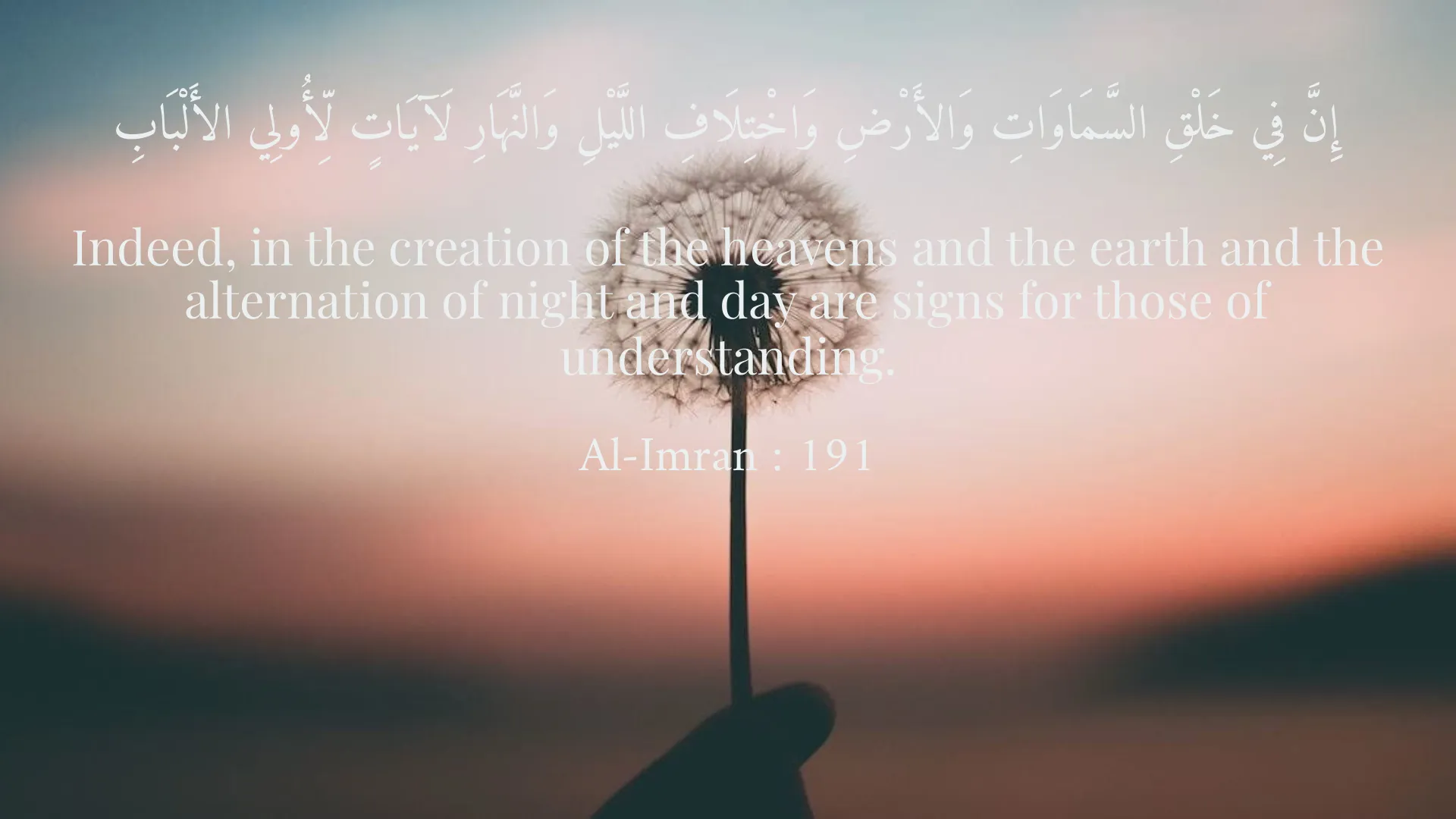
إِنَّ فِي خَلْقِ السَّمَاوَاتِ وَالأَرْضِ وَاخْتِلَافِ اللَّيْلِ وَالنَّهَارِ لَآيَاتٍ لِّأُولِي الأَلْبَابِ
Indeed, in the creation of the heavens and the earth and the alternation of night and day are signs for those of understanding.
Al-Imran : 191
قُلْ لا أَقُولُ لَكُمْ عِندِي خَزَائِنُ اللَّهِ وَلَا أَعْلَمُ الْغَيْبَ وَلَا أَقُولُ إِنِّي مَلَكٌ ۖ إِنْ أَتَّبِعُ إِلَّا مَا يُوحَى إِلَيَّ
Say, 'I do not tell you that I have the treasures of Allah, nor do I know the unseen. Nor do I say to you, I am an angel. I follow nothing but what is revealed to me.'
Al-An'am : 50
Short Story
One day, the sunlight shining over the meadow sparked reflections in Yasser's mind. He pondered the creation and its Creator. He thought to himself, 'Is all this beauty and order just a product of coincidence?' As he began to pay more attention to the Quranic verses in his life, he realized that contemplation on creation was not only inspiring but also a form of worship. Yasser decided to view the world with renewed eyes and seek God's signs in every beauty. With a thankful heart towards the Creator of the universe, he headed towards prayer and gratitude.