Quranic Answer
Understanding the concept of 'doubt' in faith from the perspective of the Holy Quran requires a careful examination and distinction between different types of doubt. The Quran generally condemns doubts that lead to disbelief (kufr), denial of truth, or hypocrisy (nifaq), referring to them as undesirable states. But is every type of doubt, even temporary doubts arising from curiosity and the search for truth, considered a sin? The Quran's answer to this question is nuanced, outlining the spiritual journey of humanity. This is a profound and significant question for any seeker of truth, as along the path of faith, the human mind sometimes encounters questions and ambiguities that may lead to uncertainty. The important thing is how we deal with these uncertainties and questions and use them to deepen our faith. The Quran strongly prohibits 'rayb' (رَیب), which signifies doubt accompanied by anxiety, pessimism, and disturbing uncertainties. This type of doubt typically arises from the refusal to accept truth, arrogance, or disregard for divine signs, and it distances the individual from guidance. Numerous verses condemn this kind of doubt because it often occurs in the face of clear and undeniable evidence, seeking excuses and denial rather than truth. For instance, in Surah Al-Hajj, verse 55, Allah says: "And those who disbelieved will remain in doubt about it until the Hour comes upon them suddenly or there comes to them the punishment of a barren Day." This verse refers to doubts that are rooted in disbelief and obstinacy, preventing the acceptance of truth. Similarly, in other verses, doubt regarding the Day of Judgment, the prophethood of messengers, or the power and oneness of God is mentioned as a characteristic of disbelievers and hypocrites, as these doubts stem from an unwillingness to accept the truth and a desire to persist in ignorance and deviation. However, in some cases, the Quran also refers to doubt as a natural stage in the journey toward certainty, provided that this doubt leads to investigation and contemplation. The story of Prophet Abraham (PBUH) in Surah Al-Baqarah, verse 260, is a prime example of this. Abraham asks God to show him how He brings the dead to life so that his "heart may be at peace" and his "certainty may increase." This request is not out of a lack of faith, but rather out of a desire for deeper understanding and to reach a higher level of certainty. God not only does not rebuke him but grants his request and shows him how to bring the dead back to life. This indicates that some questions and even internal uncertainties, when raised with the aim of achieving greater certainty and peace of heart, are not only not sins but can also be a stepping stone for the elevation of faith. In other words, healthy and dynamic doubts are those uncertainties undertaken with the aim of reaching truth, seeking knowledge, and deepening one's understanding of religious realities. This type of doubt stimulates thought, reflection, and contemplation. The Quran repeatedly invites humans to ponder divine signs, the creation of the heavens and the earth, and God's manifestations. This invitation to ponder inherently accepts that some matters might initially be vague for humans and require investigation and contemplation. If humans were to perceive everything as obvious and requiring no thought from the beginning, they would never reach the depths of truth. Therefore, doubt in faith can be divided into two categories: negative doubt (rayb) which leads to disbelief and denial, and is considered a sin; and positive doubt (in the form of sincere questioning and curiosity) which is part of the path of faith growth and attaining certainty. This type of doubt is not a sin; rather, it can be an opportunity for a deeper understanding of God and the truths of religion. The crucial factor is how an individual deals with their doubt: do they surrender to it and turn away from the truth, or do they use it as a bridge to cross towards certainty and knowledge? The Quranic solution for facing positive doubts involves reflection, contemplation of divine verses, seeking guidance from God, consulting with knowledgeable individuals, and ultimately striving to achieve certainty and peace of heart. True faith is faith that has emerged victorious from questions and ambiguities, strengthened and established through insight and awareness. This has been the path of many prophets and saints who, in their quest for certainty, have taken steps and reached high levels of knowledge. Ultimately, the Quran places great emphasis on 'yaqeen' (certainty) and 'heartfelt assurance.' This certainty is the fruit of moving along the correct path when confronting doubt. Not only is doubt not a sin if its aim is to reach certainty, but this seeking and contemplation can give an individual's faith greater strength and stability. Therefore, doubt in itself is not a sin; rather, the reaction and approach to it are determinative. If doubt leads to obstinacy, denial, and turning away from the truth, it is blameworthy. But if it is a catalyst for thought, contemplation, and reaching certainty, it is a natural and even necessary part of the spiritual journey toward the perfection of faith. A true believer is someone who, at every stage of life, honestly confronts their questions and ambiguities, and relying on divine guidance and wisdom, seeks answers that bring them closer to the source of truth. This dynamic process is a sign of living, dynamic faith, not a weakness within it.
Related Verses
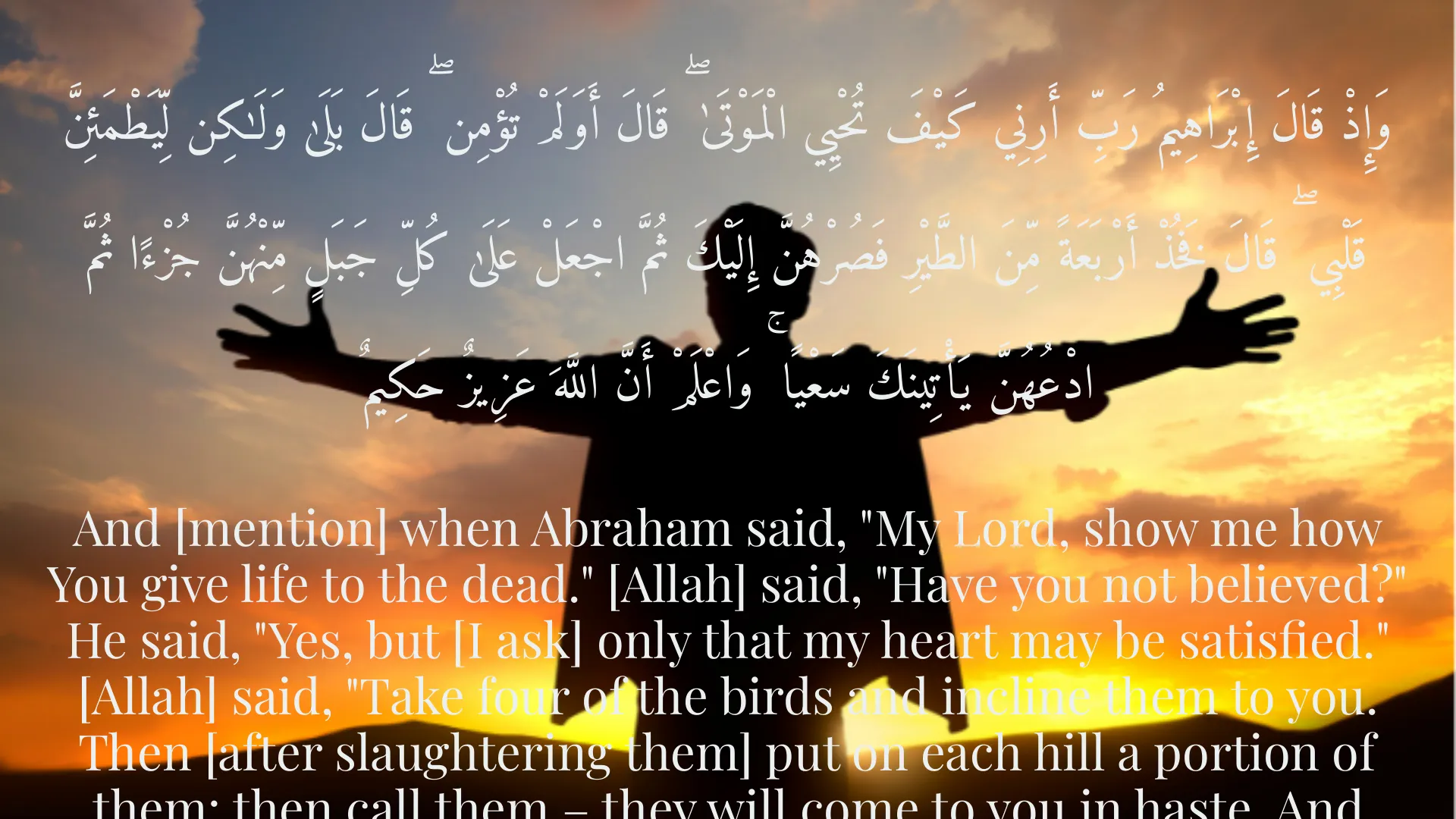
وَإِذْ قَالَ إِبْرَاهِيمُ رَبِّ أَرِنِي كَيْفَ تُحْيِي الْمَوْتَىٰ ۖ قَالَ أَوَلَمْ تُؤْمِن ۖ قَالَ بَلَىٰ وَلَٰكِن لِّيَطْمَئِنَّ قَلْبِي ۖ قَالَ فَخُذْ أَرْبَعَةً مِّنَ الطَّيْرِ فَصُرْهُنَّ إِلَيْكَ ثُمَّ اجْعَلْ عَلَىٰ كُلِّ جَبَلٍ مِّنْهُنَّ جُزْءًا ثُمَّ ادْعُهُنَّ يَأْتِينَكَ سَعْيًا ۚ وَاعْلَمْ أَنَّ اللَّهَ عَزِيزٌ حَكِيمٌ
And [mention] when Abraham said, "My Lord, show me how You give life to the dead." [Allah] said, "Have you not believed?" He said, "Yes, but [I ask] only that my heart may be satisfied." [Allah] said, "Take four of the birds and incline them to you. Then [after slaughtering them] put on each hill a portion of them; then call them – they will come to you in haste. And know that Allah is Exalted in Might and Wise."
Al-Baqarah : 260
وَلَا يَزَالُ الَّذِينَ كَفَرُوا فِي مِرْيَةٍ مِّنْهُ حَتَّىٰ تَأْتِيَهُمُ السَّاعَةُ بَغْتَةً أَوْ يَأْتِيَهُمْ عَذَابُ يَوْمٍ عَقِيمٍ
But those who disbelieved will not cease to be in doubt of it until the Hour comes upon them suddenly or there comes to them the punishment of a barren Day.
Al-Hajj : 55
فَإِن كُنتَ فِي شَكٍّ مِّمَّا أَنزَلْنَا إِلَيْكَ فَاسْأَلِ الَّذِينَ يَقْرَءُونَ الْكِتَابَ مِن قَبْلِكَ ۚ لَقَدْ جَاءَكَ الْحَقُّ مِن رَّبِّكَ فَلَا تَكُونَنَّ مِنَ الْمُمْتَرِينَ
So if you are in doubt, [O Muhammad], about that which We have revealed to you, then ask those who have recited the Scripture before you. Indeed, the truth has come to you from your Lord, so never be among the doubters.
Yunus : 94
Short Story
It is narrated that in a time not so distant, there lived an ascetic man renowned as 'Aref'. Aref spent his life in pursuit of truth and uncovering the mysteries of existence. Sometimes, questions like scattered clouds would appear in his heart, casting doubt upon his mind. But Aref never ceased his quest and never saw these doubts as a sign of weak faith; rather, he considered them a window to deeper inquiries. He knew that Saadi's Golestan states: "Sit in solitude and observe well, until you reach a state where you know nothing of yourself." So, whenever doubt enveloped him, he delved deeper into reflection and contemplation of divine verses and the wonders of creation, and engaged in discussions with the scholars of his time. Each uncertainty became a bridge to certainty, and every question, a lamp illuminating his path. Eventually, Aref attained such peace in faith that his heart, like a bright mirror, reflected the truth, and he never feared questions or ambiguities, for he knew that true faith strengthens through challenges and searches.