Quranic Answer
At first glance, the word "success" often conjures images of immense wealth, widespread fame, political power, or achieving high social status. Society frequently regards these as the primary indicators of success, and many individuals dedicate their entire lives to attaining them. But is every type of success, achieved through any means and with any objective, truly valuable and commendable from the perspective of the Holy Quran? The Quran's unequivocal answer to this question is "No." The Quran provides a comprehensive value framework that views true success as something far beyond fleeting material and worldly achievements, linking it instead to moral, spiritual, and divine criteria. The Quran explicitly distinguishes between apparent worldly successes and genuine, lasting salvation in the Hereafter. Many worldly accomplishments, such as wealth and children, are described in the Quran as "the adornment of worldly life" (زينة الحياة الدنيا). In Surah Al-Kahf, verse 46, Allah says: "Wealth and children are the adornment of worldly life. But the enduring good deeds are better to your Lord for reward and better for [one's] hope." This verse clearly indicates that while wealth and children can be divine blessings and might be considered aspects of worldly "success," true and lasting value lies in the righteous deeds accumulated for one's Hereafter. These good deeds are what endure and hold true reward with Allah. Worldly successes, no matter how impressive, are temporary and perishable; they not only vanish with death but can also be lost during one's lifetime or become a source of anxiety and corruption instead of peace. The Holy Quran defines true prosperity not in the accumulation of riches or the acquisition of power at any cost, but in drawing closer to Allah, purifying the soul, performing good deeds, and adhering to divine commands. Terms such as "Falah" (salvation/prosperity) and "Fawz" (triumph/success) are used in the Quran to describe this genuine success. For instance, at the beginning of Surah Al-Mu'minun, Allah outlines the criteria for the success of believers: "Certainly will the believers prosper [falah] - They who are during their prayer humbly submissive." The Surah continues to explain that the prosperous are those who avoid idle talk, give zakat, guard their chastity, fulfill their trusts and covenants, and maintain their prayers. These verses teach us that true success lies in sincere servitude, honesty, chastity, social and moral responsibility, and maintaining a spiritual connection with the Creator. Such success brings inner peace and divine pleasure, which are incomparable to any amount of worldly wealth. Furthermore, Surah An-Nur, verse 52, explicitly states: "And whoever obeys Allah and His Messenger and fears Allah and is conscious of Him - then these are the attainers of success [fawz]." This verse provides a clear equation: the path to true success passes through absolute obedience to Allah and His Messenger, coupled with reverence for the divine presence and observance of Taqwa (God-consciousness). Success from this perspective is an internal and sustainable process where an individual progresses on the path of servitude, and every step taken to gain divine pleasure brings them closer to salvation. Therefore, success built upon injustice, lies, deception, exploitation of others, or negligence of divine and human rights, even if seemingly prominent and fleeting, holds no value in the sight of the Quran; rather, it leads to eternal loss and damnation. The Quran vividly illustrates this truth through stories such as those of Pharaoh and Qarun. Pharaoh symbolized worldly power and dominion, reaching the pinnacle of apparent success, yet his arrogance and tyranny led to his destruction, placing him among the losers. Qarun, likewise, was a symbol of boundless wealth, but due to his arrogance and stinginess, and his failure to use Allah's blessings righteously, he and his wealth were swallowed by the earth, serving as a profound lesson for humanity. These narratives teach us that successes achieved through pride and rebellion against God, or by trampling upon people's rights, are not only worthless but ultimately lead to bitter and painful consequences in both this world and the Hereafter. However, this does not mean that Islam rejects the pursuit of worldly success. On the contrary, the Quran advises believers to strive for lawful sustenance and progress in this worldly life. Yet, this endeavor must always remain within lawful bounds, undertaken with pure intentions, and never overshadowing humanity's ultimate goal, which is the pleasure of the Lord and the attainment of eternal felicity. Indeed, worldly success becomes valuable when it serves as a means to achieve higher divine and human objectives; for instance, acquiring wealth to help the needy, establish justice, or disseminate knowledge. True success is realized when an individual intelligently views this world as a cultivation ground for the Hereafter, utilizing its blessings in accordance with divine purposes. Otherwise, if success merely leads to the accumulation of wealth or fame without regard for moral and religious principles, it is not only valueless but may ultimately lead to ruin and perdition. The conclusion is that the true value of success lies not in the quantity of achievements, but in their quality, how they are obtained, and their impact on individual and collective well-being in this life and the Hereafter.
Related Verses
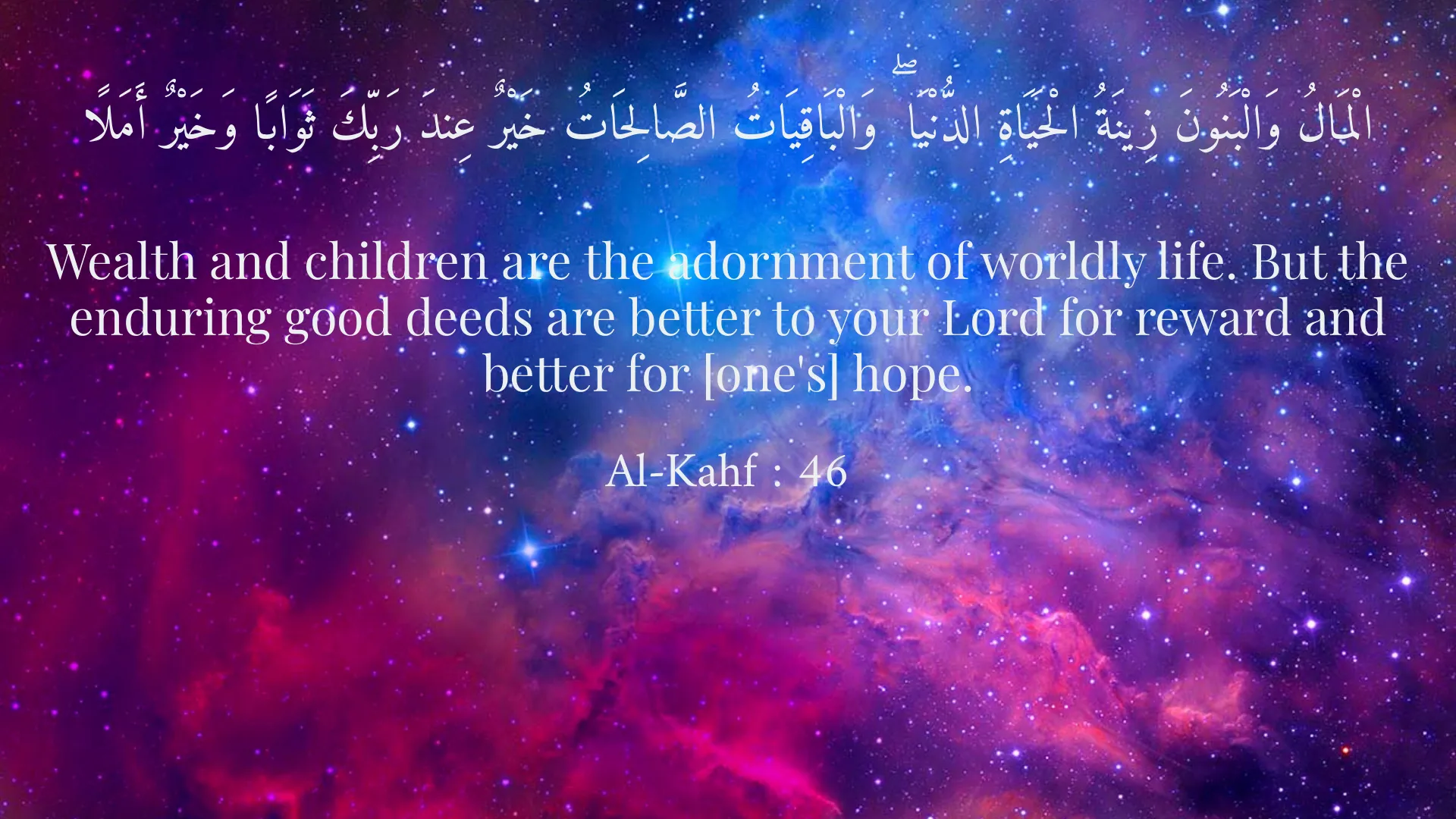
الْمَالُ وَالْبَنُونَ زِينَةُ الْحَيَاةِ الدُّنْيَا ۖ وَالْبَاقِيَاتُ الصَّالِحَاتُ خَيْرٌ عِندَ رَبِّكَ ثَوَابًا وَخَيْرٌ أَمَلًا
Wealth and children are the adornment of worldly life. But the enduring good deeds are better to your Lord for reward and better for [one's] hope.
Al-Kahf : 46
قَدْ أَفْلَحَ الْمُؤْمِنُونَ
Certainly will the believers prosper [falah]
Al-Mu'minun : 1
وَمَن يُطِعِ اللَّهَ وَرَسُولَهُ وَيَخْشَ اللَّهَ وَيَتَّقِهِ فَأُولَٰئِكَ هُمُ الْفَائِزُونَ
And whoever obeys Allah and His Messenger and fears Allah and is conscious of Him - then these are the attainers of success [fawz].
An-Nur : 52
Short Story
There was once a wealthy merchant who became so successful in his trade that his name was known far and wide, and his treasuries overflowed beyond count. He lived in a magnificent palace, with everything he desired at his fingertips. Yet, his heart found no peace, and at night, the fear of losing what he possessed kept sleep from his eyes. In the same city, in an unknown corner, lived a dervish who owned nothing but a simple cloak and a bowl for water. He spent each day in remembrance of God and serving the people. The wealthy man complained to a friend about his distressed state, saying, "All this success has brought me no ease; rather, it has become a burden." His friend replied, "True success is peace of heart and contentment, not a treasury that causes anxiety. Go and learn from that dervish who, despite his poverty, possesses the richest heart." The wealthy man came to his senses and realized that what he had considered success was nothing but a fleeting mirage, and true value lay in contentment and connection to the Divine.