Quranic Answer
Asking questions, in itself, is not a sign of a lack of faith; rather, in many instances, it is a pathway to deepen understanding, acquire knowledge, and strengthen belief. The religion of Islam consistently encourages its followers to reflect, ponder, and seek knowledge. The Holy Quran is filled with verses inviting contemplation on divine signs in the universe and within oneself, which is a form of inquiry and a quest for knowledge. Allah says in the Quran: "So ask the people of the message if you do not know" (An-Nahl: 43). This verse explicitly emphasizes the importance of questioning to gain awareness and remove ignorance, demonstrating that Islam is a religion founded on thought and research, not blind imitation. Therefore, constructive questioning, aimed at reaching the truth, resolving doubts, and increasing insight, is not only permissible but commendable and a means of spiritual growth and perfection of faith. However, the crucial point is that the 'type' and 'intention' of the question determine its value and standing. Alongside encouraging constructive questioning, the Holy Quran, in specific instances, prohibits pointless, repetitive, argumentative questions, or those that lead to hardship and difficulty. The most prominent example of this type of questioning is the story of the Children of Israel and the cow in Surah Al-Baqarah. Allah commanded the Children of Israel to sacrifice a cow to identify a murderer. This was a simple command, but instead of obeying, they began to ask countless, continuous questions about the cow's details: What should its color be? How old should it be? What should its purpose be? Each time they asked a question and more details were revealed, the task became harder for them, to the extent that the Quran states: "So they sacrificed her, though they nearly did not do it" (Al-Baqarah: 71). This story symbolizes questioning that is undertaken not for understanding, but to evade responsibility, create doubt, or impose hardship on oneself and others, leading to nothing but regret and difficulty. Such questions might stem from a weakness in faith or a lack of heartfelt submission to divine command, because the individual, instead of trusting and obeying, seeks excuses and complicates the matter. Furthermore, in Surah Al-Ma'idah, verse 101, it is stated: "O you who have believed, do not ask about things which if made apparent to you would trouble you." This verse points to divine wisdom in keeping certain matters concealed and forbids unnecessary curiosity that might have unintended consequences or reveal things that are difficult for humans to bear. This type of questioning can also originate from a lack of trust in Allah and His wisdom; it is as if the individual believes they need to know every hidden detail to manage their life, whereas Allah is more knowledgeable of His servants' welfare and keeps some matters hidden for their benefit. In other words, true faith entails a certain degree of submission and trust in the unseen; accepting that we do not know everything, nor do we need to know everything, and that Allah is the best Disposer of affairs. Therefore, the primary criterion for judging questioning is the intention behind it and its consequences. If the question arises from sincerity, scientific curiosity, and a desire for a deeper understanding of religion and the world, it is not only permissible but commendable and a sign of dynamic faith. Such questions lead to increased certainty, clarification of ambiguities, and strengthening of religious insight. However, if the questions are out of stubbornness, fault-finding, baseless skepticism, obsession, or with the intent to complicate matters, then it can indeed be a sign of a lack of faith. In such a state, the individual, instead of submitting to the truth, seeks a way to deny or justify their disobedience. True faith involves reliance on God (Tawakkul), acceptance of the unseen (Ghaib), and obedience to divine commands after reasonable and sufficient understanding. Thus, a true believer is someone who seeks to discover truths to draw closer to Allah, avoids futile questions that distract them from the main path, and submits with peace and assurance where divine wisdom dictates. Ultimately, it can be said that Islam has never stood against intellect and questioning. Rather, it urges humans to use their intellect to reach the truth and to ask their questions with pure intention and in the right direction. Reasonable and guided questions do not weaken faith; instead, they refine it and lead it to perfection. This is the difference between a seeker on the path to Allah who asks guides to avoid straying, and someone who poses a pointless question at every step to hinder their own progress.
Related Verses
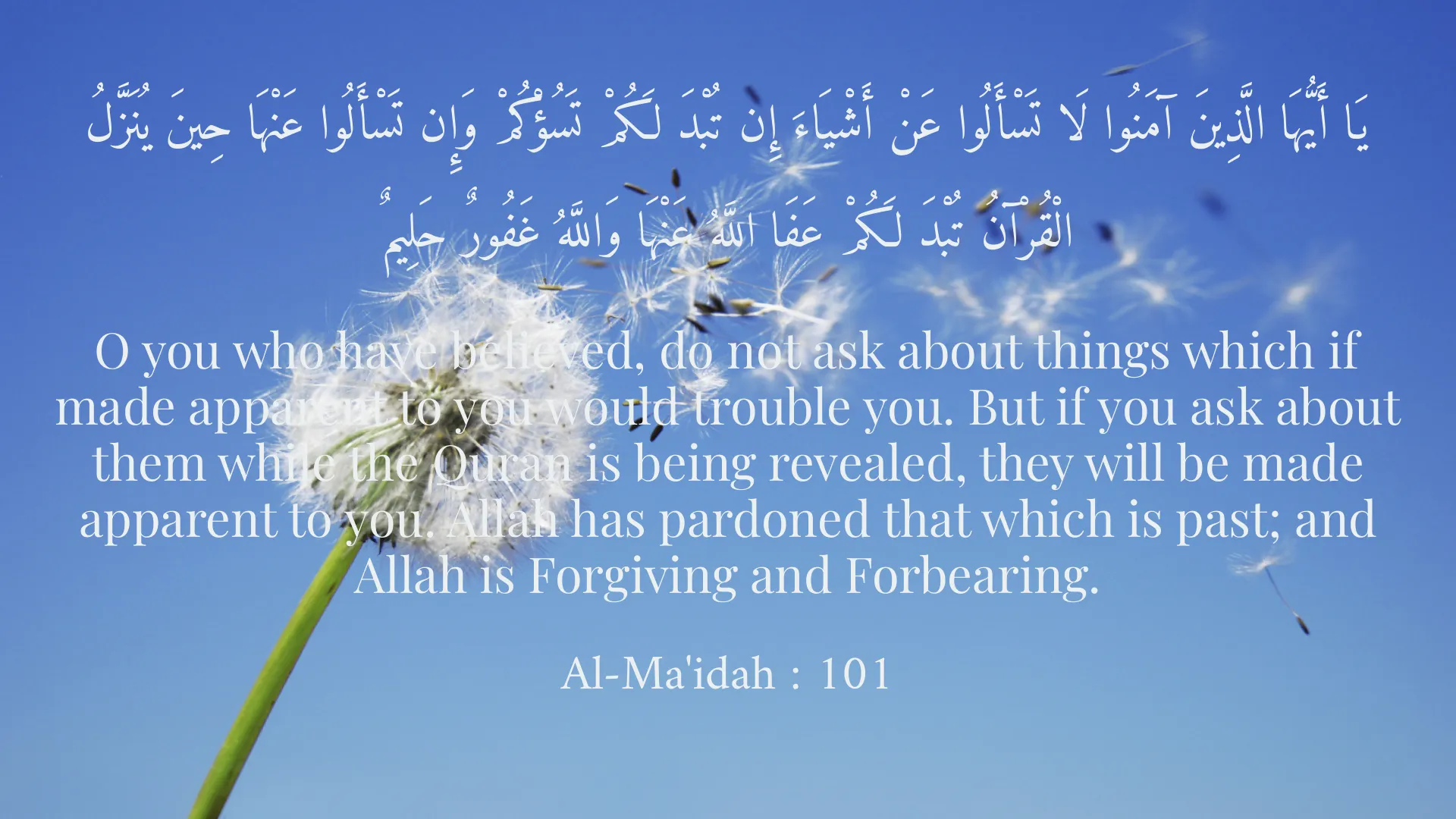
يَا أَيُّهَا الَّذِينَ آمَنُوا لَا تَسْأَلُوا عَنْ أَشْيَاءَ إِن تُبْدَ لَكُمْ تَسُؤْكُمْ وَإِن تَسْأَلُوا عَنْهَا حِينَ يُنَزَّلُ الْقُرْآنُ تُبْدَ لَكُمْ عَفَا اللَّهُ عَنْهَا وَاللَّهُ غَفُورٌ حَلِيمٌ
O you who have believed, do not ask about things which if made apparent to you would trouble you. But if you ask about them while the Quran is being revealed, they will be made apparent to you. Allah has pardoned that which is past; and Allah is Forgiving and Forbearing.
Al-Ma'idah : 101
وَمَا أَرْسَلْنَا مِن قَبْلِكَ إِلَّا رِجَالًا نُّوحِي إِلَيْهِمْ ۚ فَاسْأَلُوا أَهْلَ الذِّكْرِ إِن كُنتُمْ لَا تَعْلَمُونَ
And We sent not before you except men to whom We revealed [Our message]. So ask the people of the message if you do not know.
An-Nahl : 43
قَالَ إِنَّهُ يَقُولُ إِنَّهَا بَقَرَةٌ لَّا ذَلُولٌ تُثِيرُ الْأَرْضَ وَلَا تَسْقِي الْحَرْثَ مُسَلَّمَةٌ لَّا شِيَةَ فِيهَا ۚ قَالُوا الْآنَ جِئْتَ بِالْحَقِّ ۚ فَذَبَحُوهَا وَمَا كَادُوا يَفْعَلُونَ
He said, "He says, 'It is a cow neither trained to plow the earth nor to irrigate the field, one free from any blemish.'" They said, "Now you have brought the truth." So they sacrificed her, though they nearly did not do it.
Al-Baqarah : 71
Short Story
One day, a king asked a wise dervish, "Why do some people find a short and easy path in their search for truth, while others wander lost in a labyrinth of countless questions?" The wise dervish replied, "O King, the story of these people is like that of two students who studied under a sagacious master. The master told one, 'Bring a waterskin of water.' The first student immediately arose, went, and brought a full waterskin, saying, 'As you command!' and completed the task. But the second student began to ask questions: 'From which well? With what rope? Should the water be cold or warm? What if the well is dry?' And so, question after question piled up until night fell, and he brought no water, nor did he accomplish anything. The master smiled and said, 'Questioning to learn is good, but questioning to create obstacles or out of obsession is itself a veil on the path. He who listens to the command of heart and reason and does not seek difficulty will reach his goal sooner. But he who brings a thousand questions for every step will eventually drown in his own questions and miss the original purpose.' The king greatly benefited from the dervish's wisdom and understood that questioning is a means to gain knowledge, not a tool for making excuses or doubting.