Quranic Answer
In the rich and profound teachings of the Holy Quran, the topic of human emotions, including sorrow and grief, is addressed with a comprehensive and balanced perspective. To answer the question of whether grieving over the past is a sign of weakness, we must distinguish between 'natural human emotion of sorrow' and 'becoming enslaved by despair and hopelessness.' The Quran acknowledges that humans are emotional beings, and the emergence of feelings like grief in response to loss or unfortunate past events is entirely natural and human. Even prophets experienced sorrow. For instance, the Quran speaks of Prophet Yaqub's (Jacob's) profound grief over the separation from Prophet Yusuf (Joseph), to the point that his eyes turned white from sorrow. This illustrates that feeling grief in itself is not a flaw or a weakness; rather, it is part of the human nature that God has instilled within us. What the Quran disapproves of, and what can indeed be considered a spiritual weakness, is 'persisting in sorrow and grief to the extent that it leads to despair of Divine mercy' and 'being hindered from moving forward and striving in life.' The Quran warns believers against despair and attributes it to the disbelievers. In Surah Yusuf, verse 87, Allah states: "And do not despair of the relief of Allah. Indeed, no one despairs of relief from Allah except the disbelieving people." This verse clearly indicates that despairing of Allah's mercy and relief, often stemming from dwelling on the past and its calamities, has roots in disbelief rather than being a mere human weakness. Therefore, if grieving over the past transforms into a state that prevents an individual from striving, hoping, and trusting in God, it is at that point that such grief becomes a sign of weakness. The Quran also strongly emphasizes the importance of 'patience' (sabr) and 'reliance on Allah' (tawakkul) when facing difficulties and past issues. In Surah Al-Baqarah, verse 153, Allah says: "O you who have believed, seek help through patience and prayer. Indeed, Allah is with the patient." This verse offers a practical solution for overcoming grief and sorrow. Patience here means actively enduring and resisting problems, not being passive and surrendering to sorrow. Prayer, too, is the pillar of connection with Allah, providing inner peace and spiritual strength, and saving one from drowning in negative thoughts of the past. One who learns lessons from the past through patience and reliance on God, and looks forward to a brighter future, is not weak at all; rather, their faith and willpower are strengthened in the divine path. Furthermore, the Quran touches upon the philosophy behind past events and calamities. Much of what has happened in the past is part of divine decree (Qadar), and there are wisdoms embedded within them that may not be immediately apparent to us. In Surah Al-Hadid, verse 23, Allah states: "So that you may not grieve over what has escaped you nor exult [arrogantly] over what He has given you. And Allah does not like every self-deluded and boastful." This verse provides a profound lesson on detachment from worldly affairs and submission to divine will. Excessive sorrow and grief for the past indicate an over-attachment to worldly matters and a lack of acceptance of divine destiny, which itself can be a sign of weakness in faith. In conclusion, natural grief and sorrow for the past are never a sign of weakness; rather, they are a human and reasonable sensitivity. However, becoming trapped in this grief, reaching the stage of despair and hopelessness, and being held back from life's duties and aspirations, is definitely condemned from the Quranic perspective and can be a sign of weakness in reliance, patience, and faith. A true believer is one who, even in the depths of sorrow, does not abandon the rope of hope in God, learns from past experiences, and steps towards a better future with patience and prayer. Real strength lies in building a bridge from grief towards divine proximity and spiritual growth, not a wall to be imprisoned by regrets. The Quran invites us to a dynamic and hopeful view of life, a view that sees the past as a lesson, not a prison for the soul.
Related Verses
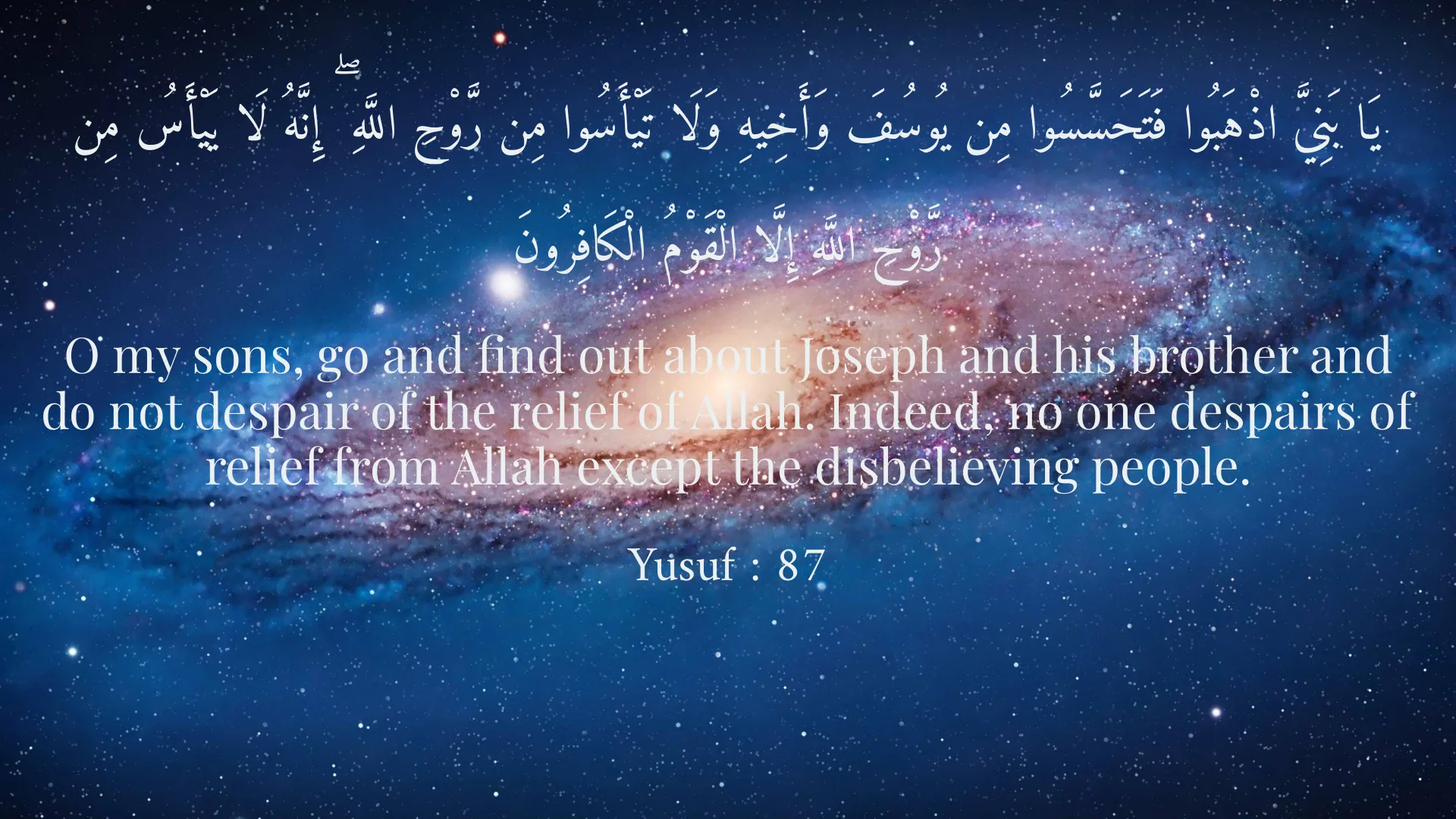
يَا بَنِيَّ اذْهَبُوا فَتَحَسَّسُوا مِن يُوسُفَ وَأَخِيهِ وَلَا تَيْأَسُوا مِن رَّوْحِ اللَّهِ ۖ إِنَّهُ لَا يَيْأَسُ مِن رَّوْحِ اللَّهِ إِلَّا الْقَوْمُ الْكَافِرُونَ
O my sons, go and find out about Joseph and his brother and do not despair of the relief of Allah. Indeed, no one despairs of relief from Allah except the disbelieving people.
Yusuf : 87
وَلَا تَهِنُوا وَلَا تَحْزَنُوا وَأَنتُمُ الْأَعْلَوْنَ إِن كُنتُم مُّؤْمِنِينَ
And do not weaken and do not grieve, and you will be superior if you are [true] believers.
Al-Imran : 139
لِّكَيْلَا تَأْسَوْا عَلَىٰ مَا فَاتَكُمْ وَلَا تَفْرَحُوا بِمَا آتَاكُمْ ۗ وَاللَّهُ لَا يُحِبُّ كُلَّ مُخْتَالٍ فَخُورٍ
So that you may not grieve over what has escaped you nor exult [arrogantly] over what He has given you. And Allah does not like every self-deluded and boastful.
Al-Hadid : 23
Short Story
Once upon a time, a wealthy merchant lost all his possessions in a fierce storm during a sea voyage. Great sorrow settled in his heart, and every day, lamenting the past, he secluded himself, unable to move forward. A compassionate wise man learned of his condition and went to visit him. The wise man kindly said: 'My friend, I know you have suffered a great ordeal. But will sunken ships return with grief and regret? Will lost wealth be re-accumulated with sighs and laments?' The merchant shook his head and sighed. The wise man continued: 'My father advised me that dwelling on past sorrows is like pouring water into a ruined mill; it grinds no wheat and turns no wheel. What has been lost, there was a wisdom in it. Rise up, and with reliance on God, begin anew. You still have your health, your intellect, and your experience; these are the greatest assets that no storm can take from you.' The merchant took heed of the wise man's comforting words, washed the dust of sorrow from his heart, and began to work and strive with new determination. Before long, he once again attained wealth and peace. He understood that true strength lies not in the absence of grief, but in letting go of the past and moving forward, relying on Divine wisdom and mercy.