Quranic Answer
In the sublime teachings of Islam and the radiant verses of the Holy Quran, helping others, benevolence (Ihsan), acts of kindness, and spending in the way of Allah are considered among the noblest and most esteemed actions. The Quran repeatedly and in various ways encourages believers to assist the needy, orphans, the poor, relatives, and those in distress, deeming it a sign of true faith and piety. The aim of this encouragement is to build a society founded on solidarity, mercy, justice, and brotherhood, where no one feels isolated or deprived. Helping others not only alleviates their burdens but also fosters the spiritual and moral growth of the helper, bringing immense reward in this world and the hereafter. Numerous verses, such as Surah Al-Baqarah verse 261, which likens the reward of charity to a seed that grows seven spikes, each with a hundred grains, or verse 267 of the same Surah encouraging believers to spend from their best possessions, clearly illustrate this esteemed status. Despite this unequivocal emphasis on the importance of help and benevolence, a key question arises: Is helping others always right, and in every circumstance? The answer from the Holy Quran and the tradition of Prophet Muhammad (peace be upon him) is not an absolute 'yes,' but rather comes with nuances and conditions. These conditions and considerations are not meant to diminish the value of helping but to ensure its effectiveness, righteousness, and alignment with the sublime objectives of Islamic Sharia. Indeed, helping, like any other action in Islam, must fall within a framework of legal and ethical principles to lead to true good. One of the most crucial and fundamental principles emphasized by the Quran is the prohibition of cooperation in sin and aggression. Allah states in Surah Al-Ma'idah, verse 2: “And cooperate in righteousness and piety, but do not cooperate in sin and aggression.” This verse sets a clear boundary: helping others is only sanctioned when it is in the path of goodness, justice, peace, and piety. If our help to someone assists them in committing a sin, or aids in oppression and aggression, or fuels corruption and destruction, such help is not only incorrect but is itself considered a sin. For instance, if someone asks for our help to commit an act contrary to Islamic law or to harm another, responding positively to them is sinful. Or, if an individual is needy, but we know they will use our financial aid to buy drugs or gamble, providing direct financial assistance in such circumstances is not only unwise but could make us complicit in their sin. Here, wisdom dictates that instead of money, more fundamental solutions such as counseling, job creation, or referral to support centers should be offered. Second is the matter of 'intention' (Niyyah). In Islam, the value of every action depends on its intention. Helping others must be sincere and solely for the pleasure of Allah, not for showing off, gaining reputation, or putting others under obligation. The Quran states in Surah Al-Baqarah, verse 264: “O you who have believed, do not invalidate your charities with reminders [of your generosity] or injury.” If help is accompanied by reminders or harm, or if it is done merely for ostentation and display, its reward is lost, and it can even turn into a sin. Therefore, even if an action appears to be helpful, but lacks a pure intention behind it, it loses its value from an Islamic legal and ethical perspective. Third, attention to priorities and avoiding harm to oneself or one's family. While self-sacrifice and altruism are highly praised in Islam, this does not mean that one should neglect their essential duties or the rights of their family. The obligatory rights of a spouse, children, and parents are among the most important priorities. Helping others should not come at the expense of neglecting these rights or jeopardizing one's family's livelihood, except in specific cases and with full consent and awareness. In times of severe famine or crisis, saving the lives of Muslims takes precedence, but under normal circumstances, balance and prudence are essential. Furthermore, helping others should not lead to irreparable harm to one's own health or life security, except in situations of Jihad and defense of faith and homeland, which have their own specific rulings. Fourth, wisdom and insight in the type of help. Sometimes, direct financial aid, instead of solving a problem, leads to laziness, dependency, or even exploitation. A wise and responsible individual assesses the situation before providing help. Is the person truly in need? Will our help enable them to stand on their own feet, or will it merely foster their dependency? Is it better to teach them how to fish rather than just giving them a fish? The Quran commands believers to act wisely and with discernment. Helping an individual who needs skills by providing training and tools is far more effective than merely giving them money. In this context, supporting sustainable development, education, health, and infrastructure creation in needy communities are deeper and more lasting forms of help that are highly valued from an Islamic perspective. In conclusion, helping others in Islam is a great virtue and a divine command, but this virtue must be exercised with wisdom, sincerity, and within the framework of Islamic legal and ethical guidelines. Help is 'always right' when it is sincerely for the pleasure of Allah, does not aid in sin or aggression, does not harm one's own obligations or the rights of one's family, and is accompanied by wisdom and prudence to lead to the best outcome and true well-being for the individual and society. This comprehensive perspective strengthens the spirit of generosity and benevolence while preventing harm and misuse. Therefore, helping with adherence to these principles is not only correct but is considered among the highest levels of human perfection and servitude.
Related Verses
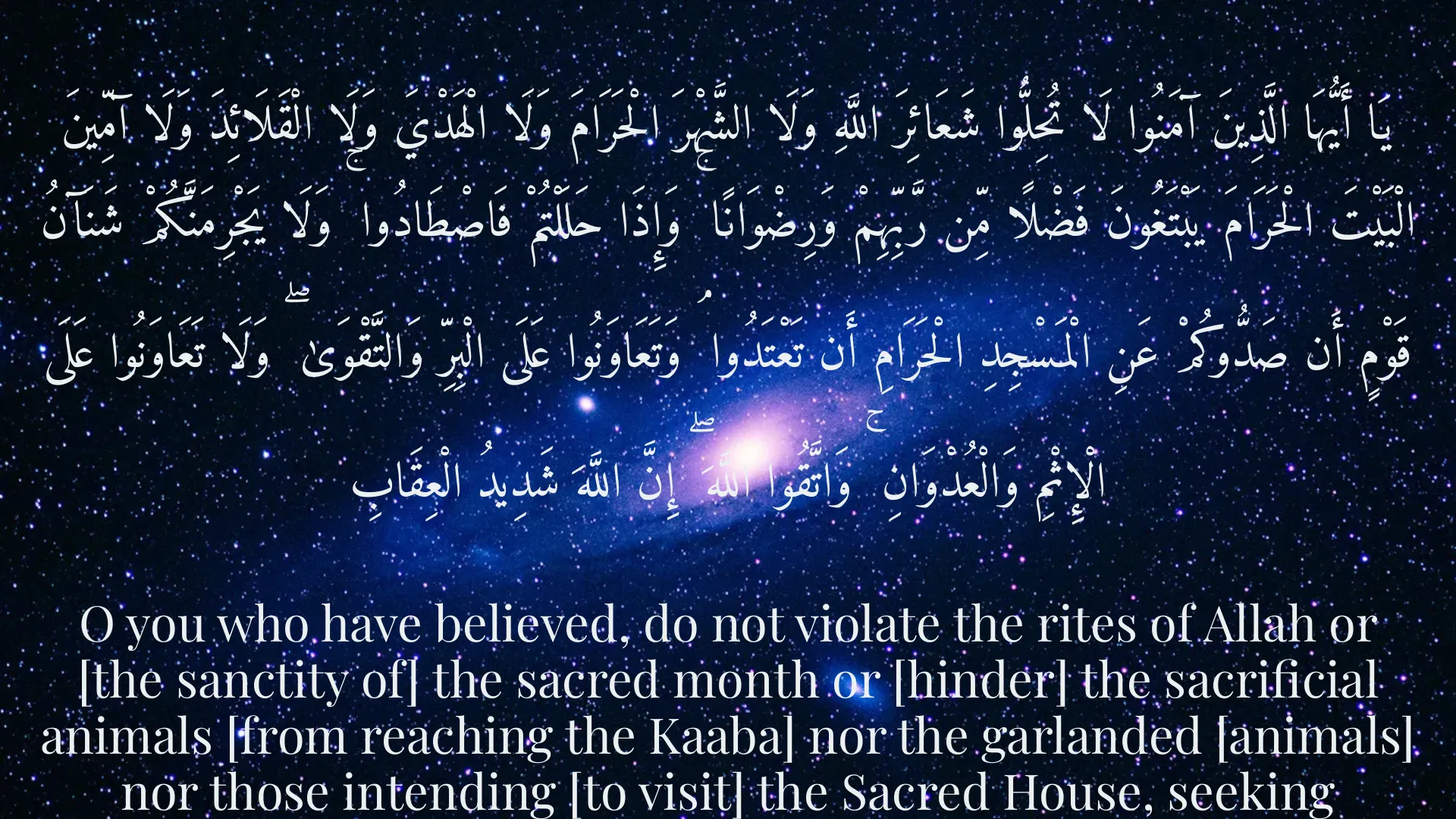
يَا أَيُّهَا الَّذِينَ آمَنُوا لَا تُحِلُّوا شَعَائِرَ اللَّهِ وَلَا الشَّهْرَ الْحَرَامَ وَلَا الْهَدْيَ وَلَا الْقَلَائِدَ وَلَا آمِّينَ الْبَيْتَ الْحَرَامَ يَبْتَغُونَ فَضْلًا مِّن رَّبِّهِمْ وَرِضْوَانًا ۚ وَإِذَا حَلَلْتُمْ فَاصْطَادُوا ۚ وَلَا يَجْرِمَنَّكُمْ شَنَآنُ قَوْمٍ أَن صَدُّوكُمْ عَنِ الْمَسْجِدِ الْحَرَامِ أَن تَعْتَدُوا ۘ وَتَعَاوَنُوا عَلَى الْبِرِّ وَالتَّقْوَىٰ ۖ وَلَا تَعَاوَنُوا عَلَى الْإِثْمِ وَالْعُدْوَانِ ۚ وَاتَّقُوا اللَّهَ ۖ إِنَّ اللَّهَ شَدِيدُ الْعِقَابِ
O you who have believed, do not violate the rites of Allah or [the sanctity of] the sacred month or [hinder] the sacrificial animals [from reaching the Kaaba] nor the garlanded [animals] nor those intending [to visit] the Sacred House, seeking bounty from their Lord and [His] approval. But when you have departed from Ihram, then [hunt and] fish. And let not the hatred of a people for having obstructed you from al-Masjid al-Haram lead you to transgress. And cooperate in righteousness and piety, but do not cooperate in sin and aggression. And fear Allah; indeed, Allah is severe in penalty.
Al-Ma'idah : 2
مَّثَلُ الَّذِينَ يُنفِقُونَ أَمْوَالَهُمْ فِي سَبِيلِ اللَّهِ كَمَثَلِ حَبَّةٍ أَنبَتَتْ سَبْعَ سَنَابِلَ فِي كُلِّ سُنبُلَةٍ مِّائَةُ حَبَّةٍ ۗ وَاللَّهُ يُضَاعِفُ لِمَن يَشَاءُ ۗ وَاللَّهُ وَاسِعٌ عَلِيمٌ
The example of those who spend their wealth in the way of Allah is like a seed [of grain] which grows seven spikes; in each spike is a hundred grains. And Allah multiplies [His reward] for whom He wills. And Allah is all-Encompassing and Knowing.
Al-Baqarah : 261
يَا أَيُّهَا الَّذِينَ آمَنُوا لَا تُبْطِلُوا صَدَقَاتِكُم بِالْمَنِّ وَالْأَذَىٰ كَالَّذِي يُنفِقُ مَالَهُ رِئَاءَ النَّاسِ وَلَا يُؤْمِنُ بِاللَّهِ وَالْيَوْمِ الْآخِرِ ۖ فَمَثَلُهُ كَمَثَلِ صَفْوَانٍ عَلَيْهِ تُرَابٌ فَأَصَابَهُ وَابِلٌ فَتَرَكَهُ صَلْدًا ۖ لَّا يَقْدِرُونَ عَلَىٰ شَيْءٍ مِّمَّا كَسَبُوا ۗ وَاللَّهُ لَا يَهْدِي الْقَوْمَ الْكَافِرِينَ
O you who have believed, do not invalidate your charities with reminders [of your generosity] or injury, like one who spends his wealth [only] to be seen by the people and does not believe in Allah and the Last Day. His example is like that of a smooth stone upon which is dust and then a torrential rain falls upon it and leaves it bare. They are unable to acquire anything of what they earned. And Allah does not guide the disbelieving people.
Al-Baqarah : 264
Short Story
It is narrated that a benevolent merchant lived in a city, renowned far and wide for his generosity. He would, without hesitation or question, extend his hand to the needy and help anyone who sought his aid. One day, a poor man approached him, pleading for gold. The merchant, without a moment's thought, gave him a purse full of coins. At that moment, a wise dervish, who had observed the scene, gently approached the merchant and said: 'Noble sir, your generosity is a great virtue, but sometimes a gift itself can become a burden. I know this man; he squanders what he acquires on gambling and frivolity, leading himself and his family to ruin. Your gold, given with the best intention, might push him further down a path of destruction rather than liberation.' The merchant, initially bewildered, pondered the dervish's words. He realized that true benevolence is not merely about giving, but about giving what truly benefits and without enabling idleness or harm. From that day forward, his generosity was tempered with wisdom, and he sought to help in a way that truly uplifted souls, not just filled pockets for a fleeting moment.