Quranic Answer
Love is a divine essence that God has embedded in human nature; therefore, examining the relationship between earthly love (human love for another human being) and heavenly love (love for God) in the Holy Quran unveils profound truths. The Quran does not explicitly state that human love for another human is a 'necessary prelude' to the love of God, but it clearly indicates that love for creation, when accompanied by insight and awareness, can be a 'mirror' reflecting the Creator's grandeur and perfection, serving as a bridge to reach boundless divine love. This perspective views human love not as an ultimate goal, but as a potential pathway to a higher truth. In numerous verses, the Holy Quran refers to the importance and status of love and affection in human lives. One of the most beautiful manifestations of this affection is the love between spouses, addressed in Surah Ar-Rum, verse 21: "And of His signs is that He created for you from yourselves mates that you may find tranquility in them; and He placed between you affection and mercy. Indeed in that are signs for a people who give thought." This verse demonstrates that affection and kindness among humans are signs and verses (Ayat) of God. When a person contemplates this deep affection and the tranquility it brings, they realize that this great blessing comes from a merciful and forgiving Lord, who is Himself the source and origin of all loves and affections. In fact, this human love can be a gateway to understanding the 'Al-Wadud' (The Loving) attribute of God, as mentioned in Surah Al-Buruj, verse 14: "And He is the Forgiving, the Loving." This verse uses the attribute 'Al-Wadud' (the One who loves greatly) for God, indicating that God Himself is the principal source and manifestation of love. Therefore, if a person does not limit loving another purely within the confines of worldly pleasures, but instead views it with insight and contemplation, they can transform this earthly experience into a ladder for ascending to higher levels of divine love. In this way, love for humanity guides one towards God, because every perfection and beauty observed in creation is a reflection and emanation of the infinite divine perfection and beauty. Just as we recognize the greatness of the artist when we gaze upon a beautiful work of art, when we experience affection and tenderness in human relationships, we can trace it back to its ultimate source, God. However, the Quran strongly warns against allowing love for creation to divert one from the love of the Creator, or to place it at a higher rank than the love of God. In Surah At-Tawbah, verse 24, Allah explicitly states: "Say, 'If your fathers, your sons, your brothers, your wives, your relatives, the wealth which you have obtained, and the commerce in which you fear decline, and the dwellings in which you delight are more beloved to you than Allah and His Messenger and jihad in His cause, then wait until Allah executes His command. And Allah does not guide the defiantly disobedient people.'" This verse clearly indicates that love for God and His Messenger must take precedence over all worldly and human attachments. If earthly love preoccupies a person and makes them forgetful of God and their duties, it will not only fail to be a prelude to divine love but can also be a significant obstacle on this path. In essence, love for humanity can be a 'vessel' for understanding divine love, provided this vessel is open towards the ultimate source, the Lord. This vessel can prepare the human heart to accept and comprehend God's immense grandeur and mercy. When a person experiences self-sacrifice, devotion, forgiveness, and generosity through loving another, they taste these divine attributes on a small scale, and this experience can lead them towards the absolute perfection of these attributes in God. Thus, human love is an opportunity to practice empathy, mercy, and sacrifice, which are all characteristics of a true believer and pathways to drawing closer to the One Essence. For this reason, many Sufis and mystics have called earthly love 'metaphorical love' (ishq-e majazi) and considered it a bridge to reach 'true love' (ishq-e haqiqi, divine love), provided that this metaphorical love does not reach a dead end but is guided towards the eternal source of love, which is God. Ultimately, it is the quality and direction of human love that determines whether it will serve as a prelude to divine love or become an impediment on that journey.
Related Verses
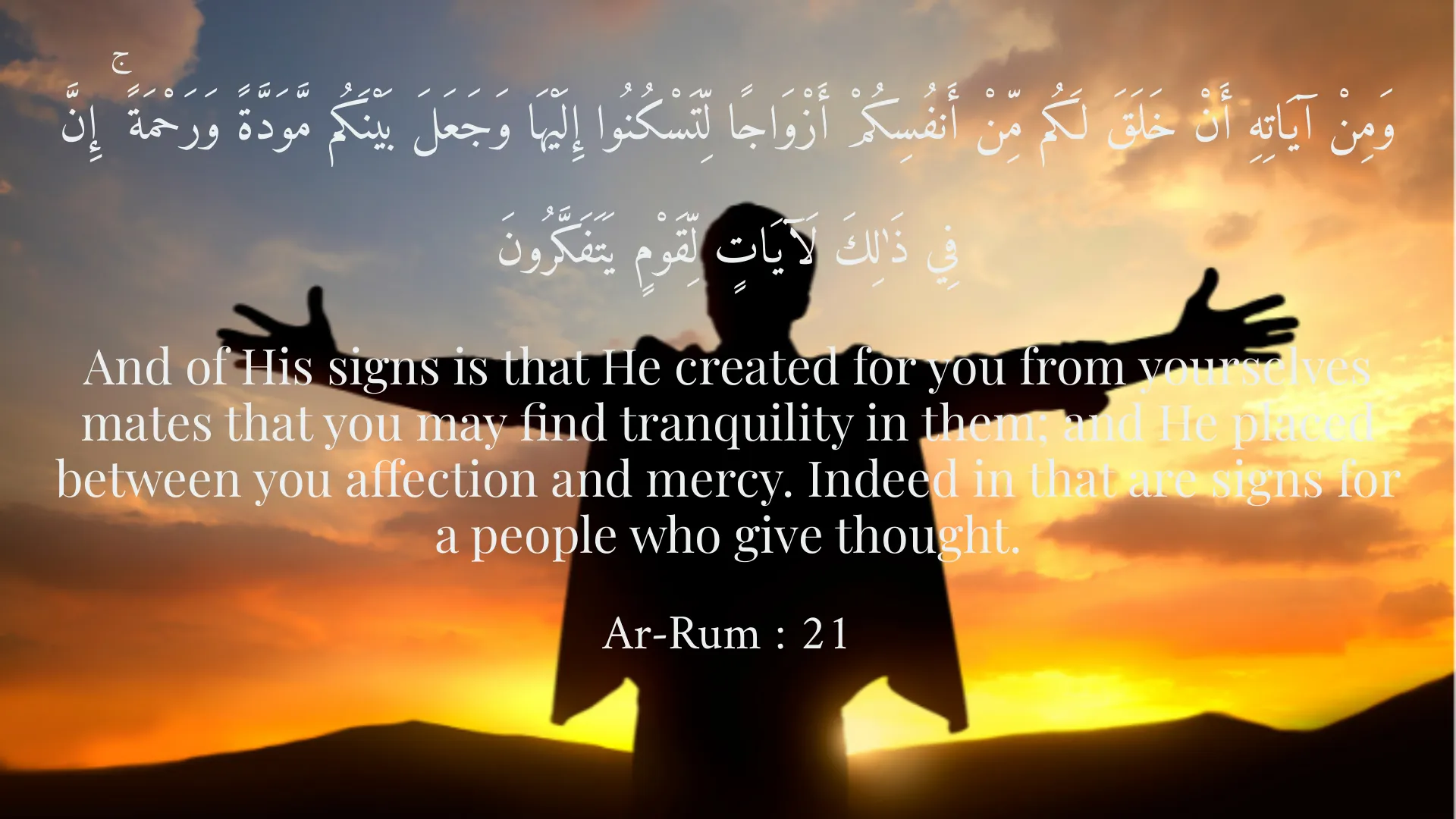
وَمِنْ آيَاتِهِ أَنْ خَلَقَ لَكُم مِّنْ أَنفُسِكُمْ أَزْوَاجًا لِّتَسْكُنُوا إِلَيْهَا وَجَعَلَ بَيْنَكُم مَّوَدَّةً وَرَحْمَةً ۚ إِنَّ فِي ذَٰلِكَ لَآيَاتٍ لِّقَوْمٍ يَتَفَكَّرُونَ
And of His signs is that He created for you from yourselves mates that you may find tranquility in them; and He placed between you affection and mercy. Indeed in that are signs for a people who give thought.
Ar-Rum : 21
قُلْ إِن كَانَ آبَاؤُكُمْ وَأَبْنَاؤُكُمْ وَإِخْوَانُكُمْ وَأَزْوَاجُكُمْ وَعَشِيرَتُكُمْ وَأَمْوَالٌ اقْتَرَفْتُمُوهَا وَتِجَارَةٌ تَخْشَوْنَ كَسَادَهَا وَمَسَاكِنُ تَرْضَوْنَهَا أَحَبَّ إِلَيْكُم مِّنَ اللَّهِ وَرَسُولِهِ وَجِهَادٍ فِي سَبِيلِهِ فَتَرَبَّصُوا حَتَّىٰ يَأْتِيَ اللَّهُ بِأَمْرِهِ ۗ وَاللَّهُ لَا يَهْدِي الْقَوْمَ الْفَاسِقِينَ
Say, 'If your fathers, your sons, your brothers, your wives, your relatives, the wealth which you have obtained, and the commerce in which you fear decline, and the dwellings in which you delight are more beloved to you than Allah and His Messenger and jihad in His cause, then wait until Allah executes His command. And Allah does not guide the defiantly disobedient people.'
At-Tawbah : 24
وَهُوَ الْغَفُورُ الْوَدُودُ
And He is the Forgiving, the Loving.
Al-Buruj : 14
Short Story
It is said that in ancient times, there was a king who fell in love with a girl whose beauty was renowned throughout the city. He became utterly devoted and infatuated, eating and sleeping only with her in mind, day and night. One day, a wise mystic came to the court and observed the king's distraught state. He asked, "O King, what is the source of all this passion and longing?" The king, with a deep sigh, spoke of his beloved's beauty and perfection. The mystic smiled and said, "O King! If all this devotion of yours is for the transient beauty of a creature that exists today and may be gone tomorrow, then what if you were to entrust this loving heart to the Creator of this unparalleled beauty? It is He who created the beauties of the world and is the source of all perfections. This love you hold for a creation can be a bridge to reach the infinite love of the Creator, if you look closely and see that every beauty and every perfection originates from Him and returns to Him." The wise mystic's words struck the king deeply. He realized that earthly love, though sweet, could be fleeting and was not the ultimate destination. From that day forward, the king turned his heart more profoundly towards God, and his love for creation became a path to reach the boundless love of the Creator of existence.