Quranic Answer
You have raised a profound and fundamental question about the essential nature of humanity from the perspective of the Holy Quran, and understanding it is key to grasping many Islamic teachings. The Quran, in a subtle and realistic manner, portrays humanity as neither inherently good nor inherently evil, but rather as a being with dual potentials, engaged in a perpetual struggle between these two aspects. Initially, the Quran emphasizes the 'pure human disposition' or fitra. This fitra refers to the primordial, pure nature upon which God created humanity; a nature that possesses a natural inclination towards monotheism, truth, moral virtues, and the recognition of the Lord. Surah Ar-Rum, verse 30, explicitly states: "So direct your face toward the religion, inclining to truth. [Adhere to] the fitra of Allah upon which He has created [all] people. No change in the creation of Allah. That is the correct religion, but most of the people do not know." This verse indicates that humans are born with an innate inclination towards the true religion and spirituality. This fitra is an inner light that guides humanity towards goodness and righteousness, paving the way for their prosperity. From this perspective, humans are intrinsically endowed with good inclinations and the capacity to understand and accept the truth. However, the Quran also addresses another aspect of human existence: their capacity for error, mistake, and even self-transgression. This does not imply inherent evil, but rather arises from human weaknesses, forgetfulness, hastiness, and susceptibility to internal temptations (the 'commanding self' or nafs al-ammarah) and external influences (Satan and worldly desires). Surah Al-Ahzab, verse 72, states: "Indeed, We offered the Trust to the heavens and the earth and the mountains, but they declined to bear it and feared it; but man [undertook to] bear it. Indeed, he was unjust and ignorant." The phrase "unjust and ignorant" (zaluman jahula) in this verse does not mean that humanity is inherently unjust and ignorant, but rather indicates that when faced with the great divine Trust (free will and responsibility), humans may deviate due to ignorance or self-transgression. This characteristic in humans is accidental, not essential. Furthermore, Surah Ash-Shams, verse 8, beautifully articulates this duality: "And [by] the soul and [by] He who proportioned it (7) And inspired it [with discernment of] its wickedness and its righteousness (8)." This verse illustrates that God has endowed humanity with both the potential for sin and rebellion (fujur) and the path of piety and spiritual growth (taqwa). This signifies the presence of potential and awareness for both paths within human existence. This inspiration is, in essence, the inner knowledge and ability to distinguish good from evil, which is essential for their free choice. The Quran unequivocally emphasizes human 'free will.' This free will is the cornerstone of human accountability. Humanity is a being with choice, capable of choosing the path of guidance or misguidance. Surah Al-Kahf, verse 29, declares: "So whoever wills - let him believe; and whoever wills - let him disbelieve." This choice itself necessitates the existence of capacity for both paths. Thus, humanity is neither compelled towards goodness nor compelled towards evil; rather, they are placed in a divine test. Therefore, the Quranic perspective on humanity is dynamic and growth-oriented. Humanity comes into the world with the capital of a pure fitra and divine inspirations, but at the same time, faces challenges from the nafs al-ammarah, satanic whispers, and worldly allurements. Human success on this path depends on understanding these two aspects of their being, strengthening the pure fitra, and combating negative inclinations. Repentance (Tawbah) and turning back to God is also a path that the Quran offers for rectifying errors and returning to the right course, a sign of divine mercy and grace upon humanity, who may stumble but possess the ability to return. Ultimately, in the Quran, humanity is a being in a state of becoming; a being who, by their own will and divine guidance, can reach the pinnacle of perfection, or, by following negative inclinations, diminish their own worth. It is this complexity and dynamism that makes humanity's position unique among God's creations.
Related Verses
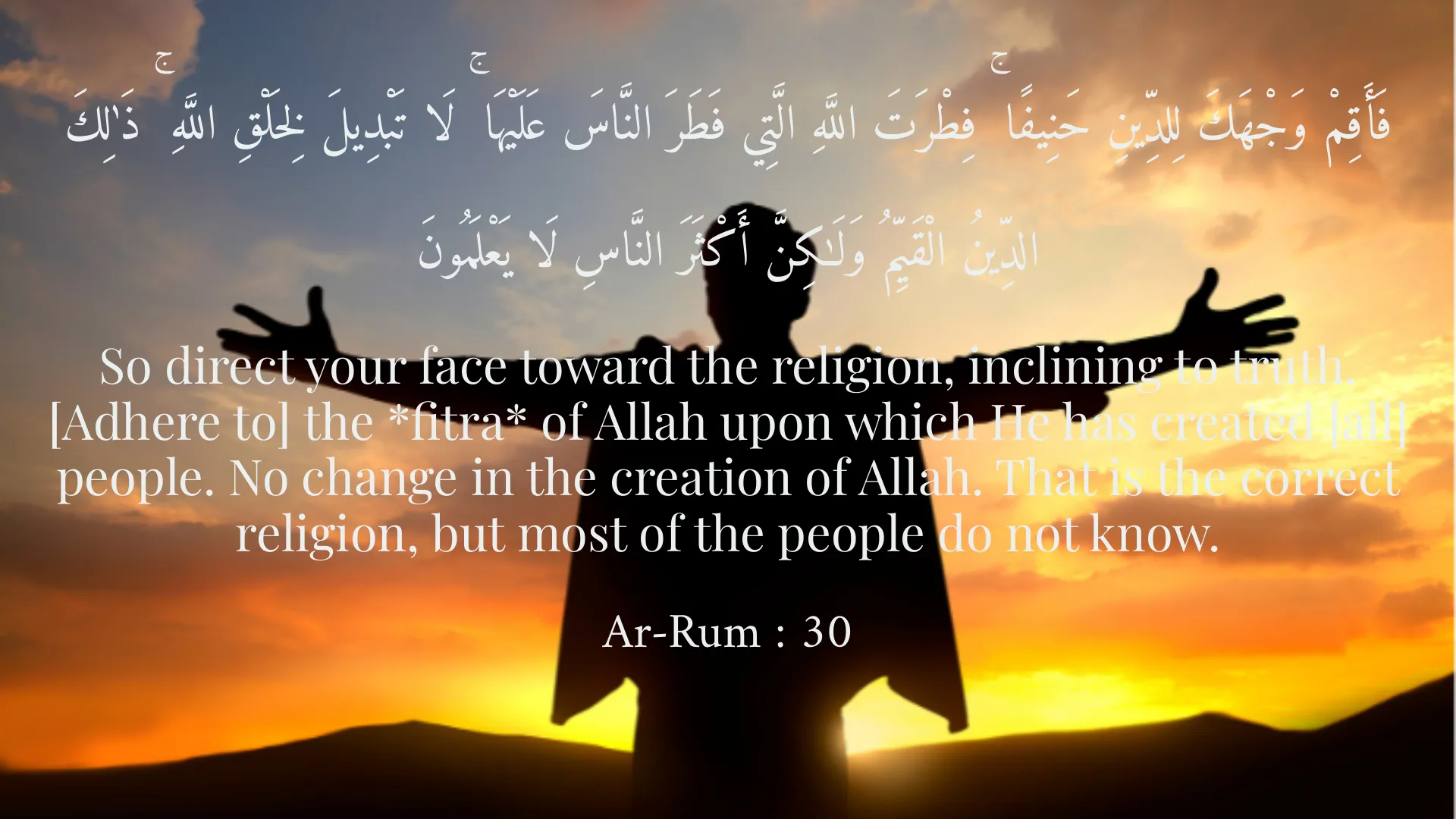
فَأَقِمْ وَجْهَكَ لِلدِّينِ حَنِيفًا ۚ فِطْرَتَ اللَّهِ الَّتِي فَطَرَ النَّاسَ عَلَيْهَا ۚ لَا تَبْدِيلَ لِخَلْقِ اللَّهِ ۚ ذَٰلِكَ الدِّينُ الْقَيِّمُ وَلَٰكِنَّ أَكْثَرَ النَّاسِ لَا يَعْلَمُونَ
So direct your face toward the religion, inclining to truth. [Adhere to] the *fitra* of Allah upon which He has created [all] people. No change in the creation of Allah. That is the correct religion, but most of the people do not know.
Ar-Rum : 30
إِنَّا عَرَضْنَا الْأَمَانَةَ عَلَى السَّمَاوَاتِ وَالْأَرْضِ وَالْجِبَالِ فَأَبَيْنَ أَن يَحْمِلْنَهَا وَأَشْفَقْنَ مِنْهَا وَحَمَلَهَا الْإِنسَانُ ۖ إِنَّهُ كَانَ ظَلُومًا جَهُولًا
Indeed, We offered the Trust to the heavens and the earth and the mountains, but they declined to bear it and feared it; but man [undertook to] bear it. Indeed, he was unjust and ignorant.
Al-Ahzab : 72
فَأَلْهَمَهَا فُجُورَهَا وَتَقْوَاهَا
And inspired it [with discernment of] its wickedness and its righteousness.
Ash-Shams : 8
Short Story
It is narrated in Saadi's Gulistan that a just king once dreamt that all the sinners of the world were engulfed in darkness and misery, except for a poor man who was engrossed in worship in a corner with a bright light. The king was greatly astonished by this dream and said to himself: "How can it be that so many people go astray and only one follows the right path?" In the morning, he summoned his vizier and recounted his dream. The wise vizier replied: "O King, every human being carries a light of <i>fitra</i> in their heart that calls them towards goodness, but the temptations of the ego and the glitter of the world sometimes obscure this light. That poor man, perhaps due to his detachment from worldly possessions and closeness to God, has managed to keep the light of his <i>fitra</i> alive and nurture it. Humanity has free will, and both paths of error and righteousness are before them, but divine mercy has always left a door open for repentance and return, so that whoever wills can return from darkness to light." The king took heed of the vizier's words and resolved to strive for the betterment and guidance of his people, understanding that every heart holds a seed of goodness that, with care and attention, will bear fruit.