Quranic Answer
Addressing the profound question of whether morality in the Holy Quran is absolute or relative, one can assert with full confidence that Quranic ethics, fundamentally and at their core, are absolute and universal. This absolutism stems from the divine and sacred origin of these concepts. The Holy Quran, as the word of the Creator of the universe, presents a set of ethical principles and values that transcend time, place, cultures, and individual human inclinations. These principles are constant and unchanging, applying to all human beings throughout history and across every corner of the globe. Allah, with His absolute knowledge of human nature and humanity's enduring needs, has established rules that ensure their well-being in both this world and the hereafter. These rules, in their essence, are by no means relative or dependent on fluctuating conditions. This ethical absolutism in the Quran originates from Tawhid, the oneness of God. When the ultimate source of good and evil, right and wrong, is solely the All-Wise and All-Knowing God, then ethical standards must necessarily emanate from His will and command. This implies that morality is not a conventional construct or a human invention that changes with societal shifts or perspectives; rather, it is a fixed and eternal truth whose source is the pure and flawless divine essence. This perspective saves humanity from wandering aimlessly amidst changing human ethical standards, providing a stable and reliable anchor for distinguishing right from wrong. Justice, truthfulness, trustworthiness, kindness to parents, avoidance of oppression, refraining from lies, adultery, murder, and theft are all values that the Quran unequivocally and firmly emphasizes. These emphases have consistently maintained the same form and degree of importance throughout history and across various societies, remaining immutable. For instance, the concept of justice in the Quran is by no means relative. Allah commands justice and severely forbids oppression, without setting a criterion for it based on personal or group interests. Verse 135 of Surah An-Nisa states: "O you who have believed, be persistently firm in justice, witnesses for Allah, even if it be against yourselves or parents and relatives." This verse clearly demonstrates that even against the closest individuals and even against personal interests, the standard of divine justice must be upheld without any reservation. This is an absolute command that does not tolerate any relative interpretation. Similarly, in Surah Al-Ma'idah, verse 8, it states: "And let not the hatred of a people prevent you from being just. Be just; that is nearer to righteousness." This injunction further underscores the absolute nature of the principle of justice in human relations, even with enemies. Furthermore, in Surah Al-Isra, verses 23 to 39, the Quran outlines a series of moral injunctions and prohibitions that clearly indicate the absolute nature of Quranic ethics. The command to worship Allah alone and to be kind to parents, the prohibition of unlawful killing, avoidance of adultery, prohibition of consuming an orphan's property, fulfilling covenants, giving full measure and weight, and avoiding arrogance are all presented without any conditions. These rulings represent moral red lines and foundational values that are in no way subject to change or negotiation, and they are obligatory for all human beings. Allah revealed these commands not due to specific social conditions or cultures, but because of the inherent nature of humanity and its true well-being. Conversely, some might argue for the relativity of morality by citing the existence of certain specific rulings that are enacted under emergency conditions or for particular groups. However, this approach is nothing more than a fallacy. The distinction between an "absolute moral principle" and its "application and implementation under specific conditions" must be correctly understood. For example, in Islam, preserving life is an absolute principle, and eating carrion or pork is forbidden. However, if someone is in extreme hunger and their life is in danger, they are permitted to consume it out of necessity. This is an exception in the application of the ruling, not a change in the principle of its prohibition. The principle of prohibition remains, but necessity, to preserve a more important principle (preserving life), allows for a temporary and limited exception. This demonstrates the flexibility of Sharia in upholding its higher objectives, not the relativity of the objectives or ethical principles themselves. Moreover, the concept of "Fitra" (innate disposition) in the Quran emphasizes the existence of an inherent and natural inclination towards good and righteousness within human beings. This Fitra is an internal and universal criterion that guides humanity towards absolute moral values. Although environment and upbringing may overshadow this Fitra, they never eradicate it. By reminding people of this Fitra, the Quran invites them to return to these natural and eternal standards. This invitation itself is proof of the absolute nature of morality, as human Fitra has maintained a consistent nature throughout history and across different places. In conclusion, morality in the Holy Quran is unequivocally absolute. This absolutism signifies the provision of a fixed and divine framework of do's and don'ts, aiming to guide humanity towards perfection and well-being. This does not mean that there is no flexibility in the implementation of rulings; rather, flexibility in specific and emergency cases is intended to preserve higher principles and the ultimate objectives of Sharia, and it never implies the relativity of the ethical principles themselves. Quranic ethical principles form the backbone of a healthy and humane society, and for this reason, they remain constant, stable, and universal.
Related Verses
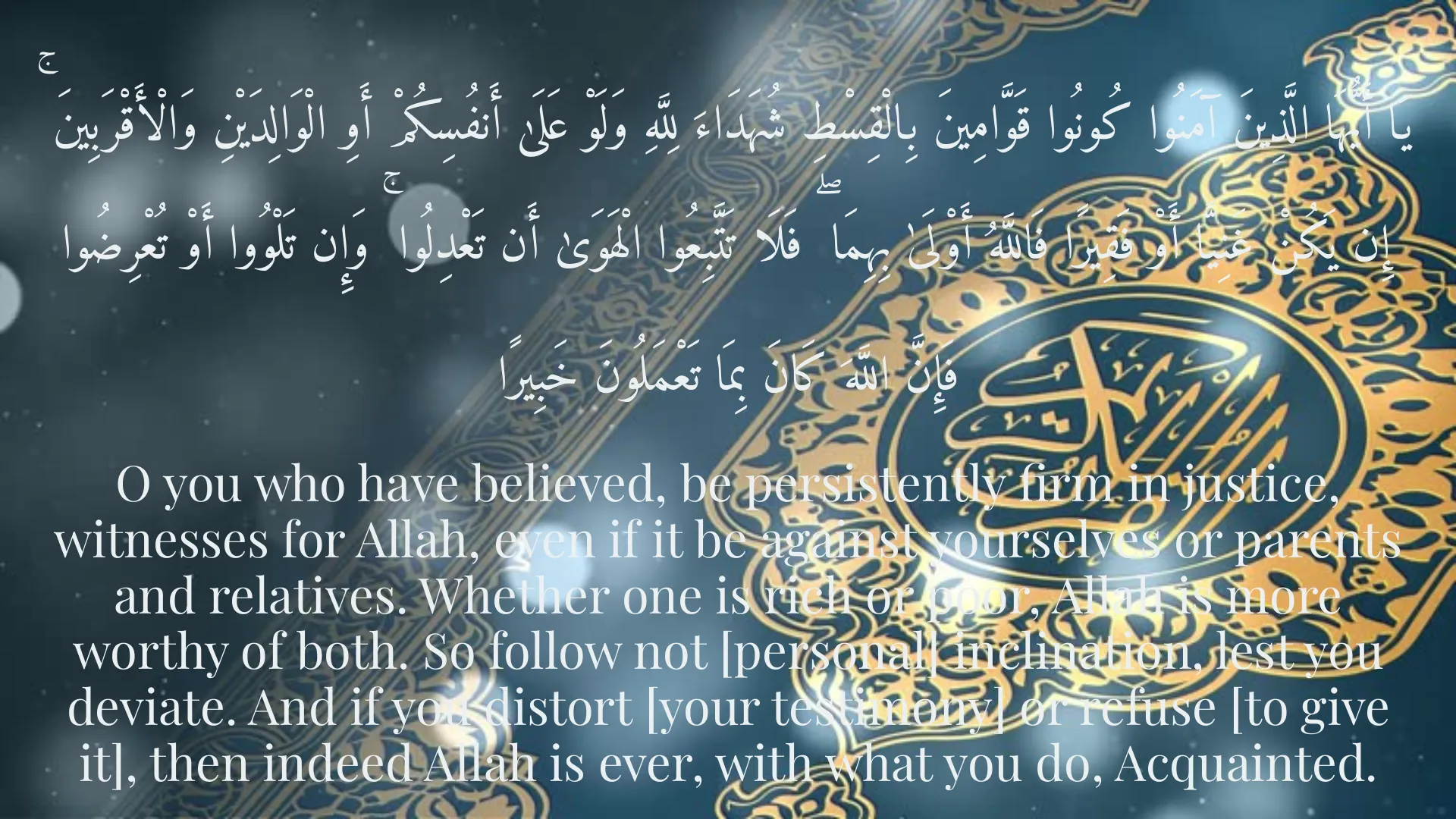
يَا أَيُّهَا الَّذِينَ آمَنُوا كُونُوا قَوَّامِينَ بِالْقِسْطِ شُهَدَاءَ لِلَّهِ وَلَوْ عَلَىٰ أَنفُسِكُمْ أَوِ الْوَالِدَيْنِ وَالْأَقْرَبِينَ ۚ إِن يَكُنْ غَنِيًّا أَوْ فَقِيرًا فَاللَّهُ أَوْلَىٰ بِهِمَا ۖ فَلَا تَتَّبِعُوا الْهَوَىٰ أَن تَعْدِلُوا ۚ وَإِن تَلْوُوا أَوْ تُعْرِضُوا فَإِنَّ اللَّهَ كَانَ بِمَا تَعْمَلُونَ خَبِيرًا
O you who have believed, be persistently firm in justice, witnesses for Allah, even if it be against yourselves or parents and relatives. Whether one is rich or poor, Allah is more worthy of both. So follow not [personal] inclination, lest you deviate. And if you distort [your testimony] or refuse [to give it], then indeed Allah is ever, with what you do, Acquainted.
An-Nisa : 135
وَقَضَىٰ رَبُّكَ أَلَّا تَعْبُدُوا إِلَّا إِيَّاهُ وَبِالْوَالِدَيْنِ إِحْسَانًا ۚ إِمَّا يَبْلُغَنَّ عِندَكَ الْكِبَرَ أَحَدُهُمَا أَوْ كِلَاهُمَا فَلَا تَقُل لَّهُمَا أُفٍّ وَلَا تَنْهَرْهُمَا وَقُل لَّهُمَا قَوْلًا كَرِيمًا
And your Lord has decreed that you not worship except Him, and to parents, good treatment. Whether one or both of them reach old age [while] with you, say not to them [so much as], 'uff,' and do not repel them but speak to them a noble word.
Al-Isra : 23
وَلَا تَقْرَبُوا الزِّنَا ۖ إِنَّهُ كَانَ فَاحِشَةً وَسَاءَ سَبِيلًا
And do not approach unlawful sexual intercourse. Indeed, it is ever an immorality and is evil as a way.
Al-Isra : 32
فَمَن يَعْمَلْ مِثْقَالَ ذَرَّةٍ خَيْرًا يَرَهُ
So whoever does an atom's weight of good will see it,
Az-Zalzalah : 7
وَمَن يَعْمَلْ مِثْقَالَ ذَرَّةٍ شَرًّا يَرَهُ
And whoever does an atom's weight of evil will see it.
Az-Zalzalah : 8
Short Story
It is narrated that once there was a tyrannical king who, in pursuit of power and wealth, greatly oppressed his people and spared no injustice. His subjects were fed up with him and had no hope for justice. At that time, a wise man, one of God's saints, spoke to him and said: 'O King! You now possess power, and everyone fears you, but know that this oppression will not have a good end, and God does not love oppressors. Even if you conquer the whole world through injustice, a day will come when you will stand alone and helpless before the True Judge, and on that day, no power will save you.' The king, who until then had only thought of his worldly power, was awakened by these insightful words and understood that justice and fairness come not from fear of people, but from the command of the Creator, and that injustice, in its essence, is inherently wrong and detestable, always leading to evil consequences. From that day on, he repented, ceased his tyranny, adopted the path of justice, and lived the rest of his life righteously. This story from Saadi's Bustan reminds us that the reward and punishment for deeds are absolute and fixed, never changing according to the times or the king's whims.