Quranic Answer
In the profound teachings of the Holy Quran, the subject of supplication (du'a) and asking Allah for various needs, both worldly and pertaining to the hereafter, is presented with a comprehensive and balanced perspective. Contrary to any misconception that praying for worldly matters might be undesirable, the Quran does not endorse such a view; rather, in numerous verses, it encourages believers to seek goodness and prosperity in both realms. The fundamental principle in this regard is to maintain balance and moderation, and to avoid neglecting the hereafter for the sake of this world. Almighty Allah, the Creator and Sustainer of all beings, has Himself permitted and even commanded human beings to turn to Him for their needs. This world is a field of trial and a platform for human growth, and material needs are an inseparable part of this life. Therefore, seeking lawful sustenance, health, tranquility, righteous family, and legitimate worldly successes is not only not undesirable but can even be considered an act of worship, provided that the conditions are met and the intentions are pure. Asking for worldly blessings with pure intention and in alignment with divine pleasure is a sign of understanding God's comprehensiveness and relying on Him in all aspects of life. One of the most prominent verses that clearly articulates this truth is Surah Al-Baqarah, verse 201. In this verse, Allah teaches us a supplication that includes asking for "good in this world" and "good in the Hereafter": "And among them is he who says, 'Our Lord, give us in this world [that which is] good and in the Hereafter [that which is] good and protect us from the punishment of the Fire.'" This verse demonstrates that asking for "hasanah" (goodness) in this world, which encompasses all forms of well-being, including prosperity, security, knowledge, health, and a desirable life, is not only permissible but is a beloved and divinely approved prayer. This du'a is the most comprehensive supplication, attending to both this world and the Hereafter, and exemplifying the balance between them. "Hasanah" in this world includes everything that improves human life here, while "hasanah" in the Hereafter refers to divine forgiveness, entry into Paradise, and His pleasure. This verse clearly indicates that a true believer always seeks comprehensive well-being in both worlds and views this world as a field for accumulating provisions for the afterlife, rather than completely abandoning it or considering it worthless. On the other hand, the Holy Quran criticizes those who cling solely to this world and devote all their efforts and concerns to it. This criticism is not because of the inherent desire for worldly things, but because of neglecting the primary purpose of creation and forgetting the Hereafter. For instance, in Surah Ash-Shura, verse 20, we read: "Whoever desires the harvest of the Hereafter - We increase for him in his harvest. And whoever desires the harvest of this world - We give him thereof, but there is not for him in the Hereafter any share." This verse clearly outlines the difference between someone who makes the Hereafter their primary goal and someone who is solely attached to this world. This does not mean that seeking worldly provisions is forbidden, but rather it is a warning about the consequence of focusing exclusively on this world and neglecting the endless rewards of the Hereafter. Allah states that if your primary goal is the Hereafter, you will be given sufficient and even more of this world, but if you only desire this world, you will have no share in the Hereafter. This perspective teaches humans to always maintain proper prioritization in life and to understand that real investment is in matters of the Hereafter, which are enduring and eternal. Another verse that emphasizes this balance is Surah Al-Qasas, verse 77: "But seek, through that which Allah has given you, the home of the Hereafter; and [yet], do not forget your share of the world. And do good as Allah has done good to you. And desire not corruption in the land. Indeed, Allah does not like corrupters." This verse not only permits but considers it a natural and legitimate matter not to forget one's share of this world. The world is a means to reach the Hereafter, not the ultimate goal. Health, wealth, power, and social status can be tools for performing good deeds, helping the needy, spreading justice, and serving the religion. If a person asks Allah for wealth, not for extravagance and waste, but for use in good causes and building up the earth, this is a commendable request. This verse clearly demonstrates that Islam is a comprehensive religion that pays attention to all dimensions of human life, both material and spiritual, and desires the well-being and progress of humanity in both areas. Thus, the key to understanding this matter lies in the "intention" and "method of utilizing" worldly blessings. Praying for worldly matters is desirable when we view this world as a bridge to achieve perfection and divine pleasure. When we pray for health, we want a healthy body so we can worship better and be beneficial to society. When we pray for wealth, we want greater ability to spend in charity and assist the needy. When we pray for career success, we want to manage our lives through lawful means and serve others. These types of requests are not only not blameworthy but indicate a correct understanding and optimal use of worldly opportunities for spiritual growth and proximity to Allah. Prayer for the world within this framework signifies a deep understanding of the philosophy of life and the role of the world on the path of servitude. It is important to never forget that all these blessings are bestowed upon us by Allah and must be used in His pleasure and for the service of creation. Another crucial point is that du'a itself is a demonstration of one's reliance and trust in Allah's power and provision. When we turn to Allah for everything we desire in our lives, we are, in fact, affirming that no power other than Him can fulfill our needs. This approach prevents polytheism and self-conceit and guides a person on the right path of servitude. Therefore, praying for worldly matters is not only not undesirable but an integral part of the servant's relationship with the Creator, expressing need and servitude. The important thing is that this prayer should be with pure intention, complete reliance, and in alignment with divine pleasure, and it should not distract us from the primary purpose of creation, which is servitude and attaining eternal bliss. Whatever is granted to us in this world is a trust from Him and should be utilized in a way that pleases Him. This delicate balance is the key to happiness in both this world and the Hereafter, and prayer is a powerful tool to achieve this balance.
Related Verses
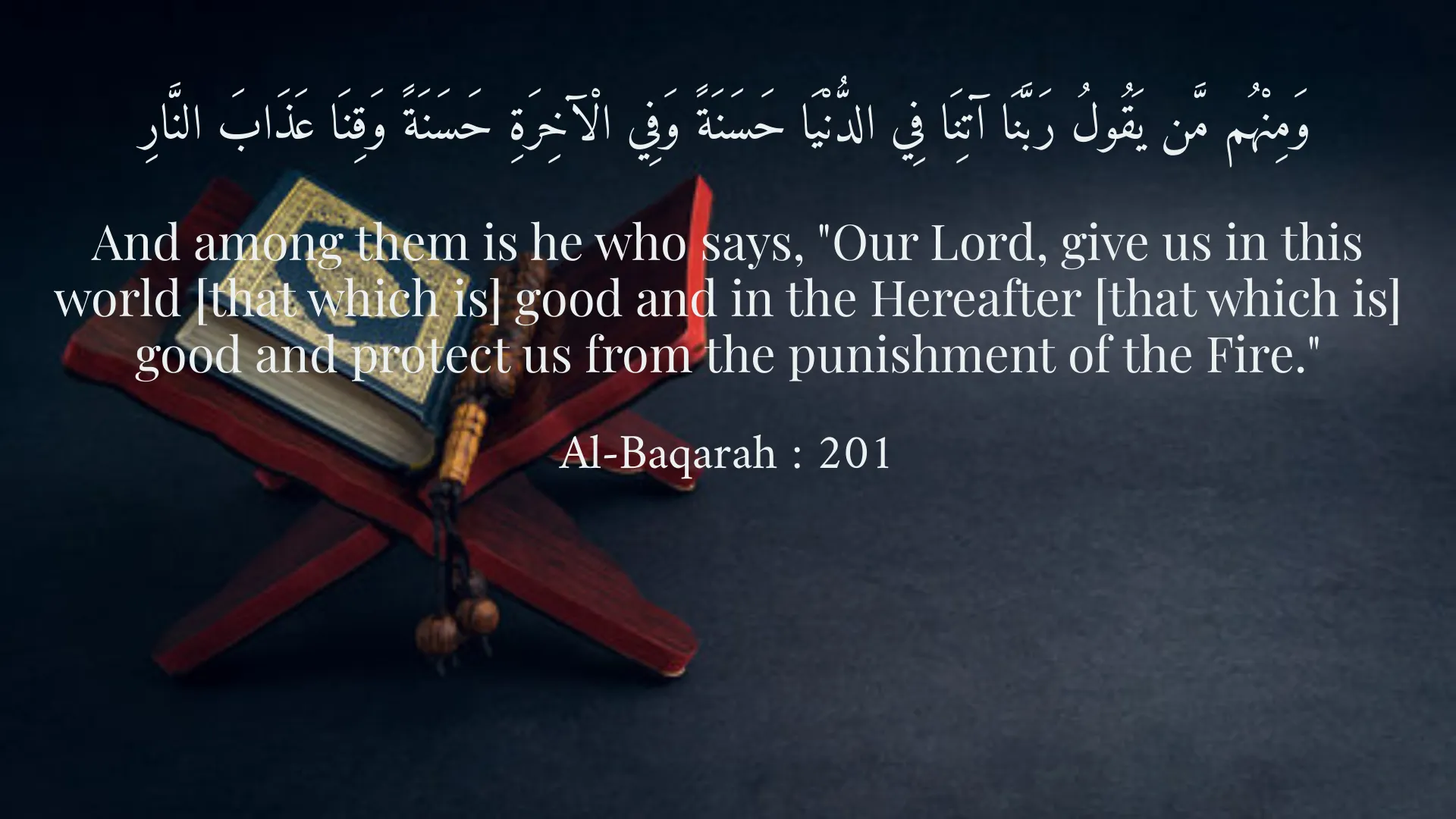
وَمِنْهُم مَّن يَقُولُ رَبَّنَا آتِنَا فِي الدُّنْيَا حَسَنَةً وَفِي الْآخِرَةِ حَسَنَةً وَقِنَا عَذَابَ النَّارِ
And among them is he who says, "Our Lord, give us in this world [that which is] good and in the Hereafter [that which is] good and protect us from the punishment of the Fire."
Al-Baqarah : 201
وَابْتَغِ فِيمَا آتَاكَ اللَّهُ الدَّارَ الْآخِرَةَ ۖ وَلَا تَنسَ نَصِيبَكَ مِنَ الدُّنْيَا ۖ وَأَحْسِن كَمَا أَحْسَنَ اللَّهُ إِلَيْكَ ۖ وَلَا تَبْغِ الْفَسَادَ فِي الْأَرْضِ ۖ إِنَّ اللَّهَ لَا يُحِبُّ الْمُفْسِدِينَ
But seek, through that which Allah has given you, the home of the Hereafter; and [yet], do not forget your share of the world. And do good as Allah has done good to you. And desire not corruption in the land. Indeed, Allah does not like corrupters.
Al-Qasas : 77
مَن كَانَ يُرِيدُ حَرْثَ الْآخِرَةِ نَزِدْ لَهُ فِي حَرْثِهِ ۖ وَمَن كَانَ يُرِيدُ حَرْثَ الدُّنْيَا نُؤْتِهِ مِنْهَا وَمَا لَهُ فِي الْآخِرَةِ مِن نَّصِيبٍ
Whoever desires the harvest of the Hereafter - We increase for him in his harvest. And whoever desires the harvest of this world - We give him thereof, but there is not for him in the Hereafter any share.
Ash-Shura : 20
Short Story
It is recounted in Saadi's Gulistan that a just king had a clever vizier. One day, the king saw his vizier with his head bowed, looking sad. The king asked, "O Vizier, what troubles you so?" The vizier replied, "O King, I am worried about this fleeting and transient world, and that I might spend my entire life pursuing it and neglect the eternal abode." The king, with a kind smile, said, "O wise Vizier, God has created the blessings of this world for the comfort of His servants, so that they may benefit from them and be grateful. As the eloquent Saadi says: 'Whoever lives in this abode, seeks his daily bread. But the wise one is he who makes the world a means to the Hereafter, not one who sacrifices the Hereafter for the world.' He then continued: "The important thing is not to cling to the world and not to consider it the ultimate goal. If you wish, pray for your daily sustenance, for the health of your body, for aiding the oppressed, for building schools and hospitals. These are all divine blessings that can bring you closer to the Hereafter, provided you know who the true Owner of these blessings is and how you should utilize them. If wealth, status, and position become a means for obedience and service, then your prayer for this world is itself an act of worship." The vizier, enlightened by the wise king's words, understood that neither seeking the world in itself is bad, nor is detachment from it a sign of perfection. Rather, balance and proper utilization of it in the path of divine pleasure are the true wisdom. From then on, the vizier prayed for both his worldly needs and his Hereafter, and remained perpetually grateful to God.