Quranic Answer
Understanding the concept of 'self-love' and distinguishing it from 'selfishness' from the perspective of the Holy Quran is a deeply nuanced and profound matter. The Quran does not teach us to neglect or despise ourselves; rather, it encourages a balanced and constructive 'self-love' that is fundamentally about caring for one's soul and body to attain proximity to God and play a constructive role in society. In contrast, 'selfishness' refers to an excessive and exclusive focus on personal interests, pleasures, and desires, without regard for the rights of others, divine obligations, or the consequences of individual actions on the community. This type of selfishness, often accompanied by arrogance, pride, greed, and stinginess, is strongly condemned in the Quran. On one hand, the Quran emphasizes the importance of 'self-preservation' and 'saving oneself.' For instance, in Surah At-Tahrim, verse 6, Allah states: “O you who have believed, protect yourselves and your families from a Fire whose fuel is people and stones.” This verse clearly indicates that caring for one's spiritual and physical well-being, and striving for salvation from divine punishment, is not selfishness but a fundamental responsibility. This form of 'self-love' means elevating the soul, purifying the self, and cultivating moral virtues so that an individual can attain the state of Nafs al-Mutma'innah (the tranquil soul); a soul that is at peace and seeks the pleasure of its Lord. This includes taking care of the body as a divine trust, acquiring knowledge, and striving for personal development, provided that the ultimate goal is to serve God and His creation. An individual who truly loves themselves will not sacrifice their physical and spiritual health for fleeting pleasures, but will instead strive for spiritual perfection. This love for oneself propels an individual towards good deeds and avoidance of sins, knowing that every action has repercussions on their soul and destiny. Conversely, the Quran strongly opposes manifestations of selfishness and self-aggrandizement. Selfishness in the Quran is often expressed through terms like takabbur (arrogance), ghurur (pride), bukhl (stinginess), hirs (greed), and hubb ad-dunya (excessive love of worldly life). These traits stem from an individual making themselves the sole center of their universe, prioritizing their own desires and benefits above all else. In Surah Luqman, verse 18, Allah clearly warns: “And do not turn your cheek [in contempt] toward people and do not walk through the earth exultantly. Indeed, Allah does not like every self-deluded and boastful.” This verse directly condemns the pride and self-admiration that arise from excessive selfishness. One who considers themselves superior to others will infringe upon their rights, disrespect them, and fail to walk the path of justice and fairness. Stinginess (bukhl) is another prominent manifestation of selfishness that the Quran severely denounces. In Surah An-Nisa, verse 37, we read: “[Those] who are stingy and enjoin upon people stinginess and conceal what Allah has given them of His bounty. And We have prepared for the disbelievers a humiliating punishment.” Stinginess is the result of excessive love for wealth and self, which prevents an individual from spending what they have in the way of God and helping others. This trait not only hinders an individual’s spiritual growth but also pushes society towards inequality and injustice. The Quran encourages humanity in numerous verses to spend in charity and help the needy, which is the exact opposite of selfishness. Spending in charity is a manifestation of ithar (altruism) and 'preferring others over oneself,' which is considered among the highest moral virtues in Islam. Therefore, from the Quranic perspective, self-love, if it means caring for one's spiritual and physical health, purifying the soul, and striving for eternal salvation, is not selfishness but a necessity. This type of self-love leads an individual towards responsibility for themselves, their family, and society. However, if this self-love leads to arrogance, pride, stinginess, greed, and disregard for the rights of others, then it transforms into reprehensible selfishness, which is the root of many moral and social corruptions. The Quran consistently emphasizes balance and moderation; a balance in which an individual neither completely neglects themselves nor considers themselves the center of the universe. Rather, they see themselves as part of a greater whole, whose well-being is intertwined with the well-being of the whole and the pleasure of their Lord. This perspective establishes a strong connection between the individual and society and places self-love in service of society and the worship of God. In summary, Islam promotes a 'healthy and constructive self-love' that is based on elevating the soul and preparing for servitude to God and service to creation. This self-love includes preserving human dignity, cultivating moral virtues, and striving for perfection. Conversely, any form of 'selfishness' that leads to arrogance, stinginess, oppression, and disregard for the rights of others is strongly prohibited by the Quran. This subtle distinction is key to understanding the correct relationship between a human being and themselves, with others, and with the Creator of existence. One who truly loves themselves lives in a way that leads to success both in this world and the Hereafter, and this success is never achieved through pure selfishness and deviation from the path of truth and community.
Related Verses
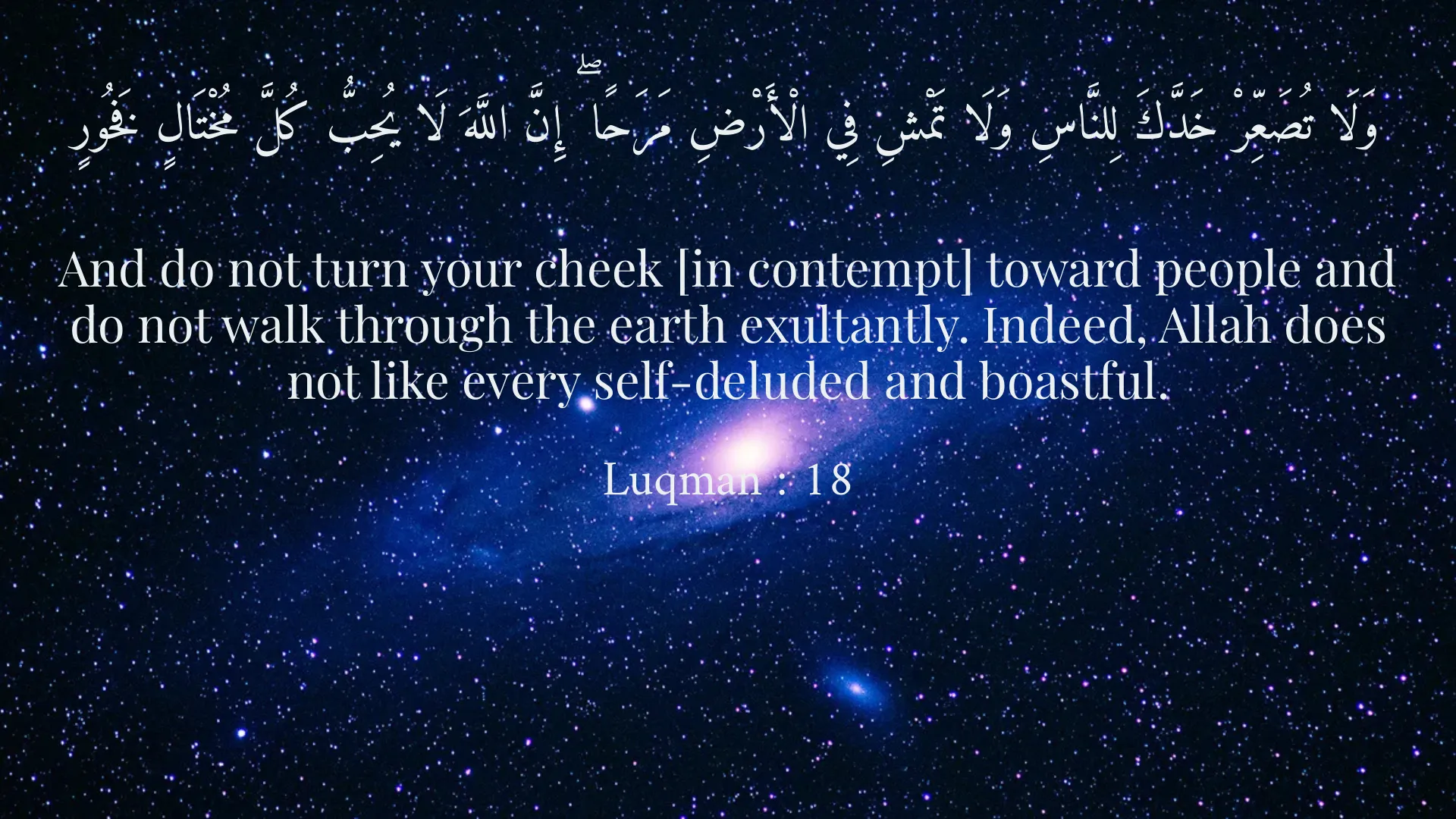
وَلَا تُصَعِّرْ خَدَّكَ لِلنَّاسِ وَلَا تَمْشِ فِي الْأَرْضِ مَرَحًا ۖ إِنَّ اللَّهَ لَا يُحِبُّ كُلَّ مُخْتَالٍ فَخُورٍ
And do not turn your cheek [in contempt] toward people and do not walk through the earth exultantly. Indeed, Allah does not like every self-deluded and boastful.
Luqman : 18
الَّذِینَ یَبْخَلُونَ وَیَأْمُرُونَ النَّاسَ بِالْبُخْلِ وَیَکْتُمُونَ مَا آتَاهُمُ اللَّهُ مِن فَضْلِهِ ۗ وَأَعْتَدْنَا لِلْکَافِرِینَ عَذَابًا مُّهِینًا
[Those] who are stingy and enjoin upon people stinginess and conceal what Allah has given them of His bounty. And We have prepared for the disbelievers a humiliating punishment.
An-Nisa : 37
يَا أَيُّهَا الَّذِينَ آمَنُوا قُوا أَنفُسَكُمْ وَأَهْلِيكُمْ نَارًا وَقُودُهَا النَّاسُ وَالْحِجَارَةُ عَلَيْهَا مَلَائِكَةٌ غِلَاظٌ شِدَادٌ لَّا يَعْصُونَ اللَّهَ مَا أَمَرَهُمْ وَيَفْعَلُونَ مَا يُؤْمَرُونَ
O you who have believed, protect yourselves and your families from a Fire whose fuel is people and stones, over which are [appointed] angels, harsh and severe; they do not disobey Allah in what He commands them but do what they are commanded.
At-Tahrim : 6
Short Story
It is narrated in Saadi's Golestan that there was a wealthy and stingy king whose sole concern was accumulating riches. He turned away from spending in the way of God and helping the needy. Day and night, he pondered how to preserve his wealth, and in his fear of its diminishing, he found no peace. In the same city lived a simple-hearted dervish who, though owning nothing, shared whatever little he acquired with others, and his heart was filled with contentment and tranquility. One day, the king saw the dervish from his palace window, smiling as he shared a piece of bread with a beggar. The king, surprised, said: "How is it that he, who has nothing, is so calm and carefree, while I, with all this wealth, live in constant fear and anxiety?" One of those present replied: "O King, he has found his wealth in giving and in a heart free from need, while you have found your wealth in hoarding and fear; one has liberated his heart and the other is a slave to his possessions. The dervish's peace comes from seeing self-love in generosity and purity, not in accumulation and selfishness."