Quranic Answer
### The Condemnation of Oppression and Corruption in the Holy Quran Oppression and corruption are two of the most severe moral failings that can exist within society, leading to the degradation of human dignity and the disintegration of social cohesion. In the Holy Quran, these issues are not just peripheral concerns; they are fundamentally condemned, and believers are urged to actively combat them. Throughout its verses, the Quran lays out principles of justice, equity, and the imperative of standing against tyranny. By considering various relevant passages, we can appreciate the depth of this condemnation and the active role that faith requires of its followers. #### The Call to Justice in Surah An-Nisa A pivotal verse that encapsulates the Quran's stance against oppression is found in Surah An-Nisa (Chapter 4), verse 135. Allah commands the believers: "O you who have believed, be persistently standing firm in justice, witnesses in justice, and do not let the hatred of a people prevent you from being just." This verse recognizes that standing firm in justice is a duty for all believers. It articulates the expectation that individuals must fulfill their obligation to uphold justice regardless of personal biases or societal pressures. The command not to let hatred sway one's judgment serves as a potent reminder that fairness is a divine mandate that must override personal grievances or adversities. The urgency of this instruction reveals that silence in the face of oppression is tantamount to complicity, a notion that resonates deeply with Islamic teachings. #### The Responsibility of the Best Nation Another important verse highlighting the duty of believers to uphold righteousness and prevent wrongdoing is found in Surah Al-Imran (Chapter 3), verse 110: "You are the best nation produced for mankind. You enjoin what is right and forbid what is wrong and believe in Allah." This verse sets forth the notion that the Muslim community holds a special responsibility in the world. Being described as the "best nation" carries with it the obligation to guide others toward virtue and away from vice. The emphasis on enjoining the right and forbidding the wrong establishes a proactive stance; it is not enough for believers to merely avoid participating in wrongdoing; they must actively strive to encourage righteous behavior among their peers. This proactive engagement creates a moral fabric in society that directly opposes oppression and corruption. It illustrates that the cultivation of a just and equitable environment is not merely a personal endeavor, but rather a collective responsibility that reinforces social welfare and integrity. #### The Dangerous Silence The Quran's admonitions about the necessity for action in the face of injustice illuminate a significant theological principle; that the consequences of inaction can be dire. When believers choose to remain silent, particularly in the face of oppression, they contribute to the perpetuation of unjust systems. The belief that one can passively witness wrongs without taking a stand against them is fundamentally at odds with Islamic teachings. This perspective aligns with numerous modern social justice movements, which advocate for active participation in the fight against social ills. The prophetic tradition further reinforces this concept. A famous narration from Prophet Muhammad (peace be upon him) states: "If one sees a wrongdoing and cannot prevent it, he should at least despise it in his heart." This narration stresses that moral disapproval is indispensable, even in instances where physical intervention is not feasible. The internal response of disapproval acts as a catalyst for acknowledging wrongs and encourages believers to seek solutions within their capacity. Silence, in this teaching, is not an option but rather a failure to uphold one's moral responsibilities. #### The Importance of Community Engagement In an age where social and political conflicts continue to escalate around the globe, the role of a believer extends beyond individual piety to encompass community engagement and activism against oppression. The Quran presents a comprehensive framework for addressing injustice, empowering believers to embody principles of equity and justice. The active pursuit of justice is a reflection of one's faith, and silence, conversely, signifies a disconnection from that faith. Communities must encourage discussions around oppression and injustice, mobilizing members to educate themselves about the issues affecting them and those around them. By fostering an understanding of the Quran’s teachings on justice, individuals can better recognize the structures of power in their societies that perpetuate inequality and corruption. #### Muslims as Advocates for Justice Moreover, the global Muslim community has a critical role in advocating for justice beyond their borders. Whether through supporting humanitarian efforts, engaging in advocacy, or simply speaking out against tyranny, Muslims are positioned to serve as advocates for justice on a broader scale. This is not merely a personal duty; it is an obligation grounded in faith that extends to the entire community. From the Middle East to Africa, and even in Western nations, Muslims have historically stood up against oppression—be it through activism, education, or community service. The values instilled in Muslims by the Quran serve as a guiding light for such endeavors. #### Conclusion In summary, the teachings within the Holy Quran regarding oppression and justice are clear and profound. Believers are called to take a firm stand against wrongdoings, embodying values of justice, equity, and moral responsibility. Silence against oppression is consistently portrayed not only as unwise but as impermissible. It is imperative for Muslims to internalize these teachings, ensuring that they not only avoid complicity in injustices but actively participate in combating them. By embodying the principles derived from the Quran, believers serve as beacons of hope, fighting against oppression and championing the cause of justice in every way possible.
Related Verses
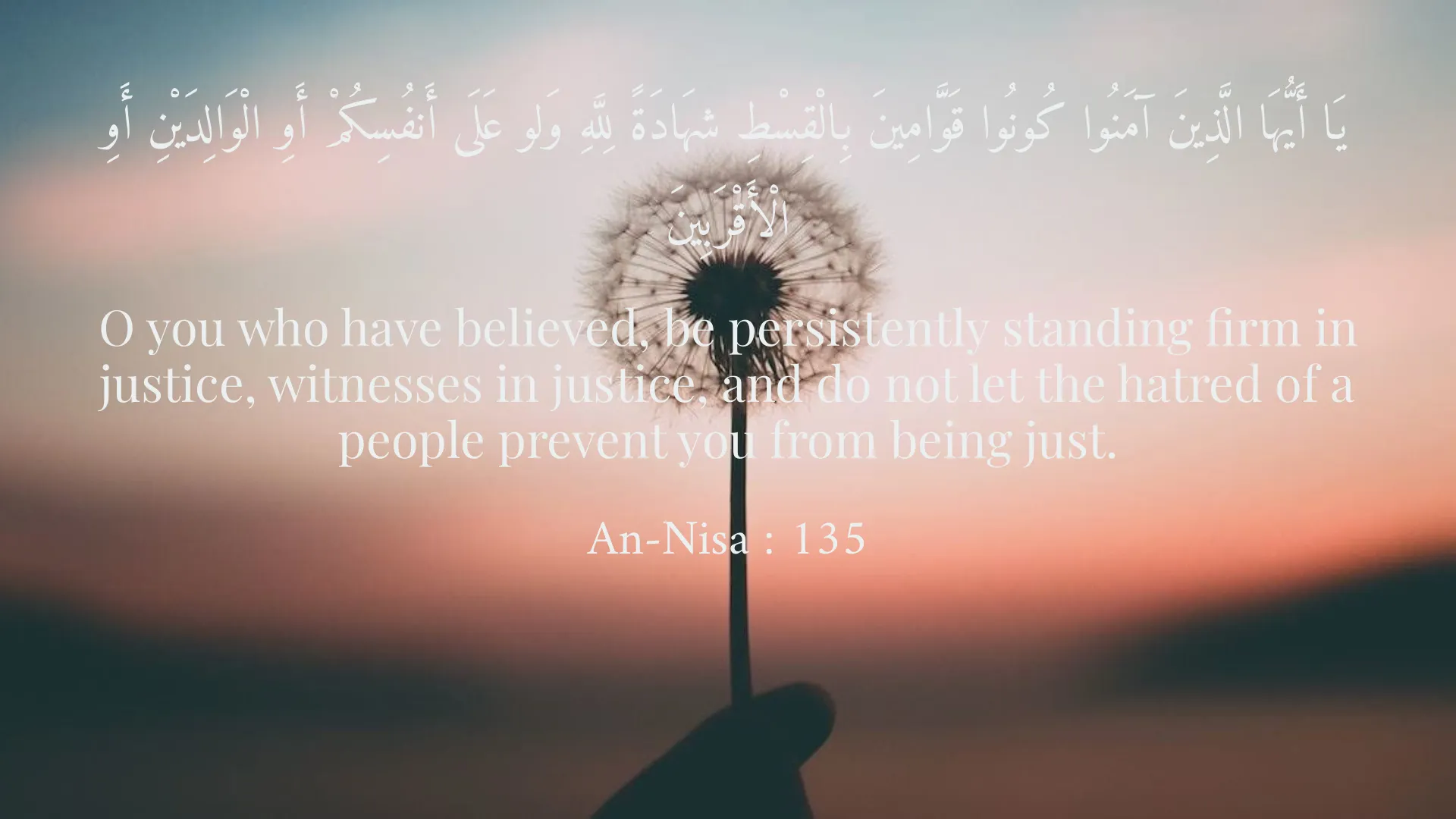
يَا أَيُّهَا الَّذِينَ آمَنُوا كُونُوا قَوَّامِينَ بِالْقِسْطِ شهَادَةً لِلَّهِ وَلو عَلَى أَنفُسِكُمْ أَوِ الْوَالِدَيْنِ أَوِ الْأَقْرَبِينَ
O you who have believed, be persistently standing firm in justice, witnesses in justice, and do not let the hatred of a people prevent you from being just.
An-Nisa : 135
كُنتُمْ خَيْرَ أُمَّةٍ أُخْرِجَتْ لِلنَّاسِ تَأْمُرُونَ بِالْمَعْرُوفِ وَتَنْهَوْنَ عَنْ الْمُنكَرِ وَتُؤْمِنُونَ بِاللَّهِ
You are the best nation produced for mankind. You enjoin what is right and forbid what is wrong and believe in Allah.
Al-Imran : 110
Short Story
Once, a man lived in a city where the ruler was extremely oppressive, and the people lived in silence and fear. This man vowed never to remain silent in the face of injustice. One day, he stood among the people and raised his voice against the ruler's tyranny. Soon, others found courage and joined him. Their silence broke, and gradually, the people began to rise for freedom and justice. This story serves as a reminder of the power of a person's voice against oppression.