Quranic Answer
From the profound and rich teachings of the Holy Quran, the answer to the question of whether success is always a sign of being on the right path is a resounding “no.” The Islamic understanding of success fundamentally differs from the prevailing and purely material interpretation in today's world. The Quran teaches us that true success lies not in the accumulation of wealth, power, fame, or worldly positions, but rather in attaining divine pleasure, purity of soul, piety (Taqwa), justice, and adherence to moral and spiritual values. This is a fundamental difference in perspective that transforms one's entire worldview. Many individuals throughout history, and even in contemporary times, have achieved remarkable material success, but these achievements have not only failed to indicate the correctness of their path but have sometimes led them further astray and to their ultimate downfall. Pharaoh is a prime example of this situation; despite his boundless power and wealth, he symbolized rebellion and misguidance and ultimately perished. Qarun, with all his treasures and riches, was eventually swallowed by the earth due to his arrogance and pride, even though he was considered the most 'successful' person of his time in material terms. The Holy Quran explicitly states that possessions and children can be a fitnah for humans, meaning a means of test and trial. In Surah Al-Anfal, verse 28, we read: "And know that your properties and your children are but a trial and that with Allah is a great reward." This verse indicates that worldly successes can be tools to gauge our faith and piety. Do we use these assets in the way of Allah, or do we let them become a source of pride and rebellion? Do we raise our children according to divine teachings, or do we steer them towards materialism? These are the questions inherent in the concept of fitnah. Sometimes, worldly success, even for those who have deviated from the right path, is presented as a form of istidraj or gradual allowance by Allah. Istidraj means that Allah bestows more blessings and successes upon a sinful and rebellious individual, allowing them to sink deeper into misguidance, ultimately leading to a more severe punishment. This is a divine strategy that appears as a reward but is, in reality, a form of torment. In Surah Al-A'raf, verse 182, it states: "And those who deny Our signs - We will progressively lead them [to destruction] from where they perceive not." This verse clearly shows that apparent success for some individuals can be a result of this divine allowance, not a sign of Allah's pleasure. Conversely, the Quran repeatedly emphasizes that the true reward and real success are in the Hereafter. Worldly life is fleeting and transient, and all its pleasures and achievements are insignificant and worthless compared to eternity. In Surah Al-Imran, verse 185, it says: "Every soul will taste death, and you will only be given your [full] compensation on the Day of Resurrection. So whoever is drawn away from the Fire and admitted to Paradise has succeeded. And what is the life of this world except the enjoyment of delusion." This verse clearly defines the criteria for true success: salvation from Hellfire and entry into Paradise. This is the success that is lasting and eternal, not temporary worldly achievements. Therefore, to determine the correctness of one's path, one should not look solely at apparent and material outcomes. Instead, one must pay attention to Quranic criteria: Does the person possess divine piety? Does he or she fulfill divine obligations and avoid prohibitions? Does he or she respect people's rights and uphold justice? Does he or she show patience in the face of difficulties and put trust in Allah? Are their actions consistent with divine pleasure? These are the primary indicators of the right path. A person might be in financial distress or face numerous challenges, yet be close to Allah and on the correct path. Conversely, a person might be at the pinnacle of prosperity and power but have spiritually fallen and be on the wrong path. The Quran teaches us to always look at the inner essence of matters and the ultimate outcome, not just fleeting appearances. Consequently, worldly success is a deceptive indicator and cannot be considered a definitive criterion for the right path; rather, the true criteria are internal and spiritual, which determine the path to felicity. Ultimately, this message from the Holy Quran reminds us to build our values and priorities upon truth and permanence, not upon transient material possessions. True success is treading the path of servitude and obedience to divine commands, even if we face worldly hardships and deprivations along this path. For the end of this path is eternal felicity and salvation, with which no worldly success can compare. It is crucial to deeply consider that Allah says in Surah Luqman, verse 27: "And if whatever trees on earth were pens and the sea [was ink], prolonged thereafter by seven [more] seas, the words of Allah would not be exhausted. Indeed, Allah is Exalted in Might and Wise." Although this verse is not directly about success, it subtly points to the vastness and boundlessness of divine knowledge and wisdom, which is beyond limited human comprehension. Therefore, the divine criteria for 'right' and 'wrong' and 'success' transcend our notions of fleeting worldly happiness. True salvation depends on following divine wisdom and joining the caravan guided by the light of the Quran, not by the false and transient glimmers of this world. In summary, the Quran warns us not to be deceived by appearances and to derive the criteria for discerning the right path from divine sources. The only path that leads to eternal salvation and the pleasure of the Lord is one built upon piety, faith, righteous deeds, patience, and trust in Allah, regardless of how much material or apparent success one may achieve on this path. This perspective provides profound peace and insight, ensuring that one does not go astray amidst life's complexities and always keeps the ultimate purpose of one's creation in mind.
Related Verses
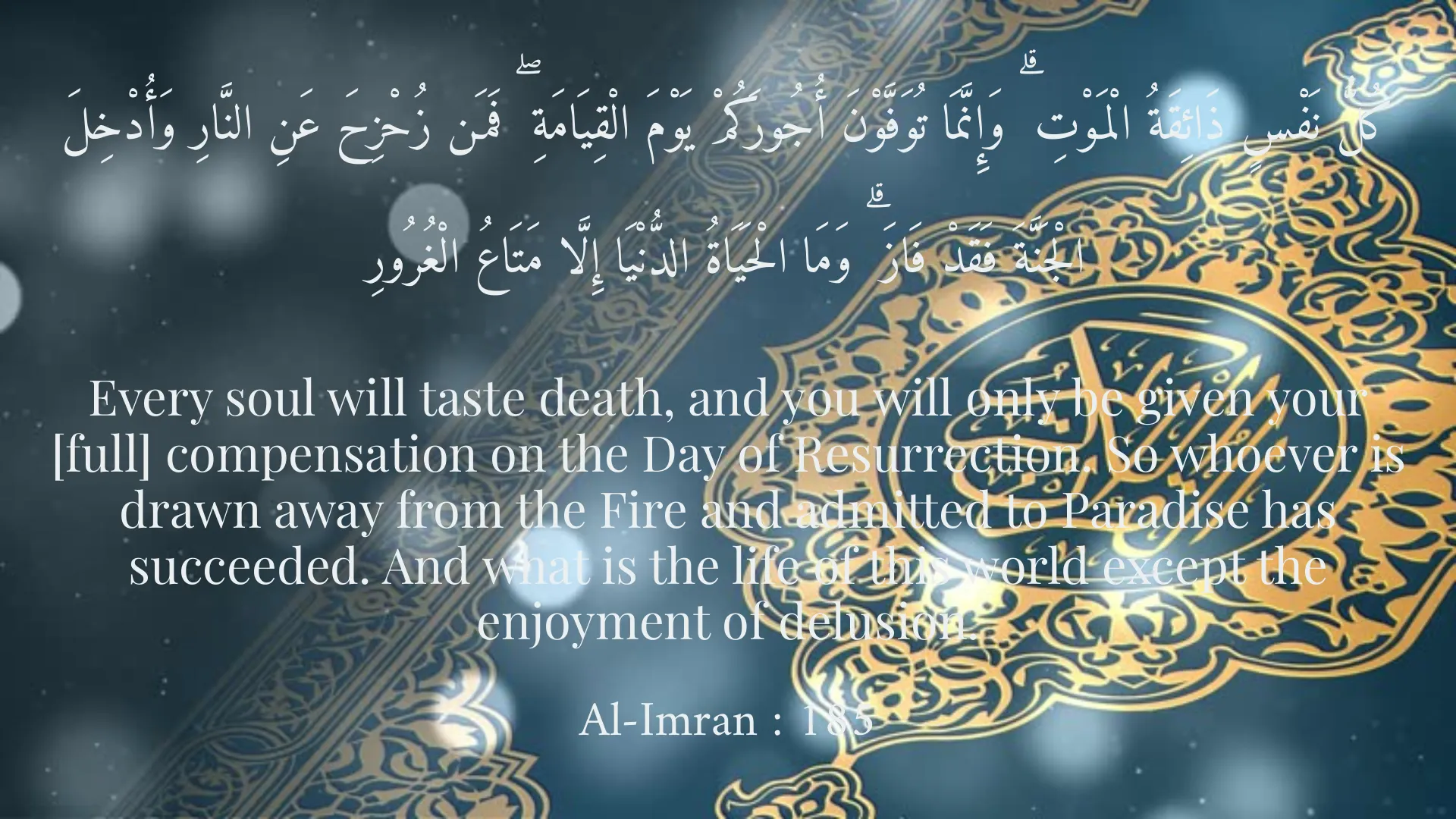
كُلُّ نَفْسٍ ذَائِقَةُ الْمَوْتِ ۗ وَإِنَّمَا تُوَفَّوْنَ أُجُورَكُمْ يَوْمَ الْقِيَامَةِ ۖ فَمَن زُحْزِحَ عَنِ النَّارِ وَأُدْخِلَ الْجَنَّةَ فَقَدْ فَازَ ۗ وَمَا الْحَيَاةُ الدُّنْيَا إِلَّا مَتَاعُ الْغُرُورِ
Every soul will taste death, and you will only be given your [full] compensation on the Day of Resurrection. So whoever is drawn away from the Fire and admitted to Paradise has succeeded. And what is the life of this world except the enjoyment of delusion.
Al-Imran : 185
وَاعْلَمُوا أَنَّمَا أَمْوَالُكُمْ وَأَوْلَادُكُمْ فِتْنَةٌ وَأَنَّ اللَّهَ عِندَهُ أَجْرٌ عَظِيمٌ
And know that your properties and your children are but a trial and that with Allah is a great reward.
Al-Anfal : 28
وَالَّذِينَ كَذَّبُوا بِآيَاتِنَا سَنَسْتَدْرِجُهُم مِّنْ حَيْثُ لَا يَعْلَمُونَ
And those who deny Our signs - We will progressively lead them [to destruction] from where they perceive not.
Al-A'raf : 182
Short Story
Once upon a time, during Saadi's era, there lived a very wealthy and successful merchant who possessed immense riches and profited greatly from every venture he undertook. He was full of arrogance and pride, believing that these successes were a sign of his superiority and the correctness of his path. Whenever someone sought his advice, he would boastfully say, “See how God loves and blesses me!” In the same city, there lived a simple-hearted dervish, a pure-hearted mystic who owned no worldly possessions but whose heart was full of the light of faith and piety. People loved him and sought his spiritual guidance. One day, the merchant arrogantly said to the dervish, “O Dervish, what has become of you that you live such a poor life? Do you not see that God has bestowed all His blessings upon me and made me successful?” The dervish smiled and said, “My friend, in the journey of life, true success lies in a pure heart and a soul free from the bondage of the world. Sometimes, God grants worldly wealth to those who have forgotten Him, so they may sink deeper into heedlessness, thinking they are beloved by Him, when in reality it is merely a test. And sometimes, He tests those who love Him with poverty, so their faith may become stronger. Remember that the end of any path is the criterion for its correctness, not its dazzling beginning.” The merchant pondered these words, and later, following the changes of fortune and the loss of his wealth, he came to understand the truth of the dervish's words and realized that the real measure is not what one gains, but with what intention and on which path one treads.