Quranic Answer
The feeling of emptiness and meaninglessness is a profound human experience that many individuals encounter throughout their lives. This feeling can manifest in various ways, from a sense of aimlessness and lack of motivation to an inner void that no material success or worldly pleasure seems capable of filling. From the perspective of the Holy Quran, this feeling of emptiness can be a strong sign and a warning from the human soul and its innate disposition (fitra), indicating a deviation from the primary path and purpose of creation: connecting with the Creator and adhering to divine teachings. The Quran does not explicitly state that 'feeling empty' is synonymous with 'being lost,' but it clearly links inner peace to the remembrance of Allah and, conversely, attributes a life of hardship and discomfort to turning away from His remembrance. The human heart, according to Quranic teachings, is a vessel that finds true tranquility and assurance only through the remembrance of Allah Almighty. In Surah Ar-Ra'd, verse 28, we read: “Those who have believed and whose hearts are assured by the remembrance of Allah. Unquestionably, by the remembrance of Allah hearts are assured.” This verse clearly indicates that the primary source of inner peace and tranquility is the remembrance of God. Therefore, when an individual experiences a feeling of emptiness, it can be understood as a sign of a deficiency or heedlessness regarding this vital source. This feeling is not necessarily a punishment but rather an internal alarm bell, inviting the individual to reassess their priorities and return to the original source of peace. The Quran also warns about the consequences of turning away from the remembrance of Allah. In Surah Taha, verse 124, it states: “And whoever turns away from My remembrance - indeed, he will have a constricted life, and We will gather him on the Day of Resurrection blind.” The phrase “Ma’ishatan Dhanka” (a constricted life) can be interpreted as a life accompanied by distress, anxiety, restlessness, and precisely this feeling of emptiness and inner dissatisfaction, even if the individual is materially prosperous. This indicates that true happiness and peace are found not in the accumulation of wealth and status but in a spiritual connection with the Creator. Emptiness, in this framework, can be a reflection of that “Ma’ishatan Dhanka,” which is a natural consequence of moving away from the central axis of life, namely the remembrance and servitude to God. The human innate disposition (fitra) is created upon monotheism and the knowledge of God. The Quran states that the purpose of creating jinn and mankind is solely to worship Allah: “And I did not create the jinn and mankind except to worship Me.” (Surah Adh-Dhariyat, verse 56). When a person deviates from this fundamental purpose, their life becomes devoid of true meaning. Just as the body needs nourishment, the soul also requires spiritual sustenance. Neglecting spiritual needs leads to spiritual malnutrition and consequently, a feeling of emptiness. This feeling is like the pain of hunger for the soul, signaling a lack of something vital. Furthermore, in Surah Al-An'am, verse 125, the Quran describes the state of the hearts of those who turn away from guidance: “So whoever Allah intends to guide - He expands his breast to [receive] Islam; and whoever He intends to misguide - He makes his breast tight and constricted as though he were climbing into the sky. Thus does Allah place defilement upon those who do not believe.” The constriction of the breast can be a metaphor for the same distress, spiritual suffocation, and feeling of emptiness, contrasting with the expansion of the breast and the peace that comes from faith and submission to Allah. Therefore, the feeling of emptiness can be regarded as a sign, a wake-up call, and a divine invitation to return to one's true self and reconnect with the source of existence. This feeling provides an opportunity for individuals to reflect on their life path, seek a deeper meaning, and fill this inner void by strengthening their connection with Allah through prayer, supplication, recitation of the Quran, contemplation of divine verses, and serving humanity. This emptiness, instead of being an obstacle, can transform into a catalyst for spiritual growth and finding the divine path, a path abundant with tranquility, purpose, and inner contentment. Ultimately, the Holy Quran posits that the remedy for this emptiness lies in returning to the monotheistic nature (fitra), believing in the unseen, and performing righteous deeds, all of which lead to a meaningful life filled with divine satisfaction.
Related Verses
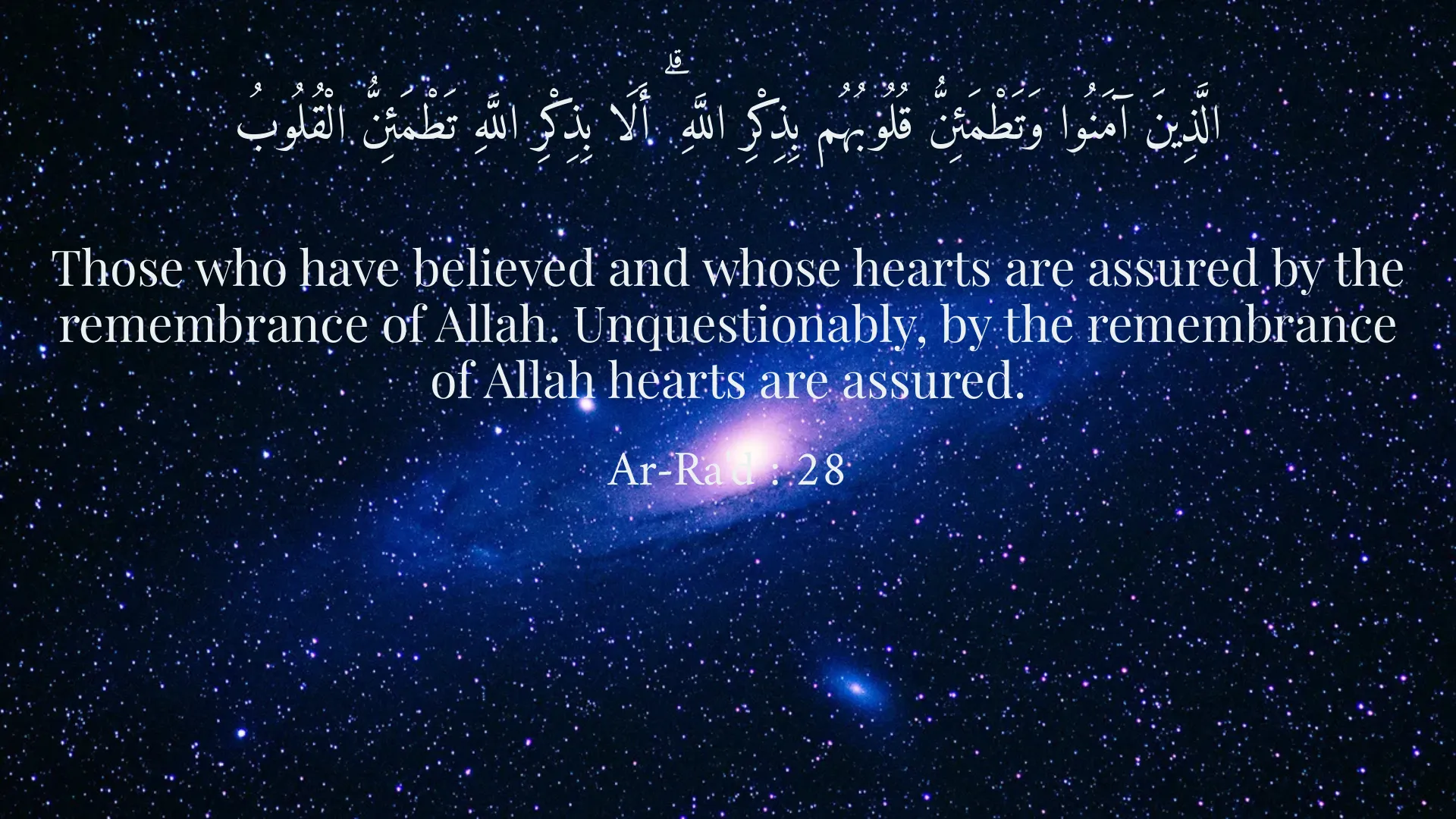
الَّذِينَ آمَنُوا وَتَطْمَئِنُّ قُلُوبُهُم بِذِكْرِ اللَّهِ ۗ أَلَا بِذِكْرِ اللَّهِ تَطْمَئِنُّ الْقُلُوبُ
Those who have believed and whose hearts are assured by the remembrance of Allah. Unquestionably, by the remembrance of Allah hearts are assured.
Ar-Ra'd : 28
وَمَنْ أَعْرَضَ عَن ذِكْرِي فَإِنَّ لَهُ مَعِيشَةً ضَنكًا وَنَحْشُرُهُ يَوْمَ الْقِيَامَةِ أَعْمَىٰ
And whoever turns away from My remembrance - indeed, he will have a constricted life, and We will gather him on the Day of Resurrection blind.
Taha : 124
فَمَن يُرِدِ اللَّهُ أَن يَهْدِيَهُ يَشْرَحْ صَدْرَهُ لِلْإِسْلَامِ ۖ وَمَن يُرِدْ أَن يُضِلَّهُ يَجْعَلْ صَدْرَهُ ضَيِّقًا حَرَجًا كَأَنَّمَا يَصَّعَّدُ فِي السَّمَاءِ ۚ كَذَٰلِكَ يَجْعَلُ اللَّهُ الرِّجْسَ عَلَى الَّذِينَ لَا يُؤْمِنُونَ
So whoever Allah intends to guide - He expands his breast to [receive] Islam; and whoever He intends to misguide - He makes his breast tight and constricted as though he were climbing into the sky. Thus does Allah place defilement upon those who do not believe.
Al-An'am : 125
Short Story
In Saadi's Golestan, it is narrated that a wealthy and magnificent king, despite possessing everything, always carried a feeling of restlessness and emptiness in his heart. Sleep eluded his eyes at night, and during the day, he found no joy in his kingdom, servants, or entourage. Suffering from this condition, he one day sought out an ascetic dervish who lived in solitude yet had a serene face and a joyful heart. The king asked, “O wise elder, I, who possess so much wealth and power, why do I never find peace, and why is my heart always empty? But you, who have nothing, where have you found such joy and tranquility?” The dervish smiled and said, “O King, you have entrusted your heart to things that are perishable and will never last. Your heart is like a vessel you try to fill with seawater, yet the sea itself is boundless, and the more you take, the more emptiness you will see. But I have entrusted my heart to the Creator of the sea, who never perishes and whose existence never diminishes. The human heart can only be filled by connecting with Him. Your heart's emptiness is a sign that your gaze is fixed on the carpet of the house, instead of the Owner of the house.” The king understood from this statement that true peace lies in connecting with the infinite source, not in accumulating the limited possessions of the world. After that, he devoted himself more to the remembrance of God, and his life became full of peace and meaning.