Quranic Answer
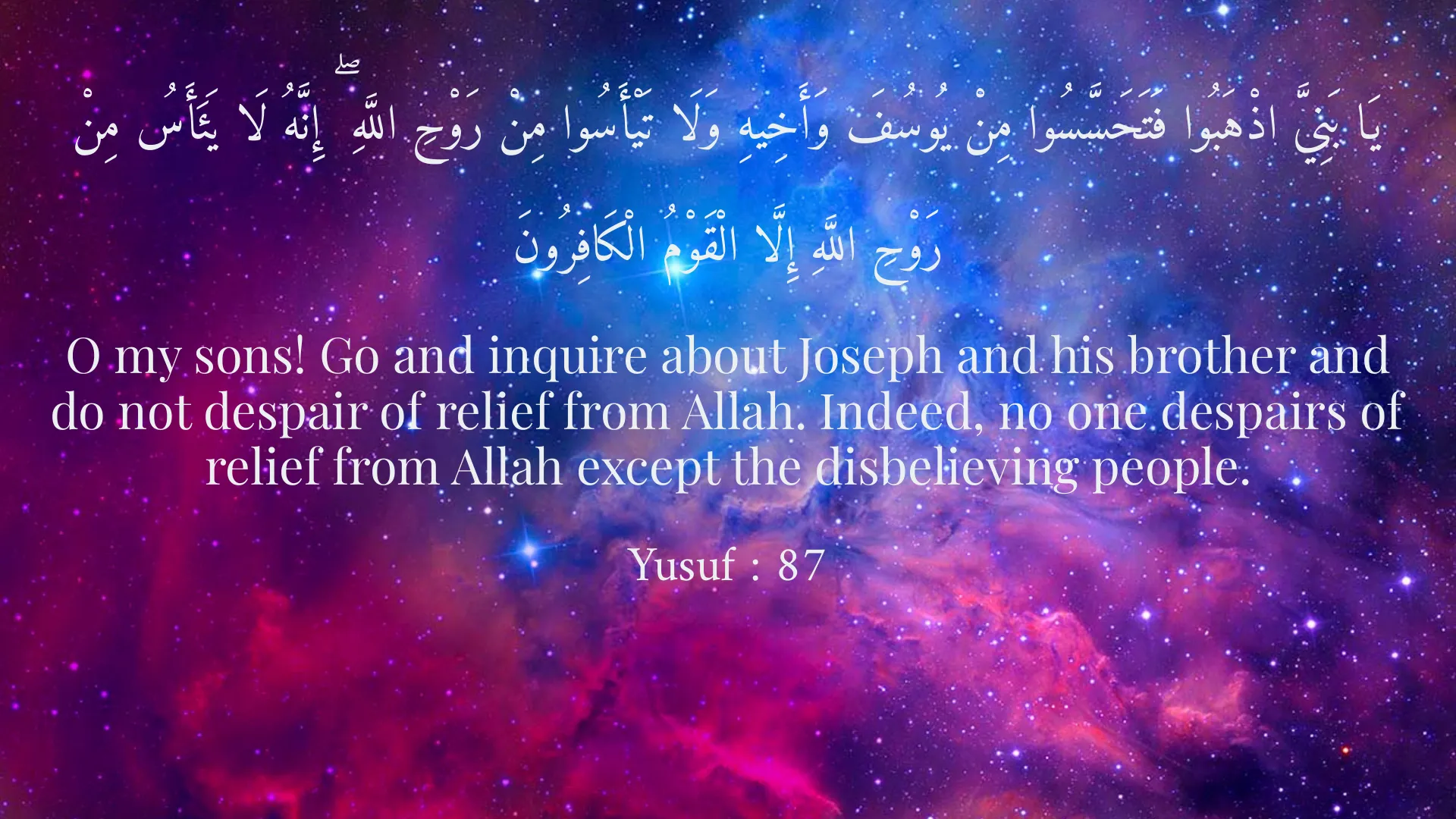
In Islam, the concept of wishing transcends mere desire; it embodies a positive mindset rooted in hope and faith. The Quran, as the holy text of Islam, encourages believers to maintain a hopeful outlook on life, to aspire for betterment, and to persist in their endeavors despite challenges. This philosophy not only fosters individual resilience but also serves as a foundation for communal harmony and growth. A pivotal reference within the Quran that illustrates the profound importance of hope and positive desires is found in Surah Yusuf. In verse 87, Prophet Jacob (Yaqub) advises his sons in a time of deep sorrow and uncertainty: 'O my sons! Go and inquire about Joseph and his brother and do not despair of relief from Allah. Indeed, no one despairs of relief from Allah except the disbelieving people.' This verse encapsulates the core belief in Islam that even in the direst of situations, one must not surrender to despair. Instead, one is encouraged to cultivate hope and actively pursue positive outcomes. The exhortation against despair in this verse holds immense significance, especially in a world often plagued by turmoil and disillusionment. For Muslims, maintaining hope is not simply recommended; it is a fundamental aspect of faith. The teachings of Islam emphasize that hope should accompany every wish, guiding individuals to foster aspirations that are not only personally gratifying but also beneficial to society. In essence, wishing in Islam is not an isolated act of longing but a conscious commitment to pursuing a path of righteousness and virtue. However, it is crucial to navigate the landscape of desires with a discerning mind—wishes must align with moral principles and the values espoused by Islam. Islam does not advocate for blind wishes devoid of ethical considerations. Instead, it invites adherents to align their aspirations with the teachings of the Quran and the Sunnah (the practices of the Prophet Muhammad). For example, wishing for success in one's profession, the attainment of knowledge, or the personal development that contributes positively to the community is not only permissible but is encouraged. These aspirations reflect a desire for both personal growth and the enhancement of community welfare. On the contrary, desiring things that contradict Islamic principles, such as engaging in illicit activities, harboring resentment, or wishing harm upon others, stands in stark opposition to the ethical framework of Islam. Such wishes not only cast aside the tenets of faith but also lead to moral decay and societal discord. Thus, there is a clear dichotomy presented within Islamic teachings: wishes rooted in the pursuit of goodness and harmony are endorsed, whereas those stemming from negativity or harm are condemned. Moreover, Islam emphasizes the importance of not just wishing, but striving to fulfill those wishes. While having positive aspirations is essential, they cannot come to fruition without dedicated effort and reliance on divine assistance. In doing so, believers are encouraged to seek Allah’s guidance and support in their endeavors. This act of seeking assistance from Allah is a fundamental element of a Muslim’s life, reinforcing the relationship between the individual and their Creator. To further exemplify this principle, one can consider a scenario in which an individual wishes to excel academically. The process begins with making a sincere intention to succeed, followed by allocating time for study, seeking knowledge, and taking advantage of available resources. In this regard, wishing for academic success evolves into actionable steps that align with the ethical guidance of Islam. This pathway not only brings personal satisfaction but also contributes to the betterment of the community by fostering educated individuals who can influence society positively. The concept of du’a (supplication) also plays a pivotal role in merging wishes with divine guidance. Muslims believe that supplicating to Allah with sincere intentions for good outcomes is crucial in the fulfillment of their wishes. Du’as serve as a means for reflecting one’s desires in the light of humility and surrender. When a believer asks Allah for assistance in their pursuits, they acknowledge that their accomplishments are not solely attributable to personal effort, but are ultimately dependent on divine will. In this context, wishing becomes a beautiful interplay between aspiration and faith, grounded in the supplicant's commitment to righteousness. In sum, wishing within the paradigm of Islam emerges as a multifaceted concept where hope, intention, and action converge. Believers are called to maintain a hopeful outlook, aligning their desires with ethical principles while striving to achieve them earnestly. The teachings of the Quran underscore that true fulfillment comes not through mere longing but through a balanced approach that incorporates effort, prayer, and ethical consideration. Positive wishes and aspirations do not only transform the individual's life but also pave the way for broader societal benefits. Conclusively, wishing within Islam is a guiding light that urges Muslims to embrace optimism, harness their desires for good, and trust in the mercy and assistance of Allah, leading not only to personal enlightenment but to collective upliftment. Thus, reflecting on the teachings of Islam about hope and aspiration reveals the profound wisdom that guides Muslims in navigating the trials of life while remaining steadfast in their faith.
Related Verses
يَا بَنِيَّ اذْهَبُوا فَتَحَسَّسُوا مِنْ يُوسُفَ وَأَخِيهِ وَلَا تَيْأَسُوا مِنْ رَوْحِ اللَّهِ ۖ إِنَّهُ لَا يَئَأَسُ مِنْ رَوْحِ اللَّهِ إِلَّا الْقَوْمُ الْكَافِرُونَ
O my sons! Go and inquire about Joseph and his brother and do not despair of relief from Allah. Indeed, no one despairs of relief from Allah except the disbelieving people.
Yusuf : 87
Short Story
One day, a man named Salim went to the seaside in search of a suitable job. He always wished to succeed and create a better life for his family. From the Quran, he had learned that hope and wishes should be positive and aligned with God's will, so he always prayed for Allah's guidance in his quest. After some time of effort, Salim succeeded in finding a suitable job, and he was deeply thankful to Allah.