Quranic Answer
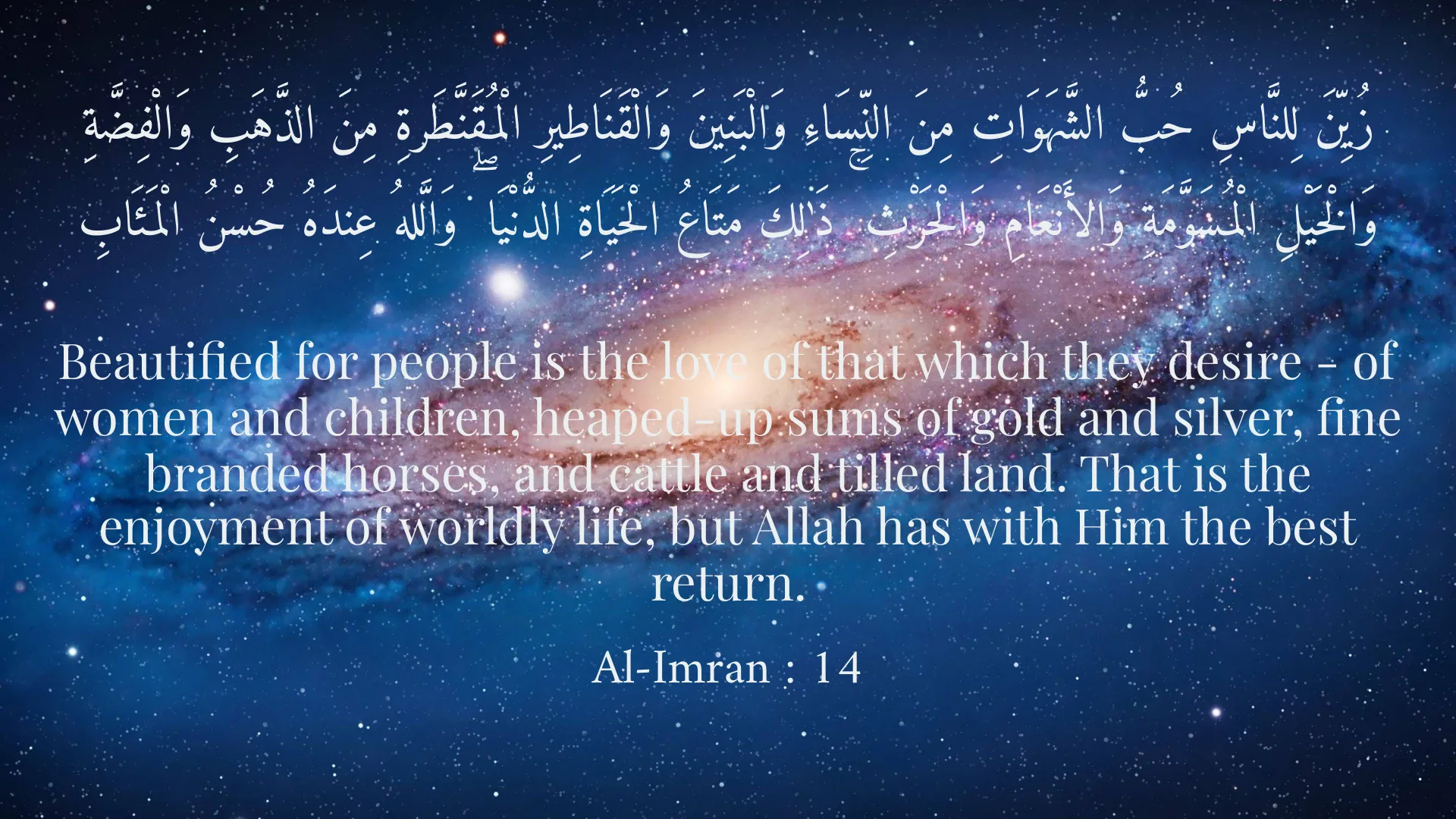
The concept of success has been a central theme in human life since time immemorial. Throughout history, societies have defined success in manifold ways, from wealth accumulation to the pursuit of knowledge and social standing. However, in the context of religious teachings, especially within the Holy Quran, the definition of success takes on a deeper and more comprehensive significance. In this context, worldly success is recognized as an important goal, but it is emphasized that true success transcends mere material achievement and lies within the framework of obedience to God and adherence to ethical and human principles. The Quran elucidates this perspective beautifully in Surah Al-Imran, verse 14, where Allah states, "Beautified for people is the love of that which they desire - of women and children, heaped-up sums of gold and silver, fine branded horses, tall (fine) sheep, and tilled land. That is the enjoyment of worldly life, but Allah has with Him the best return." This verse acknowledges the allure of worldly possessions and the things that bring enjoyment to people, but it also serves as a cautionary reminder that these are fleeting pleasures. The beauty of life’s adornments can easily distract one from the real purpose of existence, which is to engage in righteous deeds and to live a life of obedience to God. The Quranic perspective on worldly success posits that such achievements hold real value only when they are coupled with ethical actions such as honesty, fairness, and generosity. The true test of one's success is not merely the accumulation of wealth or status but rather the manner in which one attains these successes. For instance, if the pursuit of success leads individuals to disregard their religious obligations, indulge in dishonest dealings, or harm others in their quest for gain, such an approach to success bears no real worth in God’s eyes. Furthermore, the Quran offers profound insights regarding the fate of those who chase after worldly ambitions without regard for spiritual and ethical principles. In Surah An-Nisa, verse 54, Allah highlights this stark reality by stating, "Or do they envy the people for what Allah has given them of His bounty? But We had already given the family of Abraham the Scripture and wisdom and conferred upon them a great kingdom." This verse acknowledges that the disbelievers may strive for success and superiority in this world, but it warns them that without the consciousness of God and lawful practices, their endeavors will only lead to eventual punishment in the afterlife. The stark contrast between worldly success and spiritual fulfillment is further emphasized through the lens of eternal accountability. The pursuit of wealth and status, in isolation from righteous living and faith, leads to a superficial understanding of success. In light of these teachings, it becomes clear that success is not solely about personal achievements or societal recognition. Instead, it is intricately linked to our relationship with God and our responsibilities towards others. The Quran lays down the principle that worldly success should be intertwined with a sense of duty toward the Creator and fellow human beings. The impact of an individual's actions on their community and humanity at large is central to the notion of truly successful living. When one achieves success through sincerity, hard work, and ethical consideration, they establish a legacy that resonates beyond their temporal existence, impacting future generations. It is also essential to reflect on the ultimate purpose of one’s life as elaborated in the Quran. Life is a transitory phase, and worldly possessions are meant to serve as tests for ourselves. They are tools for growth, learning, and serving others, rather than mere ends in themselves. Thus, the perspective imparted by the Quran on worldly success challenges us to continuously assess our goals. Are we merely chasing after wealth? Or are we looking to create a better society, uplift the downtrodden, and build a legacy aligned with our faith? Given the contemporary pursuits of material success, it is crucial to remind ourselves of our true priorities. In the fervent chase for success, many lose sight of important moral values – values that dictate our actions and characterize our humanity. These values include compassion, empathy, generosity toward the less fortunate, and encouraging ethical standards in every aspect of life. As emphasized in the Quran, actions taken in the name of worldly success should serve higher moral and spiritual objectives. Thus, one could conclude that worldly success is indeed important, but it must never distract us from our true priorities in life. As believers, worshiping God and seeking to please Him should always come first. In this light, redefining success to incorporate spiritual fulfillment leads to a richer and more meaningful life. The Quran serves as a guide to help us maintain this balance, reminding us that our ultimate return lies not in the riches of this world but in our adherence to our faith and our deeds that bring us closer to Allah. The true measure of success is not how much one acquires, but how much one gives back, lives fairly, and cultivates a charitable spirit, serving as a testament of our obedience to God. In conclusion, the acquisition of wealth, social status, and power can be viewed as forms of success in a worldly sense. However, in the teachings of the Holy Quran, it is emphasized that these pursuits must be approached with an awareness of the Hereafter and under the shadow of obedience to God and obligatory ethical conduct. Engaging with these principles ensures that our pursuits in this world lead us toward lasting success in the eternal life to come.
Related Verses
زُيِّنَ لِلنَّاسِ حُبُّ الشَّهَوَاتِ مِنَ النِّسَاءِ وَالْبَنِينَ وَالْقَنَاطِيرِ الْمُقَنَّطَرةِ مِنَ الذَّهَبِ وَالْفِضَّةِ وَالْخَيْلِ الْمُسَوَّمَةِ وَالأَنْعَامِ وَالْحَرْثِ ۚ ذَٰلِكَ مَتَاعُ الْحَيَاةِ الدُّنْيَا ۖ وَالَّلهُ عِندَهُ حُسْنُ الْمَئَابِ
Beautified for people is the love of that which they desire - of women and children, heaped-up sums of gold and silver, fine branded horses, and cattle and tilled land. That is the enjoyment of worldly life, but Allah has with Him the best return.
Al-Imran : 14
أَمْ حَسِبْتُمْ أَن تَدْخُلُوا الْجَنَّةَ وَلَمَّا يَعْلَمِ اللَّهُ الَّذِينَ جَاهَدُوا مِنكُمْ وَيَعْلَمَ الصَّابِرِينَ
Or did you think that you would enter Paradise while Allah has not yet made evident those among you who strive and made evident those who are steadfast?
An-Nisa : 54
Short Story
Once upon a time, there was a wise man who was always in pursuit of worldly success. He worked hard and achieved wealth and power, but he never forgot that his main goal should be the pleasure and servitude of God. Not only did he strive for success in his endeavors, but he also helped others. With his family, he wanted to enjoy life while continuously increasing his faith and obedience.