Quranic Answer
Worship in Islam is a profound and multifaceted practice that encompasses both individual and communal dimensions. As a central tenet of the faith, worship is not only a personal obligation but also a societal mandate that significantly influences the moral fabric of the community. This essay delves into the intricate relationship between worship in Islam, its implications for both this world and the hereafter, and its vital role in shaping character and community values. At the core of Islamic belief is the concept of Tawhid, the oneness of Allah, which establishes the foundation for worship. Worship, or 'Ibadah,' is an act of devotion directed exclusively towards Allah and it manifests in various forms, including prayers (Salah), fasting (Sawm), charity (Zakat), and pilgrimage (Hajj). Each of these acts not only fulfills a spiritual need but also reinforces ethical behavior and social responsibility. In the Holy Quran, Allah unequivocally commands Muslims to worship Him. The significance of worship is reflected in numerous verses, emphasizing that it is not merely a means to attain rewards in the afterlife, but serves as a catalyst for promoting moral conduct and social justice in worldly life. For instance, in Surah Al-Baqarah, verse 177, Allah elaborates on the essence of righteousness, stating that it encompasses various dimensions including faith, charity, and worship. The verse underlines that righteousness extends beyond individual piety; it is intricately linked to the welfare of society. This holistic view of worship underscores its dual purpose. On the one hand, it addresses the spiritual needs of individuals, creating a connection between the believer and Allah that fosters inner peace and tranquility. On the other hand, worship has significant social implications. When people engage in worship, they are reminded of their moral responsibilities towards others, which cultivates compassion, generosity, and a sense of community. Moreover, worship in Islam is inherently communal. The collective nature of certain forms of worship, such as the Friday prayer (Jumu'ah), Eid celebrations, and communal iftars during Ramadan, fosters a sense of unity and belonging among Muslims. These gatherings not only serve as opportunities for spiritual growth but also reinforce social ties and encourage individuals to support one another. The communal aspect of worship ensures that the values of compassion and empathy are practiced in daily life, ultimately working towards the betterment of society. Charity (Zakat) is one of the five pillars of Islam and exemplifies the social obligation inherent in worship. By giving Zakat, Muslims are encouraged to take an active role in alleviating poverty and supporting those in need. This practice reinforces the idea that worship is not solely an act of devotion to Allah; it is also a conscious effort to create a more equitable and just society. The act of giving fosters a sense of solidarity and mutual support, which is essential for a healthy and thriving community. Fasting during the month of Ramadan is another significant aspect of worship that illustrates its impact on both personal and collective levels. Fasting serves as a spiritual discipline that encourages self-control, empathy for the less fortunate, and gratitude for the blessings one has. The experience of fasting not only strengthens an individual's relationship with Allah but also enhances awareness of the struggles faced by the underprivileged. Through this shared experience, communities come together, reinforcing bonds and fostering a spirit of cooperation and mutual aid. Additionally, the practice of pilgrimage (Hajj) encapsulates the essence of communal worship. Muslims from diverse backgrounds gather in Mecca to perform Hajj, embodying the unity of the Muslim Ummah (community). This act of worship transcends language, race, and nationality, illustrating that worship is a universal bond among Muslims. The lessons learned during Hajj, such as humility, patience, and the recognition of the equality of all individuals before Allah, serve as guiding principles that individuals carry back to their communities. Furthermore, worship in Islam emphasizes good morals and ethical behavior in daily life. Engaging in acts of kindness, honesty, and fairness are critical components of worship that extend beyond the confines of formal religious practices. In Surah Al-Ma’idah, verse 8, Allah commands believers to be steadfast in justice and to uphold the truth, regardless of personal biases. This directive underscores that one's devotion to Allah must manifest in ethical behavior and social responsibility, bridging the spiritual and worldly realms. Ultimately, worship in Islam fosters a holistic approach to life, intertwining the spiritual, social, and moral dimensions of human existence. Through acts of devotion, individuals are not only seeking closeness to Allah but are also nurturing qualities that enhance societal cohesion. The impact of worship extends far beyond the individual; it is a transformative force that cultivates a morally responsible community. In conclusion, worship in Islam is a profound act that reflects an individual's devotion to Allah while simultaneously addressing the broader social context. It encourages moral behavior, fosters community spirit, and acts as a tool for change, emphasizing that one's actions in this life are interconnected with the hereafter. As Muslims engage in worship, they are called not only to fulfill their spiritual obligations but also to strive for justice, compassion, and empathy towards others—ultimately working towards a society that embodies the principles of righteousness and goodness. This duality of worship as both a personal duty and a social obligation highlights its essential role in the life of every Muslim, shaping their character, their community, and their legacy in the world.
Related Verses
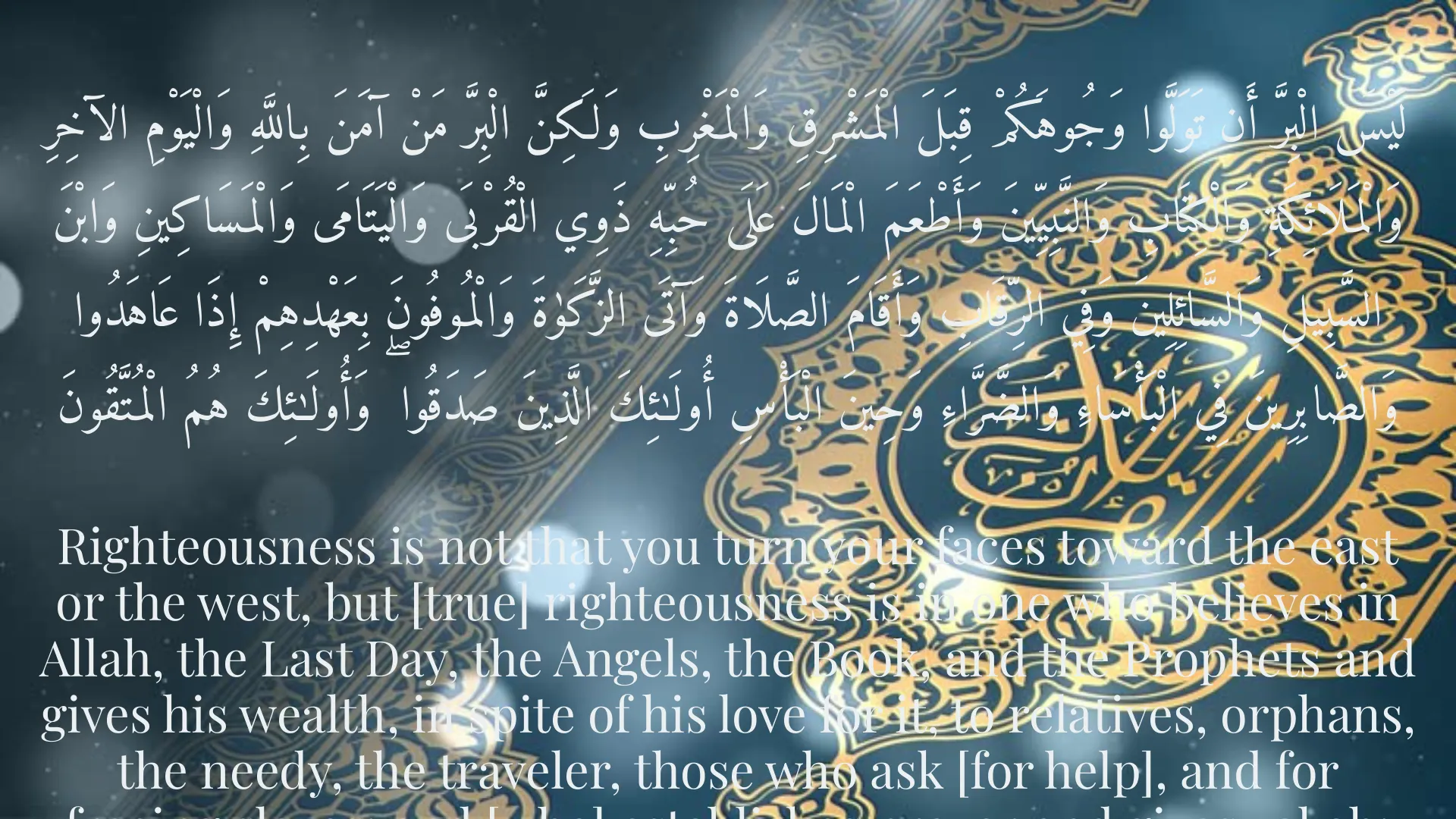
لَيْسَ الْبِرَّ أَن تَوَلَّوا وَجُوهَكُمْ قِبَلَ الْمَشْرِقِ وَالْمَغْرِبِ وَلَكِنَّ الْبِرَّ مَنْ آمَنَ بِاللَّهِ وَالْيَوْمِ الآخِرِ وَالْمَلَائِكَةِ وَالْكِتَابِ وَالنَّبِيِّينَ وَأَطْعَمَ الْمَالَ عَلَى حُبِّهِ ذَوِي الْقُرْبَى وَالْيَتَامَى وَالْمَسَاكِينِ وَابْنَ السَّبِيلِ وَالسَّائِلِينَ وَفِي الرِّقَابِ وَأَقَامَ الصَّلَاةَ وَآتَى الزَّكَوٰةَ وَالْمُوفُونَ بِعَهْدِهِمْ إِذَا عَاهَدُوا وَالصَّابِرِينَ فِي الْبَأْسَاءِ وَالضَّرَّاءِ وَحِينَ الْبَأْسِ أُولَـٰئِكَ الَّذِينَ صَدَقُوا ۖ وَأُولَـٰئِكَ هُمُ الْمُتَّقُونَ
Righteousness is not that you turn your faces toward the east or the west, but [true] righteousness is in one who believes in Allah, the Last Day, the Angels, the Book, and the Prophets and gives his wealth, in spite of his love for it, to relatives, orphans, the needy, the traveler, those who ask [for help], and for freeing slaves; and [who] establishes prayer and gives zakah; [those who] fulfill their promise when they promise; and [those who] are patient in poverty and hardship and during battle. Those are the ones who have been true, and it is those who are the righteous.
Al-Baqarah : 177
الَّذِي خَلَقَ الْمَوْتَ وَالْحَيَاةَ لِيَبْلُوَكُمْ أَيُّكُمْ أَحْسَنُ عَمَلًا ۚ وَهُوَ الْعَزِيزُ الْغَفُورُ
Who created death and life to test you [as to] which of you is best in deed - and He is the Exalted in Might, the Forgiving.
Al-Mulk : 2
Short Story
On a beautiful day, a young man named Ali was sitting by the sea, gazing at the stars. He was pondering the benefits of worship and realized that worship not only brings him closer to God but also grants him peace and happiness. Ali decided to dedicate time every day to worship and prayer, as well as to help his community. Gradually, he noticed how worship and good deeds filled his life with light and hope.