Quranic Answer
The Holy Quran does not contain any direct, explicit verse commanding a believer to "always" smile. Instead, the Quran primarily focuses on establishing the fundamental moral, spiritual, and behavioral principles for a believer, whose manifestations may include a cheerful countenance and a smile, but not as a perpetual and absolute obligation. What the Quran emphasizes is possessing a heart at peace through the remembrance of God, a soul full of hope and reliance (Tawakkul), and conduct characterized by excellent character (Akhlaq), humility, kindness, and good speech. These are deep, intrinsic qualities that, when rooted in a believer's being, naturally lead to an open and pleasant demeanor, of which smiling is a part, but not the sole expression. The Quran instructs believers to speak kindly to people and maintain good conduct. For instance, in Surah Al-Baqarah, verse 83, Allah states: "...and speak to people good words..." (وَقُولُوا لِلنَّاسِ حُسْنًا). "Good words" are not limited to the content of speech but also encompass the tone, facial expression, and cheerfulness. A smile can be a sign of this good speech and respectful, friendly interaction. In many cultures and in the esteemed religion of Islam, a smile symbolizes peace, friendship, welcome, and tranquility. This simple act can break barriers, bring hearts closer, and foster an atmosphere of empathy and affection. A believer, who considers themselves commissioned to spread mercy and peace, inevitably needs to utilize tools that achieve these goals, and a smile is one of the most effective of these tools. Furthermore, the Quran places significant emphasis on "great moral character" (Khuluqin Azeem) and good manners. In Surah Al-Qalam, verse 4, Allah says: "And indeed, you [O Muhammad] are of a great moral character." (وَإِنَّكَ لَعَلَىٰ خُلُقٍ عَظِيمٍ). Although this verse refers to Prophet Muhammad (PBUH), he is the ultimate role model (Usawa Hasana) and perfect example for all believers. The Prophet's (PBUH) conduct consistently showed him with a cheerful face and a smile, even in difficult circumstances. This was not indicative of indifference to problems but rather a reflection of inner peace, reliance on God, and the ability to manage emotions. Therefore, believers, following the example of their Prophet, strive to maintain a cheerful demeanor and good character in their interactions with others, and a smile is a natural part of this approach. Smiling in Islam can also be considered a form of "charity" (Sadaqah), as mentioned in prophetic traditions (though not directly in the Quran, it supports the general Quranic spirit of good deeds and charity). This perspective indicates that a smile is not merely an insignificant gesture but a valuable and benevolent act that can earn spiritual reward for the individual. However, it is crucial to distinguish between a genuine smile and a forced or artificial one. A smile that emanates from faith, hope, and inner peace is a reflection of the believer's heart, which finds tranquility in the remembrance of God, as stated in Surah Ar-Ra'd, verse 28: "Those who have believed and whose hearts are assured by the remembrance of Allah. Unquestionably, by the remembrance of Allah hearts are assured." (الَّذِينَ آمَنُوا وَتَطْمَئِنُّ قُلُوبُهُم بِذِكْرِ اللَّهِ ۗ أَلَا بِذِكْرِ اللَّهِ تَطْمَئِنُّ الْقُلُوبُ). This inner peace can manifest as a smile and an open countenance in interactions with others, even during challenging times that the believer patiently endures. However, this does not mean ignoring sorrow, grief, or denying natural human emotions. A believer, like other humans, experiences sadness, fear, or worry, but the difference lies in how they cope and not allowing these emotions to completely control their outward and inward state. Smiling should not imply a disregard for seriousness in tasks, responsibility, or an avoidance of life's harsh realities. In certain situations, such as confronting injustice, stating uncomfortable truths, or during mourning, smiling might be inappropriate. A believer must distinguish between different contexts and react appropriately. Nevertheless, in general and in daily interactions, cheerfulness and a smile are signs of humility, goodwill, and readiness for positive communication. The Quran also prohibits arrogance and turning away from people, as stated in Surah Luqman, verse 18: "And do not turn your cheek in contempt toward people and do not walk through the earth exultantly. Indeed, Allah does not like those who are self-deluded and boastful." (وَلَا تُصَعِّرْ خَدَّكَ لِلنَّاسِ وَلَا تَمْشِ فِي الْأَرْضِ مَرَحًا ۖ إِنَّ اللَّهَ لَا يُحِبُّ كُلَّ مُخْتَالٍ فَخُورٍ). A smile is the direct opposite of arrogance and self-conceit, signifying humility and a desire for warm interaction. In conclusion, while the Quran does not explicitly command "constant" smiling, the overall spirit of its verses encourages believers to have an open face, excellent character, pleasant speech, and warm conduct with others. A smile is a powerful tool to express these qualities and can be a sign of faith, inner peace, and commitment to Islamic principles in social interactions, except in specific circumstances where seriousness or sorrow is appropriate for the situation. Thus, smiling is not a rigid, lifeless obligation, but rather a natural manifestation of a believing heart and a tranquil soul that hopes in divine mercy and interacts with God's servants with good character.
Related Verses
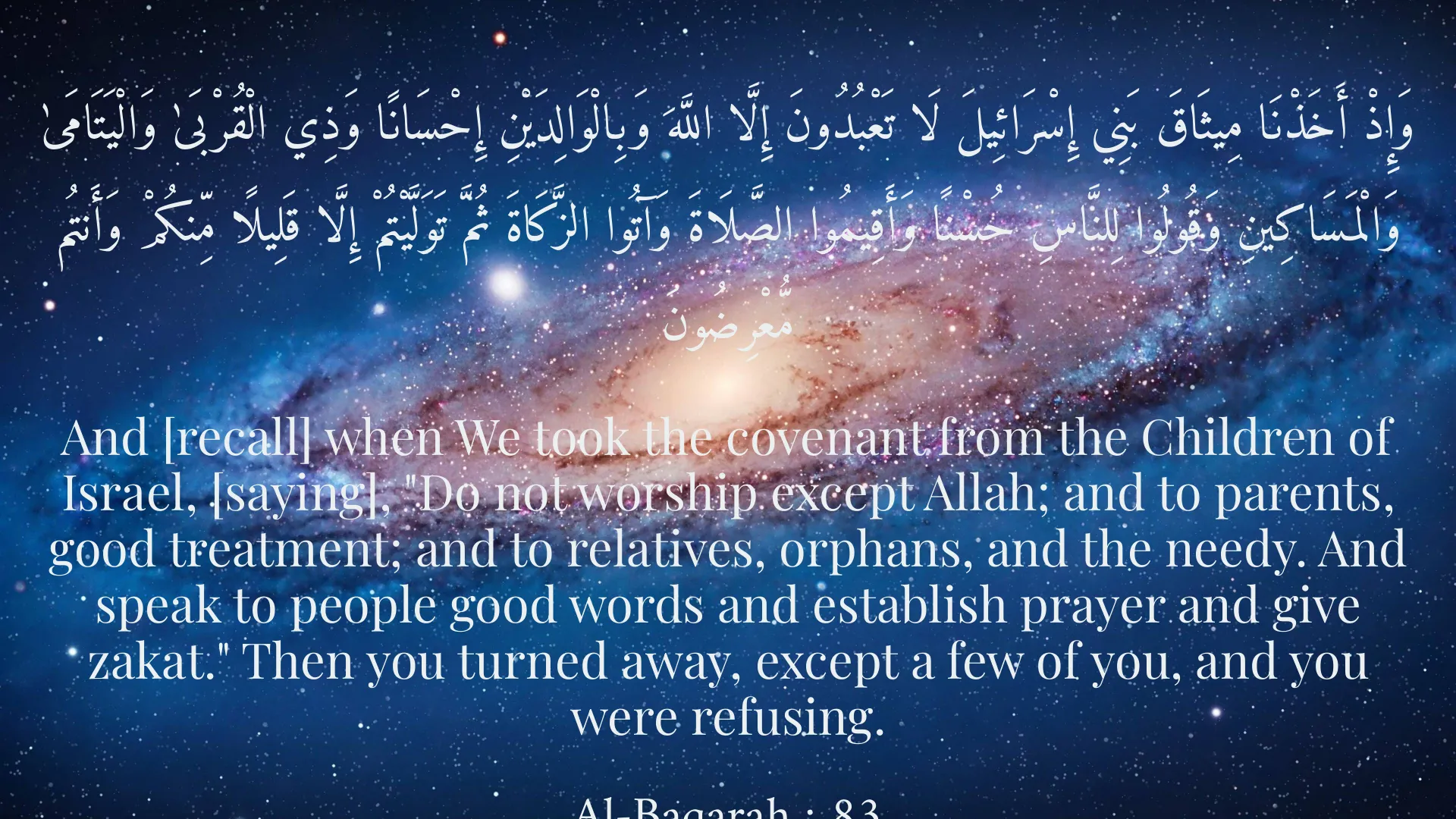
وَإِذْ أَخَذْنَا مِيثَاقَ بَنِي إِسْرَائِيلَ لَا تَعْبُدُونَ إِلَّا اللَّهَ وَبِالْوَالِدَيْنِ إِحْسَانًا وَذِي الْقُرْبَىٰ وَالْيَتَامَىٰ وَالْمَسَاكِينِ وَقُولُوا لِلنَّاسِ حُسْنًا وَأَقِيمُوا الصَّلَاةَ وَآتُوا الزَّكَاةَ ثُمَّ تَوَلَّيْتُمْ إِلَّا قَلِيلًا مِّنكُمْ وَأَنتُم مُّعْرِضُونَ
And [recall] when We took the covenant from the Children of Israel, [saying], "Do not worship except Allah; and to parents, good treatment; and to relatives, orphans, and the needy. And speak to people good words and establish prayer and give zakat." Then you turned away, except a few of you, and you were refusing.
Al-Baqarah : 83
وَإِنَّكَ لَعَلَىٰ خُلُقٍ عَظِيمٍ
And indeed, you are of a great moral character.
Al-Qalam : 4
وَلَا تُصَعِّرْ خَدَّكَ لِلنَّاسِ وَلَا تَمْشِ فِي الْأَرْضِ مَرَحًا ۖ إِنَّ اللَّهَ لَا يُحِبُّ كُلَّ مُخْتَالٍ فَخُورٍ
And do not turn your cheek in contempt toward people and do not walk through the earth exultantly. Indeed, Allah does not like those who are self-deluded and boastful.
Luqman : 18
Short Story
One day, in Saadi's time, there was an ascetic man who always appeared grim and withdrawn. People avoided him, fearing to encounter his frown. But in the same city, there was a merchant who, despite the troubles of his business, always had a smile on his face and spoke to everyone he met with an open countenance and sweet words. Saadi says: "That ascetic was known for his knowledge and piety, but the merchant for his good character and cheerfulness. The hearts of people were more inclined towards that merchant, because an open face and a smile, better than a thousand dry sermons, bring hearts together and bestow the light of love from the radiance of faith." This story illustrates how effective a cheerful face and a smile can be in attracting hearts and showcasing the beauty of faith.