Quranic Answer
The Holy Quran, revered as the sacred text of Islam, emphasizes not only the relationship between the believer and Allah but also offers profound guidance on how to navigate relationships with others. In a world where interactions are woven into the fabric of daily life, the Quran provides essential teachings aimed at safeguarding the spiritual and moral alignment of individuals. Among the many themes explored in the Quran, the topic of relationships—particularly the necessity of distancing oneself from negative influences—holds significant weight. This article delves into the critical verses of the Quran that guide believers in forming healthy relationships and avoiding those that jeopardize their faith and morals. One of the prominent verses addressing this matter is found in Surah Al-Ma'idah (Chapter 5, Verse 51). In this verse, Allah warns the believers against befriending those who are engulfed in disbelief and hostility. This divine caution serves as a reminder that not all relationships are beneficial. Rather, some can lead individuals astray from the path of righteousness. The term 'befriending' here carries with it deep implications, suggesting a close association that may lead to adopting the beliefs and behaviors of those with whom one associates. By warning against such ties, the Quran highlights the potential consequences that arise from forming relationships with those who embody principles contrary to the faith. Furthermore, this theme of caution is reiterated in Surah Al-Baqarah (Chapter 2, Verse 254), where believers are advised to avoid those who may usher them toward corruption and deviancy. Instead, Allah encourages the faithful to seek companionship with those who uphold the values laid down by divine guidance and walk the path of truth. This guidance is essential as the environment in which one resides can significantly influence one's actions, thoughts, and overall well-being. The Quran emphasizes the necessity of surrounding oneself with positive influences. When interacting with individuals who deviate from moral and religious teachings or are immersed in hypocrisy, the potential for negative impact increases exponentially. Such individuals may inadvertently lead believers to adopt harmful habits, ideologies, and practices that stray from the teachings of Islam. As social beings, humans are inherently influenced by their surroundings; thus, the Quran urges believers to choose their companions wisely. In today’s context, the relevance of these teachings is paramount. With the proliferation of social media and global connectivity, individuals often find themselves exposed to diverse beliefs and lifestyles, some of which may conflict with their own values. In such a landscape, the Quranic advice becomes even more crucial, as it calls upon individuals to reflect on their relationships and the influences they invite into their lives. This requires a conscious effort to evaluate whether those we spend time with inspire us to grow spiritually and morally or whether they lead us down a path of doubt and confusion. Moreover, the Quran not only warns against negative influences, but it also lays the foundation for positive relationships rooted in mutual respect, love, and the shared pursuit of virtue. Being in the company of those who obey Allah and strive for righteousness serves as a source of encouragement for believers. Engaging in healthy dialogue, sharing knowledge, and supporting one another in faith can significantly bolster one's spiritual journey. The Quran illustrates that such camaraderie is essential not just for psychological comfort but for cultivating a community grounded in shared values and principles. Essentially, the Quranic perspective champions healthy relationships while cautioning against those that can harm one's faith and moral compass. The call to distance oneself from negative influences is not merely a guideline for social interactions; it is a critical component of maintaining spiritual integrity. When faced with choices regarding friendships and associations, believers are called to reflect on their principles and the potential outcomes of their interactions. It is important to recognize that distancing oneself from harmful individuals does not equate to animosity or disrespect. It is a protective measure taken to ensure mental and spiritual health. By setting boundaries with those who may lead one astray or encourage negativity, individuals take a proactive step in safeguarding their faith and values. Mental health practitioners often echo this sentiment, affirming that healthy boundaries are crucial in maintaining one's well-being, both psychologically and spiritually. In conclusion, the guidance offered in the Holy Quran regarding relationships is not only timeless but serves as an essential framework for believers navigating life's complexities. By adhering to the teachings found in Surah Al-Ma'idah and Surah Al-Baqarah, individuals can empower themselves to cultivate meaningful and uplifting relationships that nurture their faith. As the Quran highlights, making conscious choices about who we let into our lives can determine our path towards righteousness and spiritual fulfillment. In our pursuit of connection and understanding, let us not forget the importance of aligning our relationships with our core beliefs and values. As we engage with the world around us, may we strive to embody the lessons of the Quran, surrounding ourselves with those who uplift, inspire, and walk the path of truth alongside us.
Related Verses
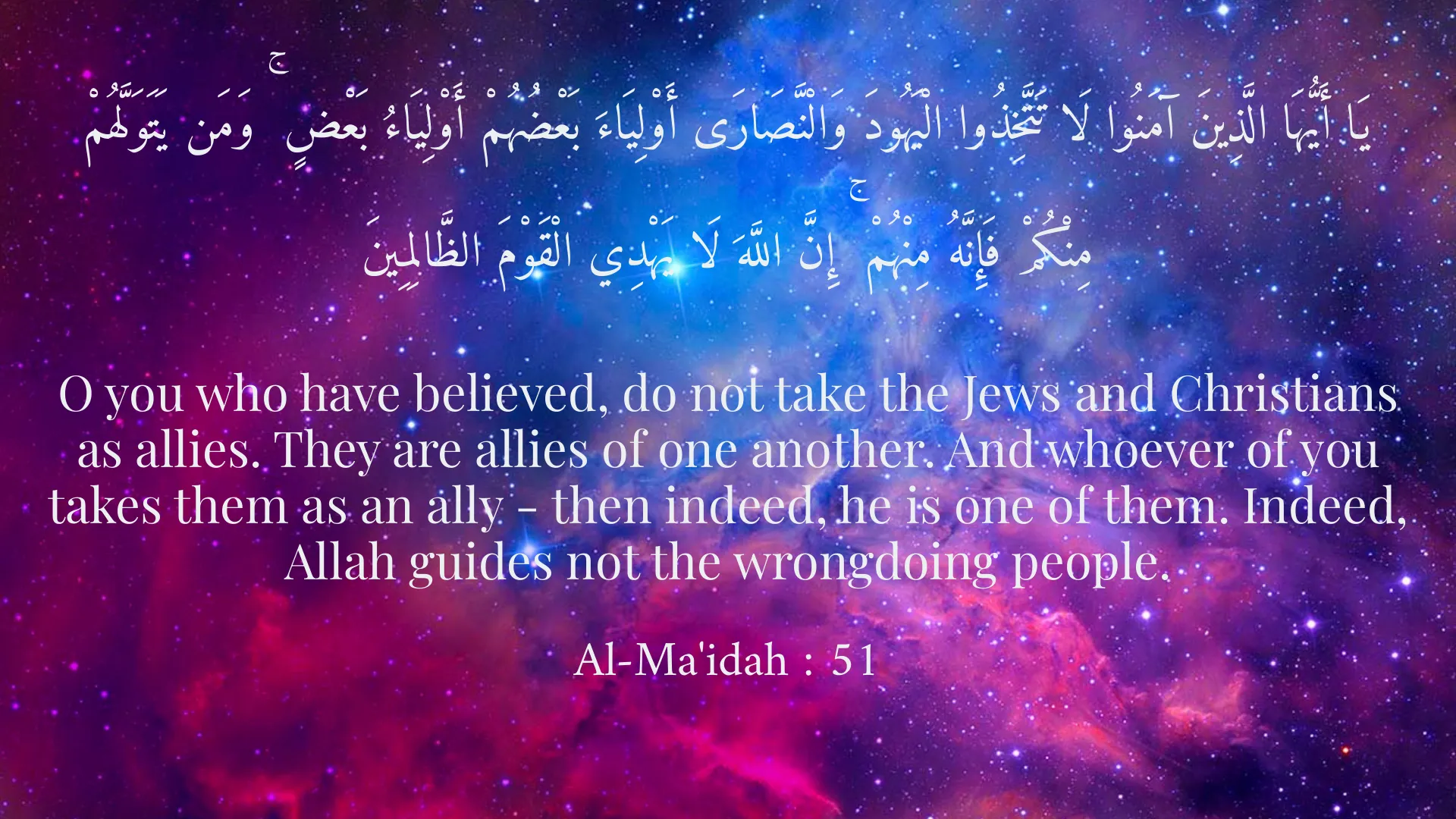
يَا أَيُّهَا الَّذِينَ آمَنُوا لَا تَتَّخِذُوا الْيَهُودَ وَالْنَّصَارَى أَوْلِيَاءَ بَعْضُهُمْ أَوْلِيَاءُ بَعْضٍ ۚ وَمَن يَتَوَلَّهُمْ مِنْكُمْ فَإِنَّهُ مِنْهُمْ ۚ إِنَّ اللَّهَ لَا يَهْدِي الْقَوْمَ الظَّالِمِينَ
O you who have believed, do not take the Jews and Christians as allies. They are allies of one another. And whoever of you takes them as an ally - then indeed, he is one of them. Indeed, Allah guides not the wrongdoing people.
Al-Ma'idah : 51
يَا أَيُّهَا الَّذِينَ آمَنُوا أَنفِقُوا مِمَّا رَزَقْنَاكُمْ مِن قَبْلِ أَن يَأْتِيَ يَوْمٌ لَا بَيْعٌ فِيهِ وَلَا خُلَّةٌ وَلَا شَفَاعَةٌ ۗ وَالْكَافِرُونَ هُمُ الظَّالِمُونَ
O you who have believed, spend from that in which We have provided you before the Day comes in which there is no trade, nor friendship, nor intercession. And the disbelievers - they are the wrongdoers.
Al-Baqarah : 254
Short Story
One day in the market, a young man sat with a compassionate seller and said, 'Why are some of your friends not likable to me?' The seller smiled and replied, 'There’s no benefit in befriending toxic individuals. You must learn to distance yourself from them.' The young man decided from that day onward to be cautious with his friends and avoid those who led him astray.