Quranic Answer
In today's world, often referred to as the Information Age, we are constantly surrounded by an overwhelming influx of data and news from myriad sources. From social media platforms to news outlets and online forums, information flows at an astonishing speed, making the discernment of truth from falsehood, right from wrong, and beneficial from harmful, one of humanity's most significant challenges. At first glance, it might seem that the Holy Quran, a book revealed over fourteen centuries ago, could not possibly offer direct answers to phenomena like the 'Information Age' or 'fake news.' However, upon deeper contemplation of its divine verses, we realize that the Quran's teachings transcend time and place, offering profound and fundamental principles and solutions for truth-seeking and for intelligently navigating information in any era, including our contemporary age. One of the most crucial Quranic principles regarding truth-seeking is its unequivocal emphasis on 'knowledge' (ilm), 'reflection' (tafakkur), 'contemplation' (tadabbur), and 'reasoning' (ta'aqqul). The Quran repeatedly invites humanity to ponder the creation of the heavens and the earth, the divine signs in nature, and within its own verses. This call to reflection and intellectual deliberation is the cornerstone for distinguishing truth from illusion. In verses such as 'Do they not then earnestly seek to understand the Quran?' (Surah Muhammad: 24) or 'Indeed in that are signs for a people who give thought' (Surah Ar-Ra'd: 3), Allah emphasizes the necessity of deep contemplation and discernment. This emphasis means that a person should not blindly and without thought accept everything they hear or see. In the Information Age, this principle teaches us to be vigilant about our information sources, to delve into the depths of content, and to avoid superficiality and impulsiveness when encountering news. Quranic truth-seeking, first and foremost, begins with cultivating one's intellectual faculties and logical reasoning. Another vital principle that the Quran presents for truth-seeking in the Information Age is the necessity of 'verification' (tabayyun) and 'investigation' regarding received news and information. Verse 6 of Surah Al-Hujurat addresses this unequivocally: 'O you who have believed, if there comes to you a disobedient one with information, investigate, lest you harm a people out of ignorance and then become regretful over what you have done.' This verse provides a golden rule for engaging with information, especially in our era. The word 'fasiq' (disobedient one) in this verse refers to someone who has deviated from divine limits and is not trustworthy, and in today's world, it can be extended to unreliable sources, fake news, rumors, and propaganda. The Quran instructs us not to act hastily when confronted with such news, but rather to 'investigate' (tabayyan); that is, to carefully examine and verify the accuracy of the information. The purpose of this investigation is to prevent harming others and to avoid regretting uninformed actions. In the age of social media and messaging apps, where news (both true and false) spreads virally, this divine command gains even greater importance. Every share and repost of news, before its accuracy is confirmed, can lead to the spread of falsehoods and irreparable harm. Furthermore, the Quran emphasizes human accountability for their words and deeds. Verse 36 of Surah Al-Isra states: 'And do not pursue that of which you have no knowledge. Indeed, the hearing, the sight, and the heart – about all those [one] will be questioned.' This verse clearly indicates that individuals are accountable for everything they hear, see, and accept in their hearts and speak with their tongues. This responsibility takes on broader dimensions in the Information Age, where content creation and dissemination have become incredibly easy. We are responsible for the accuracy of the information we produce or repost. Deliberately or even inadvertently spreading lies and rumors is not only an ethical sin but can also have devastating social and psychological consequences. Therefore, the Quran invites us to acquire 'information literacy' and 'media literacy' in its Quranic sense; that is, the ability to recognize, evaluate, and properly use information. The Quran also places great emphasis on the importance of 'truthfulness' (sidq) and avoidance of 'falsehood' (kidhb). Truthfulness is one of the prominent characteristics of believers and prophets, while lying is considered a moral vice. In the Information Age, lying can manifest as fake news, propaganda, deception, or even misuse of digital identities. The Quran teaches us not only to refrain from lying ourselves but also to stand against it and prevent society from being polluted by falsehood and deception. Truth always prevails over falsehood, and the Quran introduces itself as 'Al-Haqq' (the absolute truth) and invites adherence to it. Finally, truth-seeking in the Quran is rooted in 'piety' (taqwa) and 'insight' (basirah). A person who possesses taqwa, meaning they always see God as observing their actions, acts more cautiously when dealing with information and refrains from spreading anything they are not certain about its accuracy. Taqwa grants a person insight to distinguish truth from falsehood. Verse 18 of Surah Az-Zumar also states: 'Those who listen to speech and follow the best of it. Those are the ones Allah has guided, and those are people of understanding.' This verse highlights the importance of listening to different viewpoints and then choosing the best and most accurate among them, which itself requires deep reflection and insight. In summary, although the Quran does not explicitly mention the 'Information Age,' it provides an unparalleled guide for truth-seeking in this tumultuous era by presenting universal and timeless principles such as the necessity of investigation and verification, accountability for speech, emphasis on reflection and reasoning, and the value of truthfulness and piety. These teachings instruct us not to be mere passive consumers of information, but rather, with a critical, responsible, and truth-committed mind, to seek the light of truth in the boundless sea of information and prevent ourselves from falling into the trap of misinformation and ignorance. This Quranic framework not only protects us from the harms of the Information Age but also transforms it into an opportunity for intellectual and spiritual growth.
Related Verses
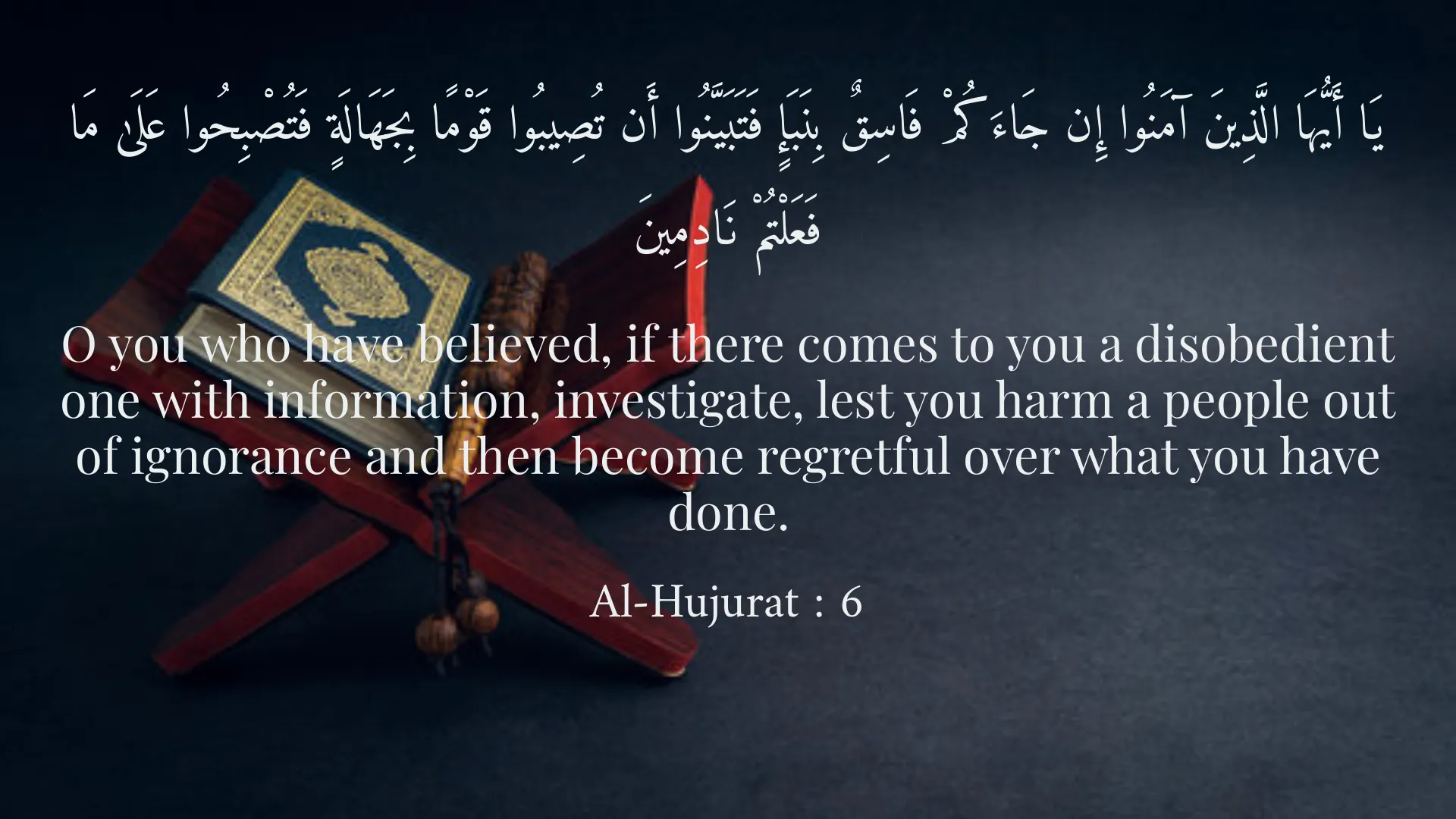
يَا أَيُّهَا الَّذِينَ آمَنُوا إِن جَاءَكُمْ فَاسِقٌ بِنَبَإٍ فَتَبَيَّنُوا أَن تُصِيبُوا قَوْمًا بِجَهَالَةٍ فَتُصْبِحُوا عَلَىٰ مَا فَعَلْتُمْ نَادِمِينَ
O you who have believed, if there comes to you a disobedient one with information, investigate, lest you harm a people out of ignorance and then become regretful over what you have done.
Al-Hujurat : 6
وَلَا تَقْفُ مَا لَيْسَ لَكَ بِهِ عِلْمٌ ۚ إِنَّ السَّمْعَ وَالْبَصَرَ وَالْفُؤَادَ كُلُّ أُولَٰئِكَ كَانَ عَنْهُ مَسْئُولًا
And do not pursue that of which you have no knowledge. Indeed, the hearing, the sight, and the heart – about all those [one] will be questioned.
Al-Isra : 36
الَّذِينَ يَسْتَمِعُونَ الْقَوْلَ فَيَتَّبِعُونَ أَحْسَنَهُ ۚ أُولَٰئِكَ الَّذِينَ هَدَاهُمُ اللَّهُ ۖ وَأُولَٰئِكَ هُمْ أُولُو الْأَلْبَابِ
Those who listen to speech and follow the best of it. Those are the ones Allah has guided, and those are people of understanding.
Az-Zumar : 18
Short Story
It is narrated that in a certain city, there lived a wise man who always refrained from hasty judgment and from repeating unfounded rumors. One day, unpleasant and insulting news about a virtuous neighbor reached his ears. The townspeople, without delay or investigation, began repeating it, each adding something more, targeting the neighbor's reputation. But this wise man, before uttering a word or making a judgment, calmly and judiciously approached the neighbor and inquired about the truth of the matter, resolving all ambiguities. He then learned that the news was merely a misunderstanding or a malicious fabrication. He told the people, 'O friends, hearing any news is easy, but discerning its truth is the work of the wise and those with insight. Let us not, with our tongues, shoot an arrow at anyone's honor before we know the truth and investigate it ourselves.' From then on, the townspeople took him as their role model in avoiding haste and seeking truth, and baseless rumors spread less among them, bringing more peace to the community. This tale reminds us of the saying of the esteemed Sa'di: 'A beneficial lie is better than a harmful truth,' and that truthfulness in speech and action, coupled with investigation, leads to salvation.