Quranic Answer
### The Virtue of Helping Others in the Holy Quran In the vast tapestry of guidance offered by the Holy Quran, one of the most significant themes that emerge is the imperative to help others. The Qur'an articulates a path toward righteousness that transcends merely spiritual or ritualistic observance; it requires engagement with the world around us and actively contributing to the well-being of others. This principle is eloquently encapsulated in Surah Al-Baqarah, verse 177, where Allah proclaims that those who help others and give charity are the true believers. But the act of helping others extends beyond the physical act of giving; it encompasses a range of interactions—be it emotional, psychological, or spiritual support—that fortify communal bonds. #### Helping Others: A Sign of True Faith In Surah Al-Baqarah, verse 177, Allah emphasizes that giving to those in need is a hallmark of true piety. It states: "It is not righteousness that you turn your faces toward the east or the west, but [true] righteousness is in one who believes in Allah, the Last Day, the Angels, the Book, and the Prophets and gives his wealth, in spite of love for it, to relatives, orphans, the needy, the traveler, those who ask [for help], and for freeing slaves; [and who] establishes prayer and gives zakah; [those who] fulfill their promise when they promise; and [those who] are patient in poverty and hardship and during battle. Those are the ones who have been true, and it is those who are the righteous." This verse lays down a comprehensive definition of righteousness, which extends far beyond the internal convictions of belief. It encompasses tangible actions of kindness, charity, and community support. Thus, helping others is not just a question of charity; it is a necessary component of one’s faith and devotion to Allah. #### The Broad Scope of Helping Others Helping others is a multi-faceted endeavor that includes not only monetary donations but also emotional and psychological support. The Quran emphasizes the importance of establishing a social network that nurtures communal welfare. It posits that every individual has a role in uplifting society through genuine acts of kindness. Whether it involves providing companionship to the lonely or assisting the burdened in managing their difficulties, the Quranic perspective perceives these as essential responsibilities. Moreover, the notion of charity (Sadaqah) in Islam is manifold. It includes obligatory giving (Zakah), which is a pillar of Islam mandated on those who are financially capable, and voluntary charity that springs from one’s benevolent inclination. Both forms of giving are vital for not only alleviating the suffering of others but also for promoting a just and balanced community. The Quran is replete with verses that illustrate the rewards awaiting those who aid others, reinforcing the idea that such deeds are spiritually enriching and essential for personal salvation. #### Fairness and Honesty in Dealings The Quran also underscores the importance of fairness and honesty in financial transactions, as seen in Surah Al-Mutaffifin, verses 1 to 3: "Woe to those who give less [than due], who, when they take a measure from people, take in full, but if they give by measure or by weight to them, they cause loss." This admonishment serves as a critical reminder that helping others embodies not only acts of generosity but also includes integrity in all dealings. The overarching principle illustrated here is that true service to humanity must be rooted in justice and equity. #### Alleviating Burdens and Pain The fundamental obligations in Islam extend to both material and emotional support. By engaging in acts of kindness, individuals are equipped to alleviate the burdens of those who are struggling—be it through economic hardship, emotional distress, or social isolation. Acts of kindness, whether big or small, can significantly impact the quality of life for those in distress. The Quran thus establishes a reciprocal relationship wherein individuals who help others ultimately enhance their own sense of purpose and belonging. Conversely, neglecting the plight of others may lead to personal and collective societal decline. The moral fabric of society is woven from the threads of compassion and empathy. Helping others, whether through actions or sincere intentions, strengthens community solidarity and fortifies interpersonal relationships. #### The Rewards of Helping Others One of the most profound outcomes of helping behaviors is the deep sense of satisfaction and joy that accompanies altruistic actions. Studies in psychology affirm that acts of kindness not only benefit the recipient but also enhance the emotional well-being of the giver. From a Quranic standpoint, performing good deeds secures God's satisfaction and blessings, enriching one’s life both spiritually and socially. This mutually beneficial relationship fosters a nurturing environment where individuals feel valued, and, in turn, are motivated to contribute positively to society. #### Constructing a Happy and Healthy Society Ultimately, the Quran presents a vision where a happy and healthy society is constructed by the collective effort of its members to help one another. This requires a re-orientation of individualistic perspectives towards community-centric values. Helping others is not merely an act of charity but a deep-seated ethos that can transform not only individual lives but the entire societal structure. Whether it is through charitable giving, offering emotional support, or simply being present for someone in need, every small act contributes remarkably to the well-being of the community. As illustrated through various verses of the Quran, the reciprocal nature of kindness and support fosters a sense of belonging and highlights the inherent interconnectedness of humanity. The emphasis on assisting others in the Quran calls for a radical rethinking of how we engage with the world—a world that thrives not on competition and isolation but on cooperation and mutual support. #### Conclusion In an age characterized by rapid social change and increasing isolation, the Quran serves as a timeless guide, reiterating the importance of helping others and maintaining a strong communal bond. It leads the way in cultivating a society built on compassion, fairness, and solidarity. In essence, the teachings of the Quran remind humanity that true kindness toward others enriches one’s spiritual life and cements a sense of community in which everyone can thrive. Thus, helping others is not only a moral duty; it is a pathway to establishing a just and harmonious society.
Related Verses
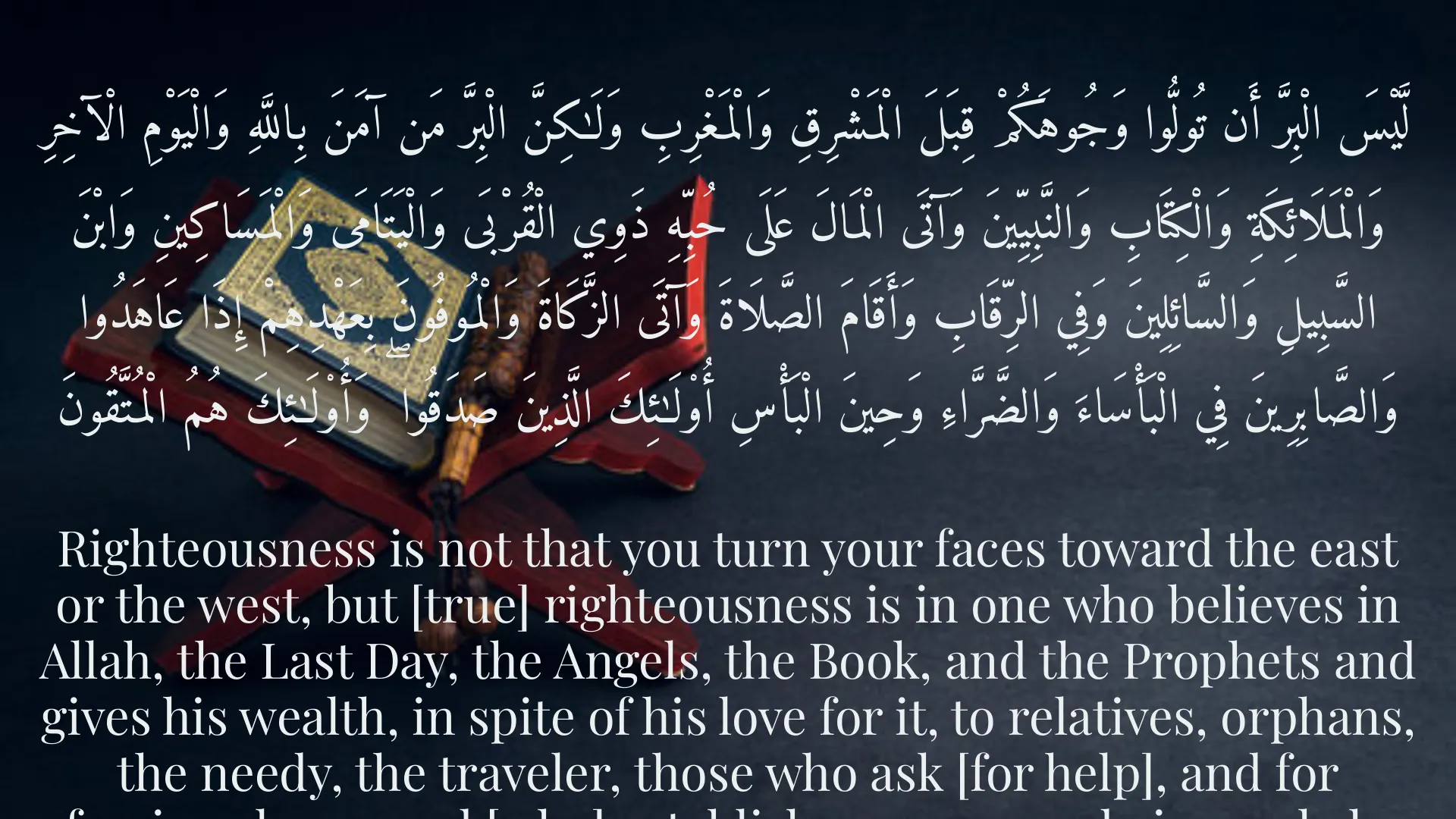
لَّيْسَ الْبِرَّ أَن تُولُّوا وَجُوهَكُمْ قِبَلَ الْمَشْرِقِ وَالْمَغْرِبِ وَلَـٰكِنَّ الْبِرَّ مَن آمَنَ بِاللَّهِ وَالْيَوْمِ الْآخِرِ وَالْمَلَائِكَةِ وَالْكِتَابِ وَالنَّبِيِّينَ وَآتَى الْمَالَ عَلَى حُبِّهِ ذَوِي الْقُرْبَى وَالْيَتَامَى وَالْمَسَاكِينِ وَابْنَ السَّبِيلِ وَالسَّائِلِينَ وَفِي الرِّقَابِ وَأَقَامَ الصَّلَاةَ وَآتَى الزَّكَاةَ وَالْمُوفُونَ بِعَهْدِهِمْ إِذَا عَاهَدُوا وَالصَّابِرِينَ فِي الْبَأْسَاءَ وَالضَّرَّاءِ وَحِينَ الْبَأْسِ أُو۟لَـٰئِكَ الَّذِينَ صَدَقُوا ۖ وَأُو۟لَـٰئِكَ هُمُ الْمُتَّقُونَ
Righteousness is not that you turn your faces toward the east or the west, but [true] righteousness is in one who believes in Allah, the Last Day, the Angels, the Book, and the Prophets and gives his wealth, in spite of his love for it, to relatives, orphans, the needy, the traveler, those who ask [for help], and for freeing slaves; and [who] establishes prayer and gives zakah; [those who fulfill their promise when they promise] and [those who are patient in poverty and hardship and during battle]. Those are the ones who have been true, and it is those who are the righteous.
Al-Baqarah : 177
وَيْلٌ لِّلْمُطَفِّفِينَ
Woe to those who give less [than due].
Al-Mutaffifin : 1
الَّذِينَ إِذَا اكْتَالُوا عَلَى النَّاسِ يَسْتَوْفُونَ
Who, when they take a measure from people, take in full.
Al-Mutaffifin : 2
وَإِذَا كَالُوهُمْ أَوْ وَّزَنُوهُمْ يُخْسِرُونَ
But if they give by measure or by weight to them, they cause loss.
Al-Mutaffifin : 3
Short Story
One day, a man went to the market to buy goods. On his way, he saw an elderly woman struggling to carry a heavy load. He thought to himself, 'What value is it to help this woman while I'm out for my errands?' However, he ultimately decided to assist her. After helping her, he felt a strange joy in his heart. At that moment, he realized that helping others not only alleviates their pains but also brings him peace.