Quranic Answer
The Quran's approach to economic justice is a comprehensive, foundational, and intricately woven part of Islam's overall moral and ethical system. The Quran posits that wealth and natural resources are trusts from God, which must be utilized for the greater good and welfare of society as a whole, rather than being confined to the hands of a select few. The primary goal is to establish a society where poverty is minimized, economic exploitation and injustice are eradicated, and every individual has equal opportunities for growth and prosperity. This perspective not only emphasizes material aspects but also delves into the spiritual and ethical dimensions of earning, spending, and consumption, ensuring that the economic cycle facilitates human advancement and remains free from any corruption or oppression. One of the cornerstones of Islamic economic justice is the concept of Zakat and Sadaqah (charity). Zakat is a divine obligation imposed upon affluent Muslims, requiring them to annually disburse a fixed percentage of their wealth to the poor, the needy, the indebted, travelers in distress, and other specific categories mentioned in the Quran (e.g., Surah At-Tawbah 9:60). The Quran describes Zakat as a means of "purifying" both one's wealth and soul (At-Tawbah, verse 103: "Take, [O Muhammad], from their wealth a charity by which you purify them and cause them to increase; and invoke [Allah's blessings] upon them. Indeed, your invocations are reassurance for them. And Allah is Hearing and Knowing."). This divinely ordained system not only facilitates the redistribution of wealth but also fosters a sense of social responsibility among the wealthy, preventing excessive accumulation of riches and the formation of deep class divides. Zakat guarantees a minimum standard of living for those in need, providing a sustainable social safety net. This divine decree clearly indicates that accumulated wealth in an Islamic society contains a right for the deprived, and the wealthy are not absolute owners but rather trustees who must observe the rights of others and utilize their wealth for the pleasure of their Lord and to aid His servants. Another critical aspect is the prohibition of Riba (interest or usury). The Quran unequivocally condemns Riba, considering it a grave sin and an act of injustice that stands in opposition to lawful trade (Al-Baqarah, verse 275: "Those who consume interest will not stand [on the Day of Resurrection] except as one stands who is being beaten by Satan into insanity. That is because they say, 'Trade is only like interest.' While Allah has permitted trade and forbidden interest. So, whoever receives an admonition from his Lord and desists, then he may have what has already passed, and his affair is [now] with Allah. But whoever returns [to dealing in interest] – those are the companions of the Fire; they will abide eternally therein."). The prohibition of Riba is significant because interest-based systems lead to the concentration of wealth in the hands of a few, the exploitation of poorer classes, and the creation of unmanageable debts. An economy built on Riba tends to stifle real production and pushes towards speculative and paper-based transactions, leading to economic instability and financial crises. In contrast, Islam encourages partnerships (Mudarabah, Musharakah) and productive investments where risk and profit are shared among parties, leading to more sustainable economic justice. This prohibition lays the foundation for an ethical economy whose aim is growth and general welfare, not the unbounded accumulation of wealth by a few in society at the expense of the majority. Furthermore, the Quran places significant emphasis on fairness and honesty in all economic dealings. It commands sellers and buyers not to cheat in weights and measures (Al-Mutaffifin, verses 1-6), to fulfill their covenants, and to refrain from deceit and fraud in transactions. This emphasis on ethics in business ensures an atmosphere of trust and integrity, which is essential for a healthy economy. The Quran also respects private ownership but does not deem it absolute, stressing the social responsibilities of property owners. Usurping others' property, hoarding (which harms the market and the people), and extravagance (Israf – wasteful and unnecessary spending) are strongly condemned, as these actions lead to the infringement of others' rights and disrupt the economic balance of society. Additionally, the Quran insists on the broad distribution of wealth and actively discourages its circulation solely among the rich. Surah Al-Hashr (59:7) states: "What Allah has returned to His Messenger from the people of the towns – it is for Allah and for the Messenger and for [his] near relatives and the orphans, the needy and the traveler – so that it may not be a perpetual distribution among the rich from among you." This verse sets forth a key principle: economic and social policies should be designed in such a way that wealth circulates justly within society and does not become monopolized by a particular group. This is also achieved through laws like inheritance, which distribute an estate among a wide range of heirs upon an individual's death, preventing its hereditary accumulation within a single family. These laws contribute to economic dynamism and opportunity creation for new generations and prevent the establishment of inherited aristocracy and monopolies. In summary, the Quran's approach to economic justice is holistic, focusing on both macro-economic aspects (like wealth distribution and circulation) and micro-economic behaviors (like individual conduct in transactions). This approach not only aims to meet basic needs and ensure livelihood but also emphasizes preserving human dignity, encouraging work and production, and fostering a society built on solidarity and cooperation. The Quran outlines an economy where wealth is a tool for achieving individual and collective well-being, not a source of oppression and division. It is a call for an ethically-driven economic system where profit is pursued with purpose and responsibility, and wealth is shared with compassion and justice, to ensure the prosperity of both this world and the hereafter for individuals and society alike.
Related Verses
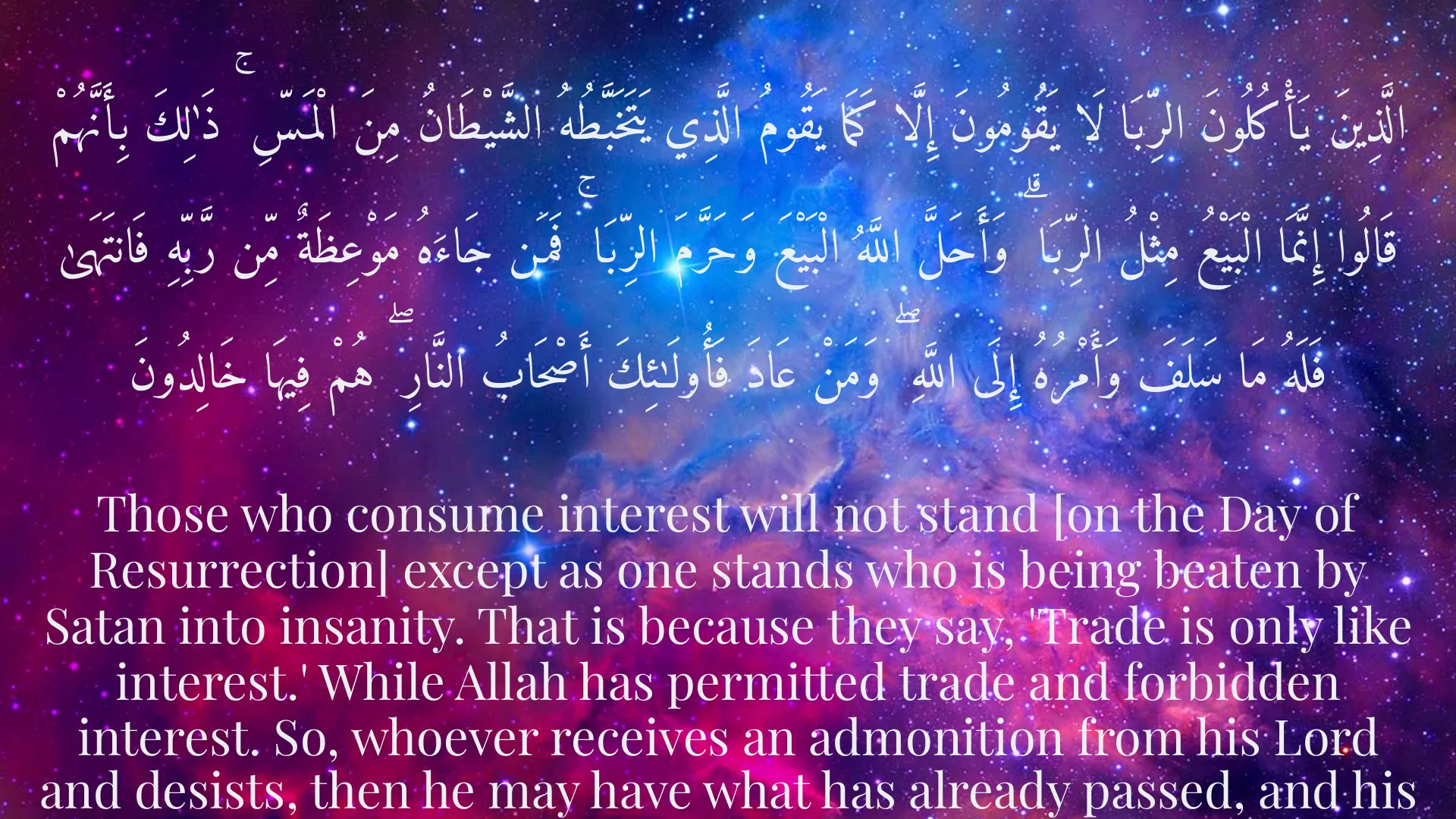
الَّذِينَ يَأْكُلُونَ الرِّبَا لَا يَقُومُونَ إِلَّا كَمَا يَقُومُ الَّذِي يَتَخَبَّطُهُ الشَّيْطَانُ مِنَ الْمَسِّ ۚ ذَٰلِكَ بِأَنَّهُمْ قَالُوا إِنَّمَا الْبَيْعُ مِثْلُ الرِّبَا ۗ وَأَحَلَّ اللَّهُ الْبَيْعَ وَحَرَّمَ الرِّبَا ۚ فَمَن جَاءَهُ مَوْعِظَةٌ مِّن رَّبِّهِ فَانتَهَىٰ فَلَهُ مَا سَلَفَ وَأَمْرُهُ إِلَى اللَّهِ ۖ وَمَنْ عَادَ فَأُولَٰئِكَ أَصْحَابُ النَّارِ ۖ هُمْ فِيهَا خَالِدُونَ
Those who consume interest will not stand [on the Day of Resurrection] except as one stands who is being beaten by Satan into insanity. That is because they say, 'Trade is only like interest.' While Allah has permitted trade and forbidden interest. So, whoever receives an admonition from his Lord and desists, then he may have what has already passed, and his affair is [now] with Allah. But whoever returns [to dealing in interest] – those are the companions of the Fire; they will abide eternally therein.
Al-Baqarah : 275
خُذْ مِنْ أَمْوَالِهِمْ صَدَقَةً تُطَهِّرُهُمْ وَتُزَكِّيهِم بِهَا وَصَلِّ عَلَيْهِمْ ۖ إِنَّ صَلَاتَكَ سَكَنٌ لَّهُمْ ۗ وَاللَّهُ سَمِيعٌ عَلِيمٌ
Take, [O Muhammad], from their wealth a charity by which you purify them and cause them to increase; and invoke [Allah's blessings] upon them. Indeed, your invocations are reassurance for them. And Allah is Hearing and Knowing.
At-Tawbah : 103
مَّا أَفَاءَ اللَّهُ عَلَىٰ رَسُولِهِ مِنْ أَهْلِ الْقُرَىٰ فَلِلَّهِ وَلِلرَّسُولِ وَلِذِي الْقُرْبَىٰ وَالْيَتَامَىٰ وَالْمَسَاكِينِ وَابْنِ السَّبِيلِ كَيْ لَا يَكُونَ دُولَةً بَيْنَ الْأَغْنِيَاءِ مِنكُمْ ۚ وَمَا آتَاكُمُ الرَّسُولُ فَخُذُوهُ وَمَا نَهَاكُمْ عَنْهُ فَانتَهُوا ۚ وَاتَّقُوا اللَّهَ ۖ إِنَّ اللَّهَ شَدِيدُ الْعِقَابِ
What Allah has returned to His Messenger from the people of the towns – it is for Allah and for the Messenger and for [his] near relatives and the orphans, the needy and the traveler – so that it may not be a perpetual distribution among the rich from among you. And whatever the Messenger has given you – take it; and what he has forbidden you – refrain from it. And fear Allah; indeed, Allah is severe in penalty.
Al-Hashr : 7
Short Story
It is said that in ancient times, there was a wealthy merchant who possessed vast riches and lived in luxury, yet he was oblivious to the plight of the poor and needy in his city. At night, his stomach was full and his clothes opulent, while his neighbors went to bed hungry. One day, a wise old man passed by his house. The merchant saw him and scornfully asked, 'O old man, what has befallen you that you are so ragged and weak?' The old man, with a gentle smile, replied, 'O young man, this is the state of one who practices contentment in this world and does not cling to fleeting possessions. But you, who have so much wealth, do you know that wealth is a blessing if spent in the right way, and a calamity if it leads to negligence and tyranny? God has said in the Quran that wealth should not circulate only among the rich among you. So, hoard nothing in your treasury but the treasures of generosity and benevolence, for those are more lasting and will grant you a high status with your Lord.' The merchant was ashamed by the old man's words, repented in his heart, and thereafter spent his wealth with justice and good deeds. His name lived on honorably among the people, and blessings came to his wealth and soul.