Quranic Answer
The Holy Quran, regarded as the ultimate source of guidance for Muslims, explicitly condemns oppression, portraying it as a despicable act that not only affects individuals but also leads to the social corruption and eventual downfall of societies. This condemnation is evident throughout the Quran as the divine text highlights the destructive nature of oppression and the importance of justice. As we explore the various verses within the Quran that address this significant issue, we see a consistent message advocating for fairness, integrity, and the inherent dignity of every individual. Oppression, in its many forms, is characterized as an act that dehumanizes individuals, denies them their rightful liberties, and creates a rift within society. The Quran portrays oppression as ugly and inhumane, contradicting the very principles of compassion and justice that it promotes. One of the central messages the Quran conveys is the importance of standing firm for justice, even when it is inconvenient or challenges one’s interests. This message is beautifully articulated in Surah An-Nisa, verse 135. Here, Allah commands the believers, "O you who have believed, be persistently standing firm in justice, witnesses in a way that is just, even if it be against yourselves or your parents and relatives." This powerful verse highlights the necessity of justice and the avoidance of oppression as fundamental principles that are inscribed within the core of Islamic ethics. In outlining the responsibilities that believers have toward not just themselves but also towards others, this verse emphasizes the idea that the pursuit of justice takes precedence over personal biases and familial allegiances. Standing up for justice, particularly when it involves calling out oppression, is not simply encouraged; it is mandated. This illustrates a profound understanding of the societal implication of justice—when injustice is allowed to prevail, it hampers the collective integrity of society, leading to widespread social decay. Furthermore, the Quran recognizes the intricacies of human relationships and economic interactions. In Surah Al-Baqarah, verse 188, Allah instructs humans, "And do not consume one another's wealth unjustly or send it [in bribery] to the rulers in order that [they might aid] you [to] consume a portion of the wealth of the people in sin, while you know [it is unlawful]." This verse beautifully encapsulates the ethical framework within which economic dealings should operate. It emphasizes the critical nature of fairness not only in social issues but also in economic ones, thereby indicating that every form of injustice, including financial oppression and exploitation, is abominable. The message is clear: the Quran prohibits unjustly taking what does not belong to one and encourages equitable distribution of wealth. The linkage of justice to the avoidance of oppression is a consistent theme throughout the Quran. Allah's instructions urge believers not only to refrain from oppressing others but also to actively protect the rights and dignity of all individuals. This reflects a broader societal vision in which everyone thrives based on mutual respect, empathy, and integrity. The comprehensive outlook that the Quran presents underscores that oppression, regardless of its nature—be it social, political, or economic—is a severe violation of Islamic principles and a betrayal to the moral fabric that binds society. Additionally, the Quran contextualizes oppression within the larger framework of divine accountability. In several instances, it warns of dire consequences awaiting those who engage in oppressive behavior. Such rebukes serve not only to deter individuals from committing injustice but also to foster a culture of mutual accountability. By instilling a sense of divine observation, individuals are reminded that their actions will ultimately be judged by Allah, promoting a collective consciousness that encourages the pursuit of righteousness. It is essential to understand that the Quran's condemnation of oppression is not limited to individual acts; it also implicitly invites societal transformation. As believers unite under the principles of justice and combat oppression collectively, they contribute to a societal framework that nurtures peace, harmony, and progress. This call to action requires communities to advocate for one another, ensuring that the rights of the marginalized and the oppressed are respected and upheld. In contemporary society, the relevance of the Quran's teachings on oppression resonates profoundly. Across the globe, numerous forms of oppression persist, ranging from systemic inequalities to unjust legal practices. The Quran invites us to reflect on our roles as advocates for justice, encouraging believers worldwide to engage in social activism, human rights advocacy, and fostering an ethical economic environment. It highlights that individual acts of kindness and justice hold the power to ripple throughout society and contribute towards meaningful change. In conclusion, the Quran's stance on oppression transcends mere prohibition; it calls for a comprehensive, active commitment to justice encompassing every facet of life. The messages conveyed in verses like those in Surah An-Nisa and Surah Al-Baqarah underscore that justice is rooted in the avoidance of oppression—an essential foundation upon which societies can prosper. Through adhering to these principles, believers are not only fulfilling their religious duty but contributing to the creation of a world characterized by fairness, integrity, and compassion. The Quran thus serves not only as a spiritual guide but also as a profound manual for building equitable societies where justice prevails, oppression is condemned and everyone can live with dignity.
Related Verses
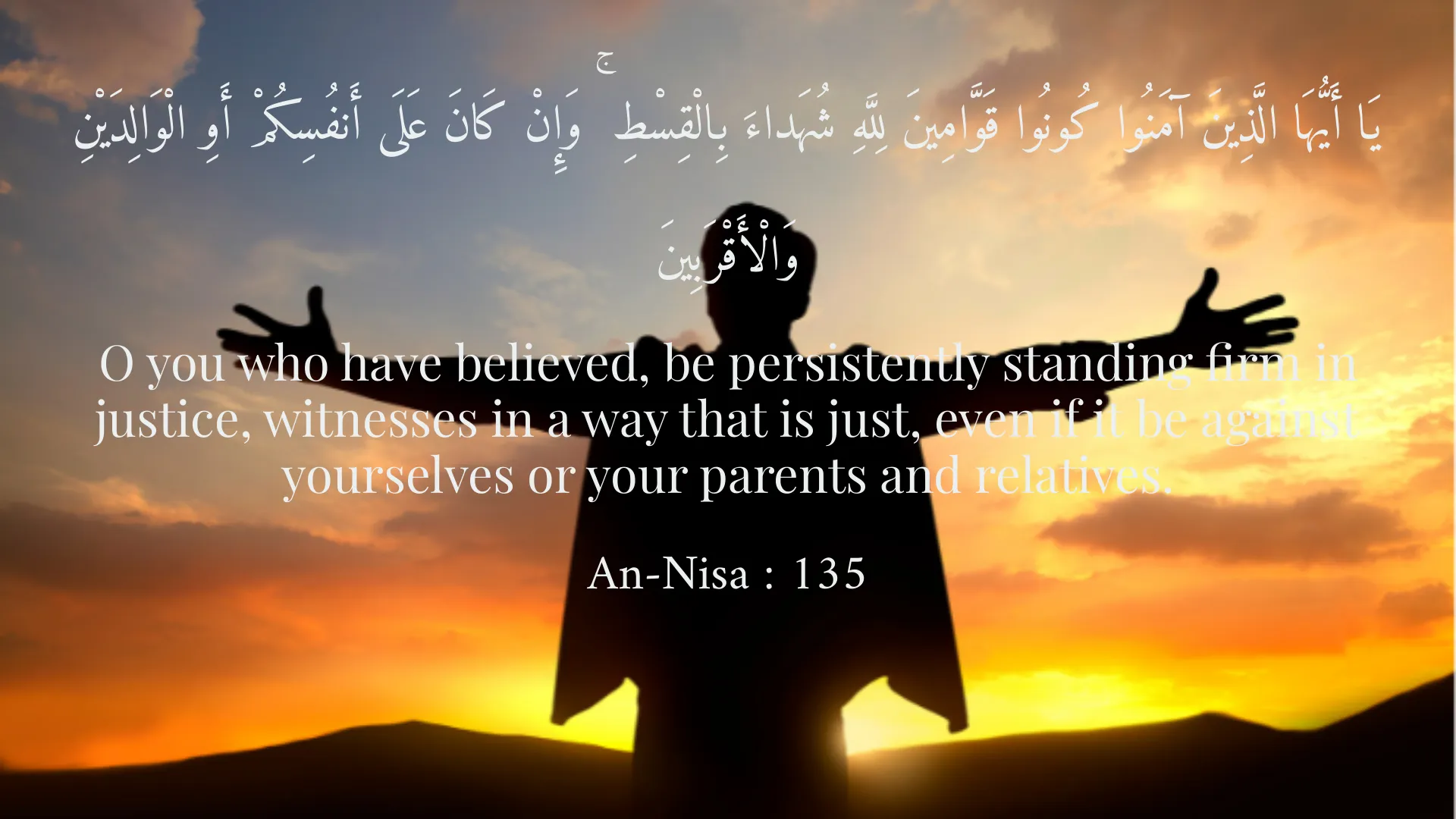
يَا أَيُّهَا الَّذِينَ آمَنُوا كُونُوا قَوَّامِينَ لِلَّهِ شُهَداءَ بِالْقِسْطِ ۚ وَإِنْ كَانَ عَلَى أَنفُسِكُمْ أَوِ الْوَالِدَيْنِ وَالْأَقْرَبِينَ
O you who have believed, be persistently standing firm in justice, witnesses in a way that is just, even if it be against yourselves or your parents and relatives.
An-Nisa : 135
وَلَا تَأْكُلُوا أَمْوَالَكُمْ بَيْنَكُمْ بِالْبَاطِلِ وَلَا تَدْفَعُوهَا إِلَى الْحُكَّامِ لِتَأْكُلُوا مِنْ أَمْوَالِ النَّاسِ بِالإِثْمِ وَأَنْتُمْ تَعْلَمُونَ
And do not consume one another's wealth unjustly or send it [in bribery] to the rulers in order that [they might aid] you [to] consume a portion of the wealth of the people in sin, while you know [it is unlawful].
Al-Baqarah : 188
Short Story
One day, a man named Ali was quarreling with someone in the market. He was lamenting the oppression he faced. In that moment, he remembered the Quranic verses that condemn oppression. He decided instead of seeking revenge, to work towards reforming society and to ask Allah for patience. In this way, Ali found peace and was able to make others aware of the ugliness of oppression through his kind behavior.