Quranic Answer
Marriage in the Quran: A Sacred Duty and Social Foundation The Quran holds a central place in the lives of Muslims, providing guidance on various aspects of life. Among these, the institution of marriage occupies a significant role, as it encompasses not only a sacred duty but also serves as an essential social framework. In exploring the concept of marriage as conveyed in the Quran, it becomes evident that it is revered and positioned as a divine ordinance that brings both spiritual fulfillment and social harmony. ### Marriage as a Divine Command In Surah An-Nur, verse 32, Allah addresses the believers with an encouragement to marry, emphasizing that it is a virtuous act. The verse states: "And marry those among you who are single, and those who are fit for marriage from among your male and female servants. If they are poor, Allah will enrich them from His bounty." This verse strongly indicates that marriage is not simply a personal desire or societal expectation but rather a divine command that carries the weight of responsibility. Allah assures that He will provide for those who may not have the financial means to marry, reinforcing the notion that marriage is a natural necessity, and, more importantly, that divine support will be given. This divine endorsement portrays marriage as a pivotal institution that strengthens the social fabric by uniting individuals and supporting family growth, welfare, and compassion. ### The Emotional and Spiritual Dimensions of Marriage Beyond the practical implications of marriage, the Quran dives deep into the emotional and spiritual advantages that this union brings. In Surah Ar-Rum, verse 21, Allah clarifies the purpose of marriage with profound clarity, stating: "And among His signs is that He created for you spouses from among yourselves that you may find tranquility in them, and He placed between you love and mercy." This verse conveys the essence of what it means to be married in the eyes of Islam. It speaks to the deeper connection between spouses, where love and mercy govern their relationship and inspire a tranquil home life. The mutual support between partners fosters emotional growth, where each individual aids the other in spiritual and personal development. Such a bond constructed on the tenets of love, mercy, and tranquility reflects the divine nature of marriage as not only a partnership but a shared spiritual journey. ### The Role of Family in Society As the Quran elaborates on marriage, it naturally extends the discussion to the family unit. Family is recognized as a vital building block of society. Surah Al-Ankabut, verse 21 states: "And if We had willed, We could have made every person marry their partner, but it is only by the grace and mercy of Allah that they can be guided otherwise." Here, the emphasis is placed on the divine wisdom behind the complexities of relationships. This verse reminds the believers that while Allah possesses the power to dictate unions, He grants free will, allowing individuals to choose their paths. The grace and mercy of Allah are barriers for guidance and connection, emphasizing that family ties are divinely sanctioned but also organically formed through love and mutual agreement. Family, as suggested in these verses, goes beyond mere blood relations; it encompasses the nurturing of relationships, the upbringing of children, and a sense of belonging which ultimately fosters community cohesion. These families become a nurturing ground for moral values and social responsibility, legitimizing the importance of marriage in the broader context of societal growth. ### Marriage’s Impact on Generational Continuity A critical aspect of marriage in the Quran is its role in the continuation of generations. By establishing a family formed through a loving marriage, individuals are fulfilling both a personal and broader societal responsibility. Children raised within the framework of a healthy marriage benefit from parental love, guidance, and the instillation of moral values. In essence, the continuity of generations is a central theme within Islamic teachings on marriage. As couples come together and establish families, they are not merely creating a household; they are upholding the continuity of Islam and contributing actively to future generations. The Quran emphasizes that it is through these familial connections that individuals can flourish, develop their identities, and uphold their community's values. ### Challenges and Resilience in Marriage It is essential to recognize that while marriage is viewed in a positive light within the Quran, it does not shy away from acknowledging the challenges that couples may face. The institution of marriage requires effort, mutual respect, and understanding to navigate life's vicissitudes. The Quran guides individuals through these challenges, providing principles that can help maintain marital harmony. Respect for one another, open communication, patience, and forgiveness are pivotal theme that resonates through Quranic teachings. As couples experience the various ups and downs of life together, their commitment to one another solidifies their bond, enabling them to transcend trials and emerge resilient as partners in both life and faith. In this light, the Quran provides both solace and encouragement to couples experiencing any form of trials, ensuring they adhere to the sacred values within their marriage. ### Conclusion In conclusion, the Quran presents marriage not merely as a social contract or cultural practice but as a sacred duty woven into the fabric of faith, offering both spiritual and emotional growth. By engaging in marriage, believers are fulfilling a divine command and establishing a foundation for their families and communities. The teachings emphasize that marriage instills love, mercy, and tranquility, which are necessary for personal growth and societal progress. Through understanding the holistic nature of marriage as outlined in the Quran, individuals can appreciate its significance on multiple fronts, both in nurturing themselves and in contributing to a harmonious and resilient society.
Related Verses
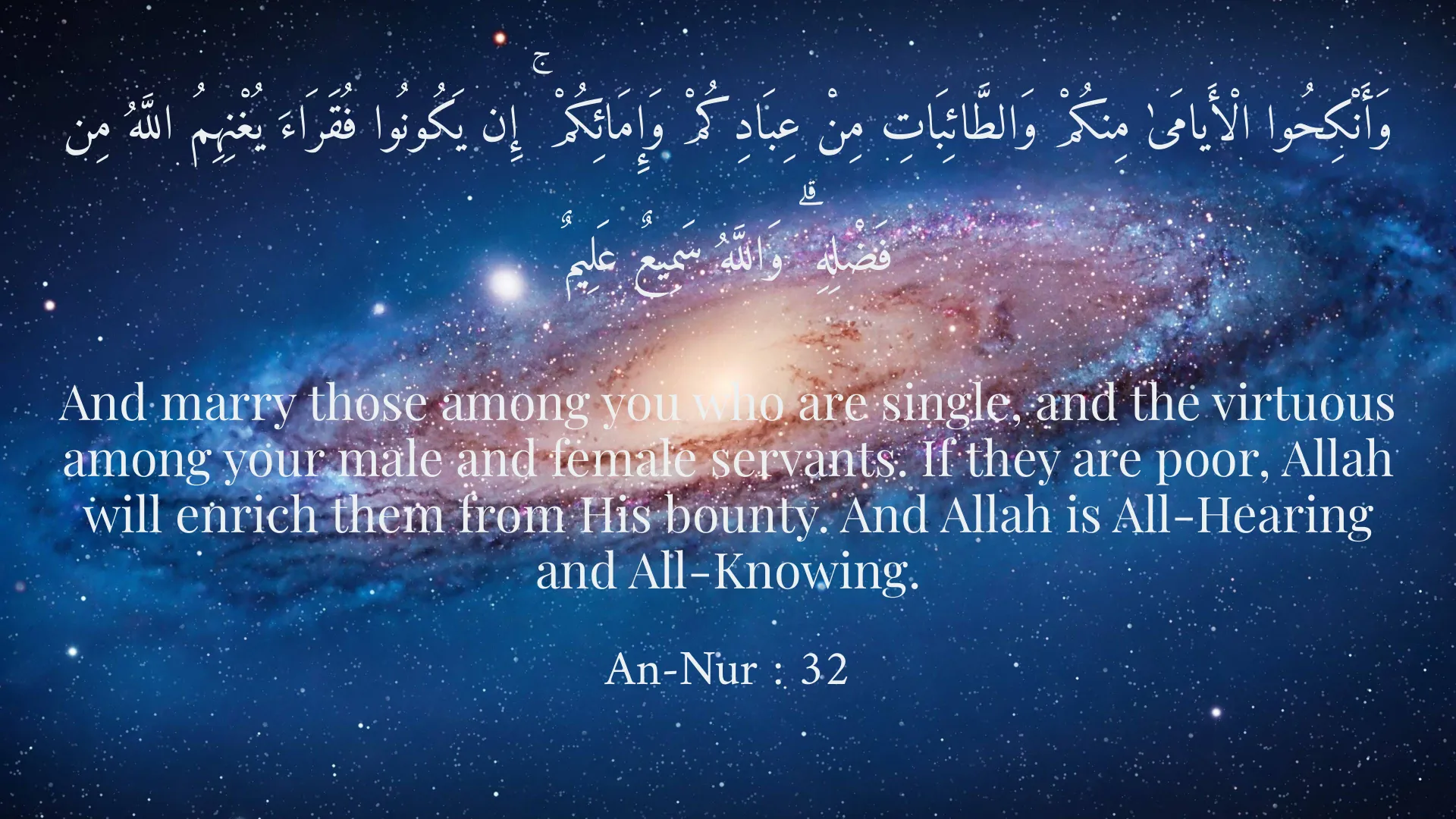
وَأَنْكِحُوا الْأَيامَىٰ مِنكُمْ وَالطَّائِبَاتِ مِنْ عِبَادِكُمْ وَإِمَائِكُمْ ۚ إِن يَكُونُوا فُقَرَاءَ يُغْنِهِمُ اللَّهُ مِن فَضْلِهِ ۗ وَاللَّهُ سَمِيعٌ عَلِيمٌ
And marry those among you who are single, and the virtuous among your male and female servants. If they are poor, Allah will enrich them from His bounty. And Allah is All-Hearing and All-Knowing.
An-Nur : 32
وَمِنْ آيَاتِهِ أَنْ خَلَقَ لَكُمْ مِّنْ أَنفُسِكُمْ أَزْوَاجًا لِّتَسْكُنُوا إِلَيْهَا وَجَعَلَ بَيْنَكُمْ مَوَدَّةً وَرَحْمَةً ۚ إِنَّ فِي ذَٰلِكَ لَأَيَاتٍ لّقَوْمٍ يَتَفَكَّرُونَ
And among His signs is that He created for you spouses from among yourselves that you may find tranquility in them and He placed between you love and mercy. Indeed, in that are signs for a people who give thought.
Ar-Rum : 21
وَلَوْ شَأَ اللَّهُ لَأَجْعَلَكُمْ أُمَّةً وَاحِدَةً وَلَكِن يُضِلُّ مَن يَشَاءُ وَيَهْدِي مَن يَشَاءُ ۗ وَإِنَّ اللَّهَ سَمِيعٌ عَلِيمٌ
And if Allah had willed, He would have made you one nation, but He causes to stray whom He wills and guides whom He wills. And Allah is All-Hearing and All-Knowing.
Al-Ankabut : 21
Short Story
One day, Hossein, a young man, was contemplating marriage and forming a family. He turned to the Quran and looked at the verses related to marriage. By reading Surah An-Nur and its soothing verses, he realized that Allah had instructed him to create a life filled with love and mercy alongside a spouse. Hossein decided to seek guidance from his religious teacher and discussed how to choose a suitable partner. A while later, he got married, and his life was filled with love and joy.