Quranic Answer
The Holy Quran offers a profound and multi-faceted perspective on migration (Hijra) and expatriation (ghurbah), encompassing both spiritual and social dimensions. This divine book often views migration not merely as a physical relocation but as a symbolic and spiritual journey towards perfection, religious freedom, and seeking refuge in the embrace of God. In numerous verses, migration undertaken to preserve one's faith and escape oppression is presented as a virtuous act, deserving immense divine rewards. This concept reaches its zenith in the historical account of the Prophet Muhammad's (PBUH) migration with his companions from Mecca to Medina, which serves as a timeless paradigm for all believers who endure hardships for the sake of God, even to the extent of leaving their homeland. One of the primary reasons for migration, from the Quran's perspective, arises when an individual or community in their place of residence is unable to freely practice their religious obligations and is subjected to oppression and persecution. In such circumstances, the Quran encourages believers to migrate, reminding them that Allah's earth is vast, and a safe haven for worship and a righteous life can be found elsewhere. This call to migration is not merely a suggestion but sometimes a divine imperative, neglecting which could amount to self-oppression. Verses such as Surah An-Nisa, verse 97, clearly emphasize this point, admonishing those who remained under oppression without migrating, except for those who were truly helpless. These verses teach us that preserving faith and human dignity takes precedence, even at the cost of abandoning one's home and native land. However, the Quran's view on migration is not solely confined to its religious aspect. It also encourages travel and movement on earth for seeking lawful sustenance and acquiring knowledge and wisdom. Surah Al-Muzzammil, verse 10, teaches us that there is abundant bounty and provision on earth for those who seek Allah's grace. This dimension of migration indicates that Islam does not favor stagnation but considers movement and dynamism as essential pillars of a healthy and productive life. Therefore, individuals who travel to other lands to improve their economic situation or attain better life opportunities are also, from the Quran's viewpoint, performing a legitimate and approved act, provided that these journeys are conducted within the boundaries of divine laws and human ethics. Alongside the concept of Hijra, the Quran also addresses the state of 'ghurbah' or expatriation, which signifies being away from one's homeland, family, and friends, and experiencing a sense of alienation in a foreign land. This state naturally entails emotional and psychological challenges, ranging from loneliness and homesickness to difficulties in adapting to a new environment and different culture. While the Quran does not directly delve into these specific feelings, it offers profound solace and strength to believers by emphasizing patience (sabr), reliance on God (tawakkul), and seeking refuge in Him in all circumstances. Expatriates and migrants are encouraged to endure hardships with reliance on God, knowing that Allah never wastes the reward of those who do good. Indeed, ghurbah can be an opportunity for self-development, strengthening one's faith, and increasing dependence on the Creator. This experience makes one realize that their true homeland is not this world but the Hereafter, and all of us are travelers in this world on our way to the ultimate destination. Furthermore, the Quran stresses the responsibility of the Muslim community towards migrants. The story of the Ansar of Medina, who welcomed the Muhajirun (migrants) from Mecca with open arms and selflessly embraced them as brothers, stands as an unparalleled example of social solidarity and upholding the rights of migrants, praised in numerous Quranic verses. This assistance and affection are not merely an ethical duty but an act of worship that yields abundant worldly and otherworldly rewards. The Quran guides the community to view migrants not as a burden, but as an integral part of the Ummah, and to assist them in resolving their problems. This perspective transforms ghurbah into an opportunity to strengthen the bonds of Islamic brotherhood and expand the circle of love and empathy. In conclusion, the Quran's perspective on migration and expatriation is comprehensive and elevated. It views migration not only as a response to external compulsions (such as oppression) but also as a conscious choice for spiritual growth, preserving human dignity, and seeking lawful sustenance. At the same time, recognizing the difficulties of expatriation, the Quran calls believers to patience and reliance on God and encourages society to support and show affection towards migrants. This viewpoint transforms migration into an opportunity for spiritual purification, strengthening faith, and spreading justice and solidarity in the world. Ghurbah, with all its challenges, can be a springboard to achieving higher spiritual ranks and a deeper understanding of the meaning of life, provided that one treads this path with faith and reliance on God.
Related Verses
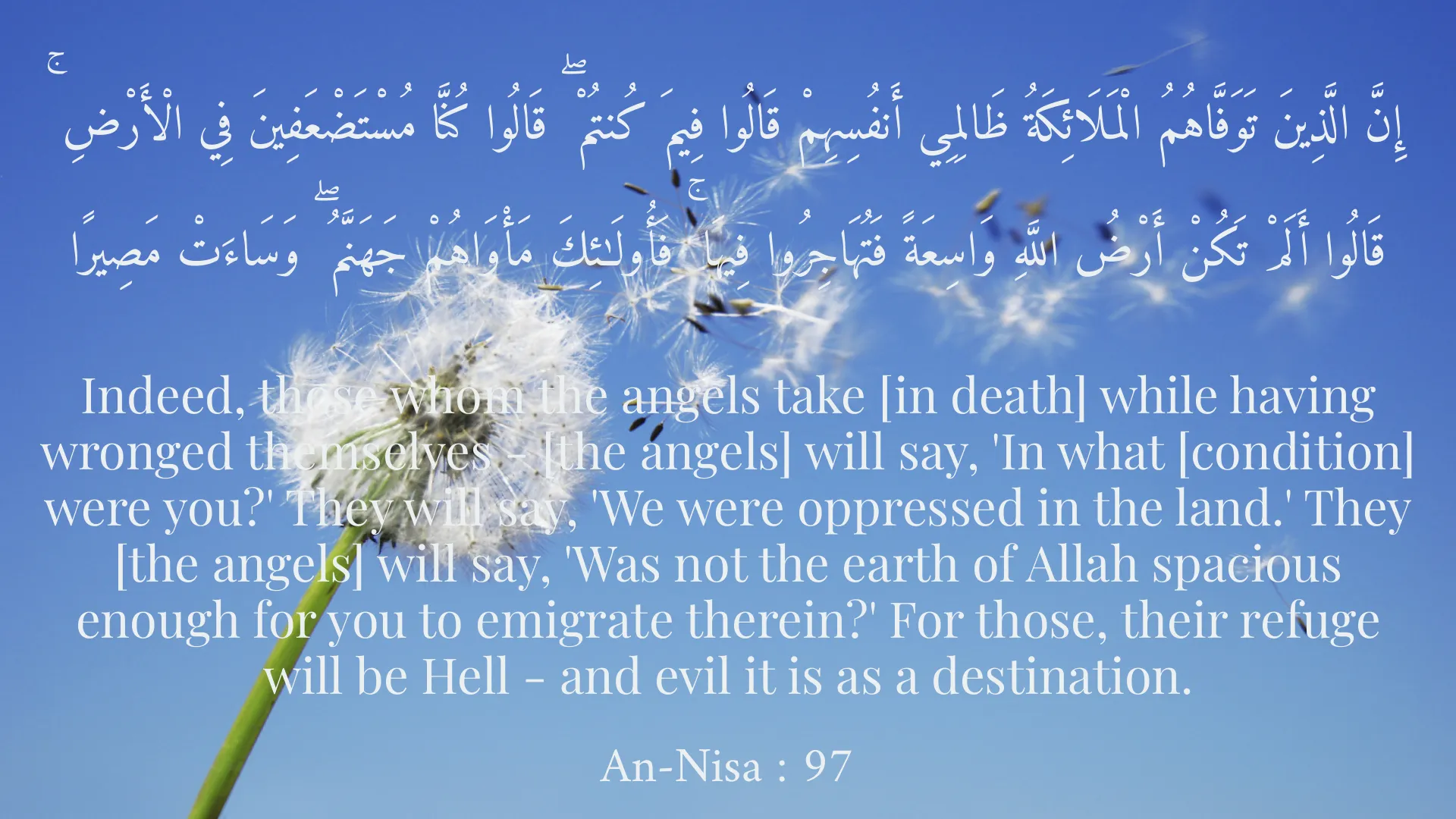
إِنَّ الَّذِينَ تَوَفَّاهُمُ الْمَلَائِكَةُ ظَالِمِي أَنفُسِهِمْ قَالُوا فِيمَ كُنتُمْ ۖ قَالُوا كُنَّا مُسْتَضْعَفِينَ فِي الْأَرْضِ ۚ قَالُوا أَلَمْ تَكُنْ أَرْضُ اللَّهِ وَاسِعَةً فَتُهَاجِرُوا فِيهَا ۚ فَأُولَٰئِكَ مَأْوَاهُمْ جَهَنَّمُ ۖ وَسَاءَتْ مَصِيرًا
Indeed, those whom the angels take [in death] while having wronged themselves - [the angels] will say, 'In what [condition] were you?' They will say, 'We were oppressed in the land.' They [the angels] will say, 'Was not the earth of Allah spacious enough for you to emigrate therein?' For those, their refuge will be Hell - and evil it is as a destination.
An-Nisa : 97
وَالَّذِينَ هَاجَرُوا فِي اللَّهِ مِن بَعْدِ مَا ظُلِمُوا لَنُبَوِّئَنَّهُمْ فِي الدُّنْيَا حَسَنَةً ۖ وَلَأَجْرُ الْآخِرَةِ أَكْبَرُ ۚ لَوْ كَانُوا يَعْلَمُونَ
And those who emigrated for [the cause of] Allah after they had been wronged - We will surely settle them in this world in a good [place], and the reward of the Hereafter is greater, if only they could know.
An-Nahl : 41
الَّذِينَ آمَنُوا وَهَاجَرُوا وَجَاهَدُوا فِي سَبِيلِ اللَّهِ بِأَمْوَالِهِمْ وَأَنفُسِهِمْ أَعْظَمُ دَرَجَةً عِندَ اللَّهِ ۚ وَأُولَٰئِكَ هُمُ الْفَائِزُونَ
Those who believed and emigrated and strove in the cause of Allah with their wealth and their lives are greater in rank in the sight of Allah. And it is those who are the attainers [of success].
At-Tawbah : 20
Short Story
It is narrated that a man had traveled from his homeland into expatriation, and the hardships of the journey had worn him down. One night, he sat alone and heartbroken in a caravanserai, sighing from the distance of his companions and homeland. A wise elder, who was there, observed his state and gently said: "O young man! Do you not know that this world is a transient abode, and we are all travelers within it? Whoever treads the path of God, even if in a foreign land, has Him as a companion. Exercise patience and rely on His mercy, for every stranger has a God, and every heart a refuge." The man was comforted by the elder's words and realized that expatriation, when accompanied by patience and reliance on God, is itself a path to perfection and a deeper understanding of the Divine Presence.