Quranic Answer
The Holy Quran offers a comprehensive and balanced perspective on the status and role of women in society, which, contrary to common misconceptions, is remarkably progressive and liberating. In the Quranic view, men and women are created from a single soul, indicating no fundamental difference in their inherent human worth or dignity. Both genders are equally accountable before God for their deeds, share individual responsibility, and pursue spiritual perfection. This equality is explicitly affirmed in several verses. For instance, in Surah Al-Imran, verse 195, Allah states: “So their Lord responded to them, 'Indeed, I will not allow to be lost the work of [any] doer among you, whether male or female.'” This verse clearly demonstrates that the criterion for divine valuation and reward is piety and righteous deeds, not gender. Regarding social responsibilities, the Quran imposes no inherent restrictions on women's participation in various societal spheres; instead, it provides avenues for their active and effective involvement. The most significant social responsibility emphasized in the Quran and the Sunnah of Prophet Muhammad (PBUH) is women's role within the family and in nurturing future generations. Mothers are considered the fundamental pillars of the family and architects of their children's characters, playing an unparalleled role in shaping the future of society. The Quran strongly recommends kindness to parents, especially mothers, highlighting the foundational importance of women's educational and nurturing role in the community. Furthermore, in marital relations, men and women are described as complementary to each other: “They are clothing for you, and you are clothing for them” (Al-Baqarah/187), symbolizing mutual tranquility, protection, and solidarity. This partnership forms the basis of shared responsibility within the family unit. In the public sphere, the Quran refers to believing men and women as “allies and protectors of one another,” sharing the social responsibility of enjoining what is right and forbidding what is wrong (Al-Tawbah/71). This verse implies that women, like men, have a duty to actively contribute to societal reform and the promotion of ethical and divine values. This responsibility can manifest in various forms, including educational, cultural, charitable, and healthcare activities, as well as participation in social and political consultations, provided these activities do not conflict with Islamic ethical principles and legal boundaries. Islamic history offers numerous examples of learned women, traditionists, jurists, businesswomen, and even those involved in social and political spheres who, inspired by Quranic teachings, played significant roles. Women's economic rights are also explicitly stated in the Quran. Women have the right to independently use their wealth, earn income, and inherit property. Verse 7 of Surah An-Nisa states: “For men is a share of what the parents and close relatives leave, and for women is a share of what the parents and close relatives leave, be it little or much - an obligatory share.” This verse establishes the right to ownership and inheritance for women, a right that was often denied in pre-Islamic times. Economic freedom allows women to play a more active role in society and participate in charitable and social affairs without complete financial dependence on others. Protecting women's privacy and dignity is also among the Quranic injunctions; hijab, as a covering and a boundary, is not a restriction but a means to preserve modesty and prevent the objectification of women in society, enabling them to participate in social arenas with peace of mind and focus on their intellectual and moral capabilities. This allows for their full and dignified contribution. Therefore, the Quran's perspective on women and their social responsibilities is comprehensive, just, and empowering. The Quran considers women to be complete human beings, endowed with rights and duties equal to men in relation to God and society, while emphasizing the complementary and distinct roles that each gender plays within the family and community. This perspective not only grants women the right to social activity and participation but also encourages it, provided that these activities are conducted within the framework of Islamic ethics and uphold human dignity. This approach liberated women from the constraints of the pre-Islamic era and granted them a dignified status on the path of perfection and social progress.
Related Verses
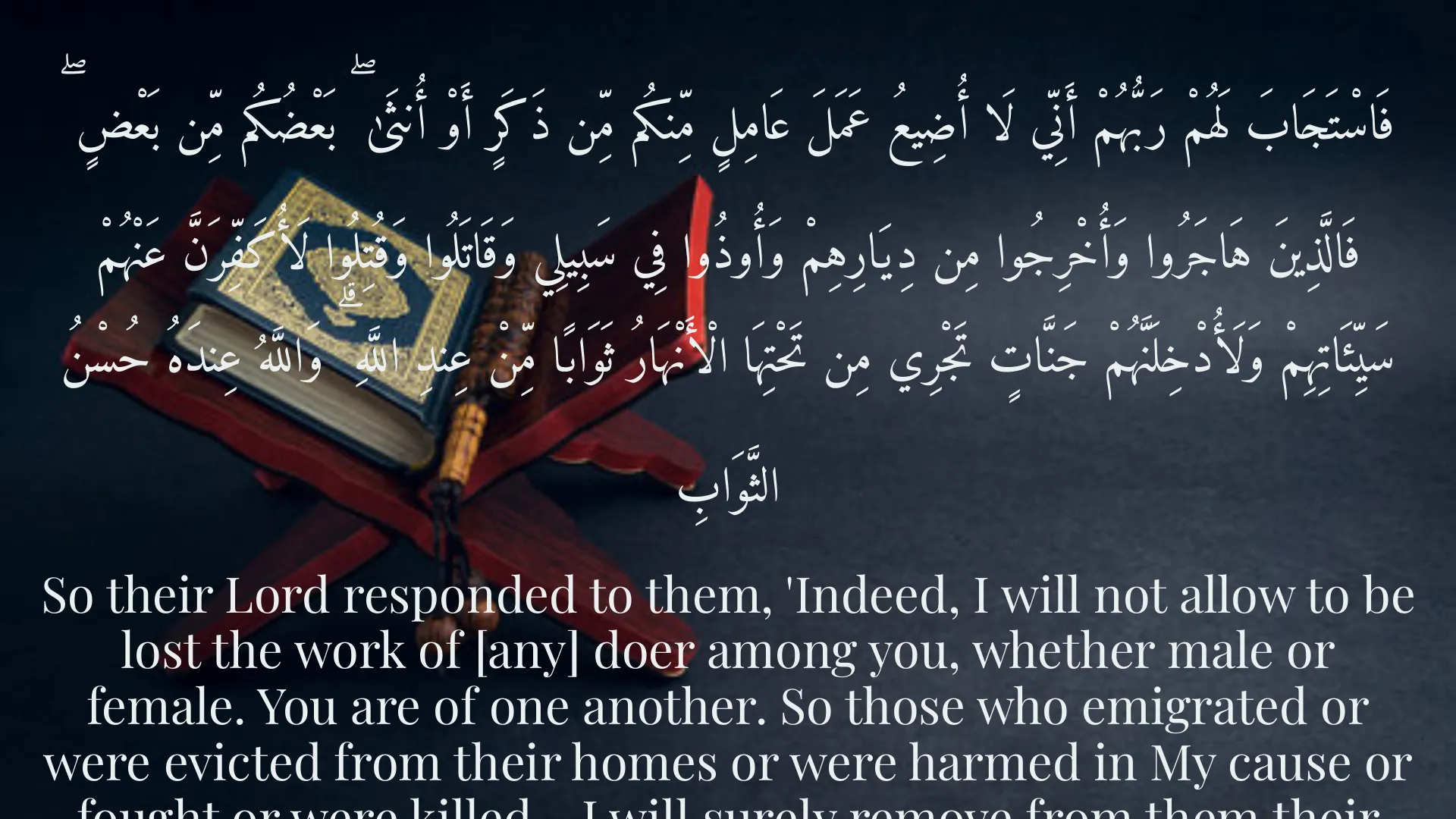
فَاسْتَجَابَ لَهُمْ رَبُّهُمْ أَنِّي لَا أُضِيعُ عَمَلَ عَامِلٍ مِّنكُم مِّن ذَكَرٍ أَوْ أُنثَىٰ ۖ بَعْضُكُم مِّن بَعْضٍ ۖ فَالَّذِينَ هَاجَرُوا وَأُخْرِجُوا مِن دِيَارِهِمْ وَأُوذُوا فِي سَبِيلِي وَقَاتَلُوا وَقُتِلُوا لَأُكَفِّرَنَّ عَنْهُمْ سَيِّئَاتِهِمْ وَلَأُدْخِلَنَّهُمْ جَنَّاتٍ تَجْرِي مِن تَحْتِهَا الْأَنْهَارُ ثَوَابًا مِّنْ عِندِ اللَّهِ ۗ وَاللَّهُ عِندَهُ حُسْنُ الثَّوَابِ
So their Lord responded to them, 'Indeed, I will not allow to be lost the work of [any] doer among you, whether male or female. You are of one another. So those who emigrated or were evicted from their homes or were harmed in My cause or fought or were killed - I will surely remove from them their misdeeds, and I will surely admit them to gardens beneath which rivers flow as reward from Allah, and Allah with Him is the best of reward.'
Al-Imran : 195
وَالْمُؤْمِنُونَ وَالْمُؤْمِنَاتُ بَعْضُهُمْ أَوْلِيَاءُ بَعْضٍ ۚ يَأْمُرُونَ بِالْمَعْرُوفِ وَيَنْهَوْنَ عَنِ الْمُنكَرِ وَيُقِيمُونَ الصَّلَاةَ وَيُؤْتُونَ الزَّكَاةَ وَيُطِيعُونَ اللَّهَ وَرَسُولَهُ ۚ أُولَٰئِكَ سَيَرْحَمُهُمُ اللَّهُ ۗ إِنَّ اللَّهَ عَزِيزٌ حَكِيمٌ
The believing men and believing women are allies of one another. They enjoin what is right and forbid what is wrong and establish prayer and give zakah and obey Allah and His Messenger. Those - Allah will have mercy upon them. Indeed, Allah is Exalted in Might and Wise.
At-Tawbah : 71
لِلرِّجَالِ نَصِيبٌ مِّمَّا تَرَكَ الْوَالِدَانِ وَالْأَقْرَبُونَ وَلِلنِّسَاءِ نَصِيبٌ مِّمَّا تَرَكَ الْوَالِدَانِ وَالْأَقْرَبُونَ مِمَّا قَلَّ مِنْهُ أَوْ كَثُرَ ۚ نَصِيبًا مَّفْرُوضًا
For men is a share of what the parents and close relatives leave, and for women is a share of what the parents and close relatives leave, be it little or much - an obligatory share.
An-Nisa : 7
Short Story
Long ago, in a city whose name is lost to history, a severe dispute arose over irrigation rights for the fields. The elders and notables of the city tried as they might, but could not reach a just solution. Drought and discord exacerbated the people's suffering. Amidst this, a wise and benevolent old woman lived in a corner of the city, known for her deep knowledge and profound insight, though she never participated in formal gatherings. Upon the advice of a devout young man, the people turned to her. After listening to the grievances and arguments of both sides, the old woman, in a calm tone and gentle speech, said: “O people, Allah has bestowed His blessings equally upon all. Water is life, and life cannot be monopolized by a limited group. A way must be found for everyone to benefit from it, and for no one to suffer, not based on power, but on need and justice.” She proposed a solution where water was allocated to each farmer in turns, based on the size of their land, but with the condition that each person, during their turn, would save a surplus of water for their neighbors in times of emergency. This plan was a symbol of solidarity and altruism. Upon hearing her words, the people were astonished by her sagacious judgment and implemented it. Thus, peace and abundance returned to the city, and that wise woman, without holding any official position, brought tranquility to the citizens through her knowledge and social responsibility, demonstrating that wisdom and foresight emanate not only from men but also from women and can bring prosperity to a community.