Quranic Answer
In the Quranic perspective, the concepts of time and eternity are not merely separate entities but are profoundly and fundamentally intertwined. Understanding this relationship is crucial for comprehending the purpose of creation and the path of human life. The Holy Quran introduces time not as an absolute and endless concept, but rather as a creation of God, a means to test human beings and reveal their deeds. This world, Dunya, is a realm where time flows linearly and finitely; it has a definite beginning and end, and every moment within it is considered an opportunity to plant the seeds of eternity. In contrast, eternity, or Abadiyyah, refers to timelessness and endlessness, pertaining to life after death – the Hereafter, Paradise, and Hell – as well as to the everlasting essence of the Divine Being. These two concepts are explained in the Quran as two sides of the same coin, each complementing the other. The Quran repeatedly points to the transient and perishable nature of worldly life. Verses such as "And what is the life of this world except the enjoyment of delusion?" (Al-Imran: 185) or the description of worldly life as rain that makes plants flourish and then wither (Al-Kahf: 45) clearly demonstrate the limitation and impermanence of time in this world. This transience of time warns humans that their opportunities are limited and that they must utilize every moment to accumulate good deeds and gain divine pleasure. Indeed, time in this world is a field of action, a farm where humans sow the seeds of their deeds and will harvest their produce in eternity. Every action, word, and even intention formed during this short temporal span will have an everlasting repercussion in the eternal abode. From this perspective, time is not merely a measure of life but transforms into a scale for valuing deeds. On the other hand, eternity in the Quran is described as the ultimate destination and the inevitable fate of human beings after death. The Hereafter (Akhirah) is a realm where the worldly concepts of time and space lose their meaning. The Holy Quran, in describing the Day of Judgment and the states of the dwellers of Paradise and Hell, emphasizes the eternal nature of life after death. For instance, in Surah Hud, verses 107 and 108, Allah states: "They will abide therein as long as the heavens and the earth endure, except what your Lord wills," indicating that residence in Paradise and Hell will be as long as the heavens and the earth exist (which in the Quranic view signifies relative eternity), unless Allah wills otherwise. However, in other verses, the absolute eternity for the righteous inhabitants of Paradise and the wrongdoers in Hell is also mentioned. This eternity is a direct and immediate consequence of the actions performed during the limited time in this world. This means that every action, no matter how small, can have eternal and boundless results. Furthermore, the relationship between these two concepts manifests in the description of the Divine Being. Allah is introduced in the Quran as "The First and The Last" (Al-Hadid: 3); He is the One who exists before the beginning of time and after its end, and His existence is independent of any temporal constraint. This implies that time itself is a creation that Allah has brought into being and over which He has complete dominance. From this perspective, the divine view of time is entirely different from the human view. For Allah, all times – past, present, and future – are simultaneously and eternally manifest and known. This truth provides humans with comfort and assurance that even amidst the passage of time and changes, there is a constant and stable Being who encompasses all affairs and holds the reins of everything. In summary, the Quran considers time a precious opportunity and a test for human beings to properly utilize it to secure provisions for their eternity. This relationship is not one-sided; eternity also gives meaning to time and defines the ultimate goal for human actions and endeavors in this world. Without an understanding of eternity, time becomes a meaningless and aimless cycle. But with the existence of eternity, every moment of worldly time transforms into a piece of a larger puzzle that shapes a person's everlasting destiny. Therefore, the Quran invites humans to reflect on the passage of time and prepare for the eternal abode, teaching them that every moment of worldly life is an unparalleled opportunity to build an eternal future.
Related Verses
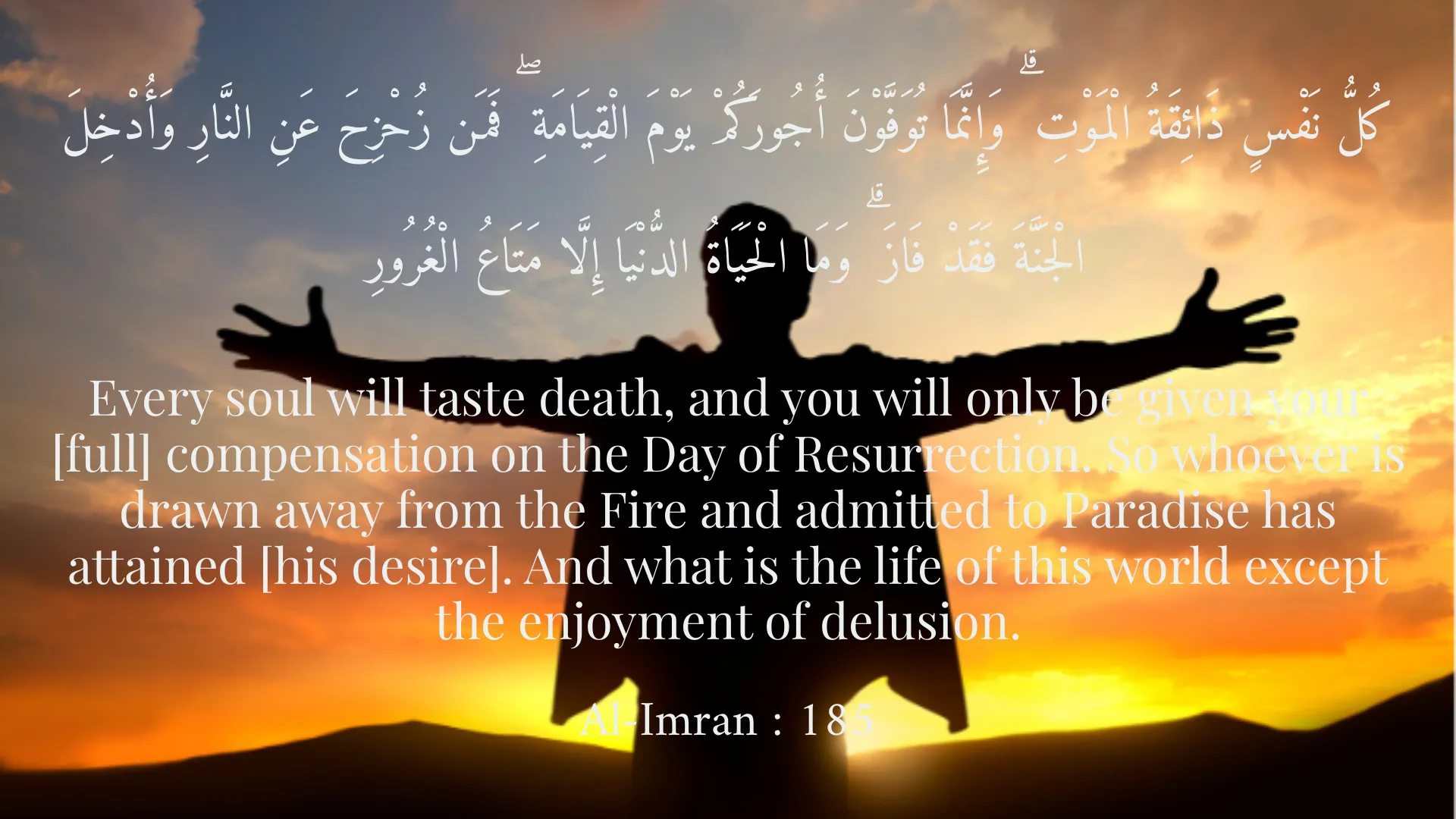
كُلُّ نَفْسٍ ذَائِقَةُ الْمَوْتِ ۗ وَإِنَّمَا تُوَفَّوْنَ أُجُورَكُمْ يَوْمَ الْقِيَامَةِ ۖ فَمَن زُحْزِحَ عَنِ النَّارِ وَأُدْخِلَ الْجَنَّةَ فَقَدْ فَازَ ۗ وَمَا الْحَيَاةُ الدُّنْيَا إِلَّا مَتَاعُ الْغُرُورِ
Every soul will taste death, and you will only be given your [full] compensation on the Day of Resurrection. So whoever is drawn away from the Fire and admitted to Paradise has attained [his desire]. And what is the life of this world except the enjoyment of delusion.
Al-Imran : 185
وَاضْرِبْ لَهُم مَّثَلَ الْحَيَاةِ الدُّنْيَا كَمَاءٍ أَنزَلْنَاهُ مِنَ السَّمَاءِ فَاخْتَلَطَ بِهِ نَبَاتُ الْأَرْضِ فَأَصْبَحَ هَشِيمًا تَذْرُوهُ الرِّيَاحُ ۗ وَكَانَ اللَّهُ عَلَىٰ كُلِّ شَيْءٍ مُّقْتَدِرًا
And present to them the example of the life of this world, [being] like rain which We have sent down from the sky, and the vegetation of the earth mingles with it and [then] it becomes dry remnants scattered by the winds. And Allah is over all things competent.
Al-Kahf : 45
هُوَ الْأَوَّلُ وَالْآخِرُ وَالظَّاهِرُ وَالْبَاطِنُ ۖ وَهُوَ بِكُلِّ شَيْءٍ عَلِيمٌ
He is the First and the Last, the Outward and the Inward; and He is, of all things, Knowing.
Al-Hadid : 3
Short Story
Once upon a time, the wise man Saadi was strolling in his garden, pondering the passage of life. One of his disciples asked him, "Master, why do people become so attached to this fleeting world and neglect thoughts of the eternal abode?" Saadi smiled and said: "My son, the story of humanity is like that of a traveler who spreads out his belongings in a caravanserai on the way, and settles in so comfortably as if it were his eternal home. Yet, he is oblivious that the true destination lies ahead, and this caravanserai is merely a place for a brief rest. The more he attaches his heart to this transient dwelling, the further he strays from his provisions for the journey, and when the call to depart sounds, he will set off empty-handed and regretful. The wise person is one who takes only what is necessary from this worldly caravanserai and dedicates the rest of his effort to preparing provisions for the irreversible journey." This story, told in a friendly tone, reminds us that our time in this world is very short, and we must make the most of it to prepare for eternal life.