Quranic Answer
Fear of death is a fundamental part of human existence that many individuals face. It is a universal experience that transcends cultures, beliefs, and personal circumstances. Most people will encounter this fear at some point during their lives, leading to a multitude of reactions, thoughts, and emotions. The Holy Quran, regarded as the holy book of Islam, addresses this critical aspect of life with profound clarity and insight, offering guidance not only for the believer but for humanity as a whole. The Quran emphasizes that death is an undeniable reality that every person must eventually confront. In Surah Al-Mu’minun, verses 99-100, Allah states that when death approaches, people find themselves filled with regret and wish they could return to life to perform righteous deeds: 'Until, when death comes to one of them, he says, "My Lord, send me back that I might do righteousness in that which I left behind." No! It is only a word he is saying; and behind them is a barrier until the Day they are resurrected.' This poignant passage illustrates that the fear of death is often rooted in feelings of inadequacy and the realization that one may not have accomplished everything they intended to while alive. As Muslims believe that life is a test, this perspective causes many to reflect on their actions and the legacy they are leaving behind. The recognition of the transient nature of life is reinforced in Surah At-Tawbah, verse 185, where it is written: 'Every soul will taste death, and you will only be given your [complete] compensation on the Day of Resurrection.' This succinctly captures the essence of the human experience, indicating that life is fleeting and that individuals must prepare for the everlasting life in the Hereafter. The fear of death is further exacerbated by the apprehension that individuals may face dire consequences for their actions on that fateful day. The thought of divine judgment and accountability weighs heavily on the minds of many, creating a significant source of anxiety. In fact, in Surah Al-Baqarah, verse 154, the Quran emphasizes the inevitability of death: 'And do not say about those who are killed in the cause of Allah, "They are dead." Rather, they are alive, but you perceive [it] not.' This verse encourages believers to understand that death is not the end but a transition into a new existence. Such awareness can alleviate the grip of fear and instead nurture hope and faith in the promises of the Hereafter. The idea that death leads to eternal life and a state of being that transcends mortality can indeed transform fear into hope. For instance, many religious teachings emphasize the importance of good deeds, compassion, and nurturing one's spirituality, which can serve as a buffer against the dread of death. When individuals begin to see life as an opportunity to cultivate goodness and prepare for a more profound existence after death, they may approach their mortality from a different perspective. However, it is essential to recognize that the fear of death is not solely a spiritual phenomenon; it is also influenced by various cultural, social, and psychological factors. Different cultures have distinct beliefs and practices surrounding death, which can frame how individuals perceive and deal with their mortality. In some cultures, death is celebrated as a natural part of life, whereas, in others, it is met with fear and sadness. These cultural narratives shape people's attitudes towards death and might either heighten or alleviate their fears. Additionally, psychological factors such as an individual's mindset, past experiences with loss, and even mental health can deeply affect one's approach to death. For instance, those who have experienced significant trauma related to mortality may harbor more intense fears compared to those who have not encountered such experiences. Effective coping mechanisms for managing the fear of death may include fostering spiritual beliefs, engaging in open conversations about mortality, seeking therapy, or participating in community support groups. Awareness of the human condition and acceptance of death as an intrinsic part of life can pave the way for peace and acceptance. This reflects the teaching in the Quran to approach existential realities with gratitude and understanding. By acknowledging the transitory nature of life while nurturing a strong faith in the Hereafter, individuals can cultivate resilience against the fear of death. Moreover, the transformative power of education cannot be overlooked. Knowledge about life, death, and what lies beyond can empower individuals to confront their fears head-on. Educational programs and discussions surrounding mortality can teach people to view death not as an end, but as part of a larger cycle that includes life, afterlife, and rebirth. In conclusion, while the fear of death is a fundamental human experience, understanding this phenomenon through the lens of spirituality, culture, and psychology can provide much-needed context and comfort. The Holy Quran offers profound insights into mortality, guiding believers to navigate their fears with wisdom and faith. Through this understanding, the acceptance of death can lead to a more meaningful life, characterized by righteous deeds and a focus on spiritual growth. Ultimately, embracing the realities of life and the Hereafter can help individuals manage their fears and find greater peace, allowing them to fully engage with the present while preparing for what lies ahead.
Related Verses
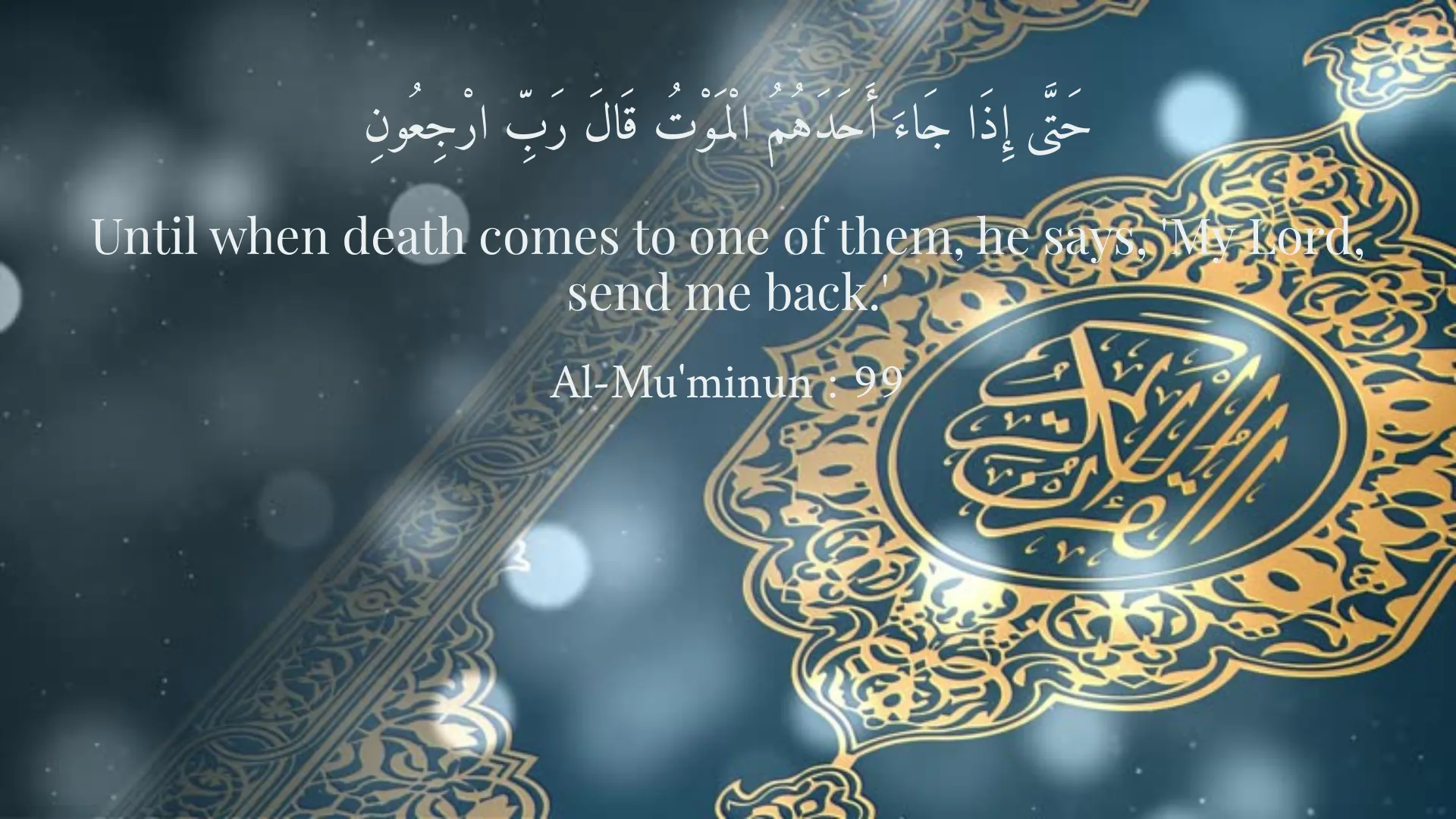
حَتَّى إِذَا جَاءَ أَحَدَهُمُ الْمَوْتُ قَالَ رَبِّ ارْجِعُونِ
Until when death comes to one of them, he says, 'My Lord, send me back.'
Al-Mu'minun : 99
كُلُّ نَفْسٍ ذَائِقَةُ الْمَوْتِ ۖ وَإِنَّمَا تُوَفَّوْنَ أُجُورَكُمْ يَوْمَ الْقِيَامَةِ ۚ فَمَن زُحْزِحَ عَنِ النَّارِ وَأُدْخِلَ الْجَنَّةَ فَقَدْ فَازَ ۚ وَمَا الْحَيَاةُ الدُّنْيَا إِلَّا متَاعُ الْغُرُورِ
Every soul will taste death. And you will only be given your full compensation on the Day of Resurrection. So he who is evicted from the Fire and admitted to Paradise has attained what he was rewarded. And what is the worldly life except the enjoyment of delusion?
At-Tawbah : 185
وَلَا تَقُولُوا لِمَن يُقَتَلُ فِي سَبِيلِ اللَّهِ أَمْوَاتٌ ۖ بَلْ أَحْيَاءٌ وَلَكِن لَّا تَشْعُرُونَ
And do not say about those who are killed in the cause of Allah, 'They are dead.' Rather, they are alive, but you perceive [it] not.
Al-Baqarah : 154
Short Story
One day, a man was sitting by the beach, gazing at the sea. He shared with his friends, "I always fear death because I don’t know what happens next." One of his friends smiled and replied, "My friend, death is a gateway to eternal life. Perhaps our fear comes from the unknown, but if we do good, we can hope to see each other again one day." These words brought him tranquility and made him realize that life and death are two sides of the same coin.