Quranic Answer
The concept of 'pure intention,' known as Ikhlas in Arabic, is one of the most fundamental and crucial principles in Islamic teachings and the Holy Quran. Ikhlas means performing all actions and acts of worship solely to gain the pleasure and approval of Allah (God), without any worldly motivations, desire for human attention, or aspiration for status among people. The Quran explicitly commands that our deeds must be performed purely for Him and with a sincere intention. For instance, in Surah Al-Bayyinah, verse 5, Allah states: “And they were not commanded except to worship Allah, [being] sincere to Him in religion, inclining to truth, and to establish prayer and to give zakat. And that is the correct religion.” This verse clearly indicates that the core of religious practice is sincerity in servitude to God. Despite these emphatic directives, why do we sometimes find it challenging to maintain pure intention and face difficulties in the sincerity of our intentions? This issue stems from various roots, many of which are mentioned in the Quranic verses and Islamic teachings. One of the most significant obstacles is the whispers of Satan (Waswas). Satan, the sworn enemy of humanity, constantly strives to divert our good deeds from the path of sincerity. He instills evil thoughts, leading individuals towards hypocrisy (Riya), self-display, or seeking praise from others. Surah An-Nas, verses 4-6, refers to this whisperer: “From the evil of the whisperer, the one who withdraws. Who whispers into the hearts of mankind. From among the jinn and mankind.” These whispers can divert our intention from its primary goal, which is divine pleasure. The second major factor is excessive attachment to the worldly life and its allurements (Hubb al-Dunya). When the love of this world takes root in the human heart, actions inadvertently acquire a worldly hue. A person might outwardly perform a deed for God, but inwardly, their aim might be to acquire wealth, status, fame, or other temporal benefits. The Holy Quran repeatedly warns humanity against preferring worldly life over the Hereafter. For example, in Surah At-Tawbah, verse 38, we read: “O you who have believed, what is [the matter] with you that when you are told to go forth in the cause of Allah, you adhere heavily to the earth? Are you satisfied with the worldly life instead of the Hereafter? But what is the enjoyment of worldly life compared to the Hereafter except a little?” This verse illustrates how attachment to worldly matters can impede sincere jihad and sacrifice in the path of God. Riya' (showing off or hypocrisy) is itself a branch of worldly attachment and a consequence of Satanic whispers, directly targeting pure intention. Riya' means performing actions to be seen by others and to gain their praise, rather than for God's pleasure. This act nullifies the spiritual reward of the deed and is referred to in some narrations as 'hidden Shirk' (associating partners with God covertly). The Quran also condemns hypocrites who perform their prayers lazily and to show off to people. Weakness of faith (Iman) and heedlessness of God's remembrance (Ghaflah) are other reasons that can hinder sincerity. When a person's connection with God weakens and they remember Him less frequently, their heart becomes susceptible to non-divine motivations. Conversely, one who constantly remembers God and has strong faith is better able to purify their actions for His pleasure. To overcome these challenges and attain pure intention, the Quran and Sunnah offer solutions: Firstly, constant remembrance of Allah (Dhikrullah) keeps the heart awake and purifies it from impurities. Secondly, seeking refuge in Allah from the evil of Satan by reciting specific verses and supplications blocks the infiltration of whispers. Thirdly, contemplating the Hereafter and the insignificance of worldly life compared to eternal rewards helps individuals reassess their priorities. Fourthly, performing good deeds in secret as much as possible helps train and strengthen pure intention, as in this case, Allah is the sole observer. Fifthly, self-accountability (Muhasabah) and constant self-awareness of inner motives before, during, and after performing any action are highly effective for discerning and purifying intentions. Finally, supplication (Du'a) and humble pleading to Allah for help in preserving sincerity are vital, as success in any good deed comes from Him. This is a continuous inner struggle, but with reliance on God and persistent effort, one can achieve the sublime status of sincerity and taste the sweetness of divine pleasure.
Related Verses
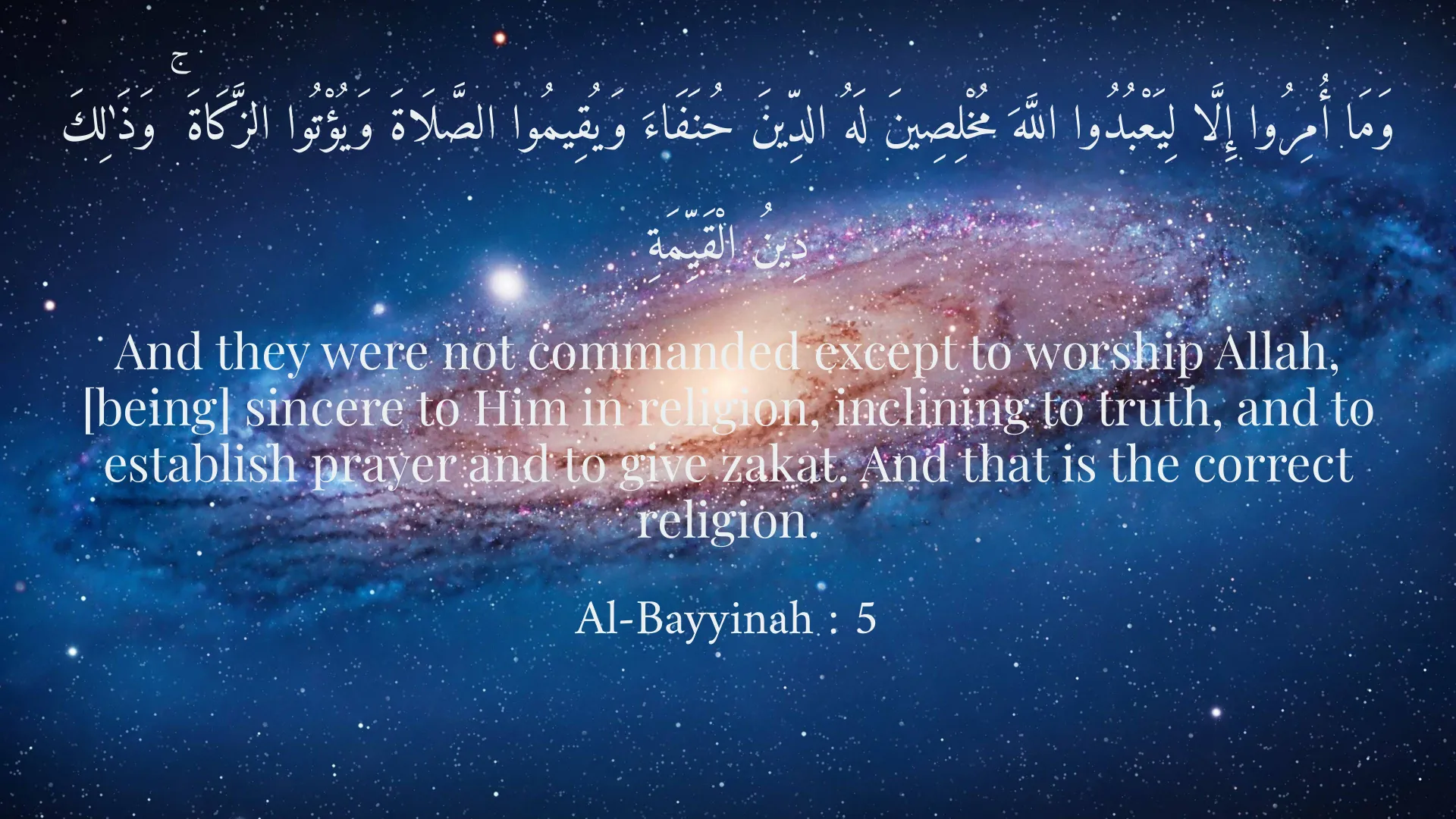
وَمَا أُمِرُوا إِلَّا لِيَعْبُدُوا اللَّهَ مُخْلِصِينَ لَهُ الدِّينَ حُنَفَاءَ وَيُقِيمُوا الصَّلَاةَ وَيُؤْتُوا الزَّكَاةَ ۚ وَذَٰلِكَ دِينُ الْقَيِّمَةِ
And they were not commanded except to worship Allah, [being] sincere to Him in religion, inclining to truth, and to establish prayer and to give zakat. And that is the correct religion.
Al-Bayyinah : 5
مِن شَرِّ الْوَسْوَاسِ الْخَنَّاسِ
From the evil of the whisperer, the one who withdraws.
An-Nas : 4
الَّذِي يُوَسْوِسُ فِي صُدُورِ النَّاسِ
Who whispers into the hearts of mankind,
An-Nas : 5
مِنَ الْجِنَّةِ وَالنَّاسِ
From among the jinn and mankind.
An-Nas : 6
يَا أَيُّهَا الَّذِينَ آمَنُوا مَا لَكُمْ إِذَا قِيلَ لَكُمُ انفِرُوا فِي سَبِيلِ اللَّهِ اثَّاقَلْتُمْ إِلَى الْأَرْضِ ۚ أَرَضِيتُم بِالْحَيَاةِ الدُّنْيَا مِنَ الْآخِرَةِ ۚ فَمَا مَتَاعُ الْحَيَاةِ الدُّنْيَا فِي الْآخِرَةِ إِلَّا قَلِيلٌ
O you who have believed, what is [the matter] with you that when you are told to go forth in the cause of Allah, you adhere heavily to the earth? Are you satisfied with the worldly life instead of the Hereafter? But what is the enjoyment of worldly life compared to the Hereafter except a little?
At-Tawbah : 38
Short Story
It is narrated that one day, a devout worshipper stood in prayer in a corner of the mosque, bowing and prostrating with such humility and reverence that it astonished every observer. A wise man, passing by, paused for a moment and observed the worshipper carefully. After the prayer, the wise man approached the worshipper and, with a kind smile, said: 'Your prayer was beautiful and your humility commendable, but did you not, during your prostration, glance slightly this way to see if anyone was observing you?' The worshipper lowered his head, ashamed. The wise man continued: 'He who worships solely for the pleasure of the Truth has no need for the gaze of creation. Sincerity is like a clear spring that flows only towards the sea of truth, not towards the small ponds of this person's or that person's praise.' The worshipper learned a valuable lesson from this wise counsel, and from then on, he strived to seek only God's view, not that of people, and felt the sweetness of true peace in his heart.