Quranic Answer
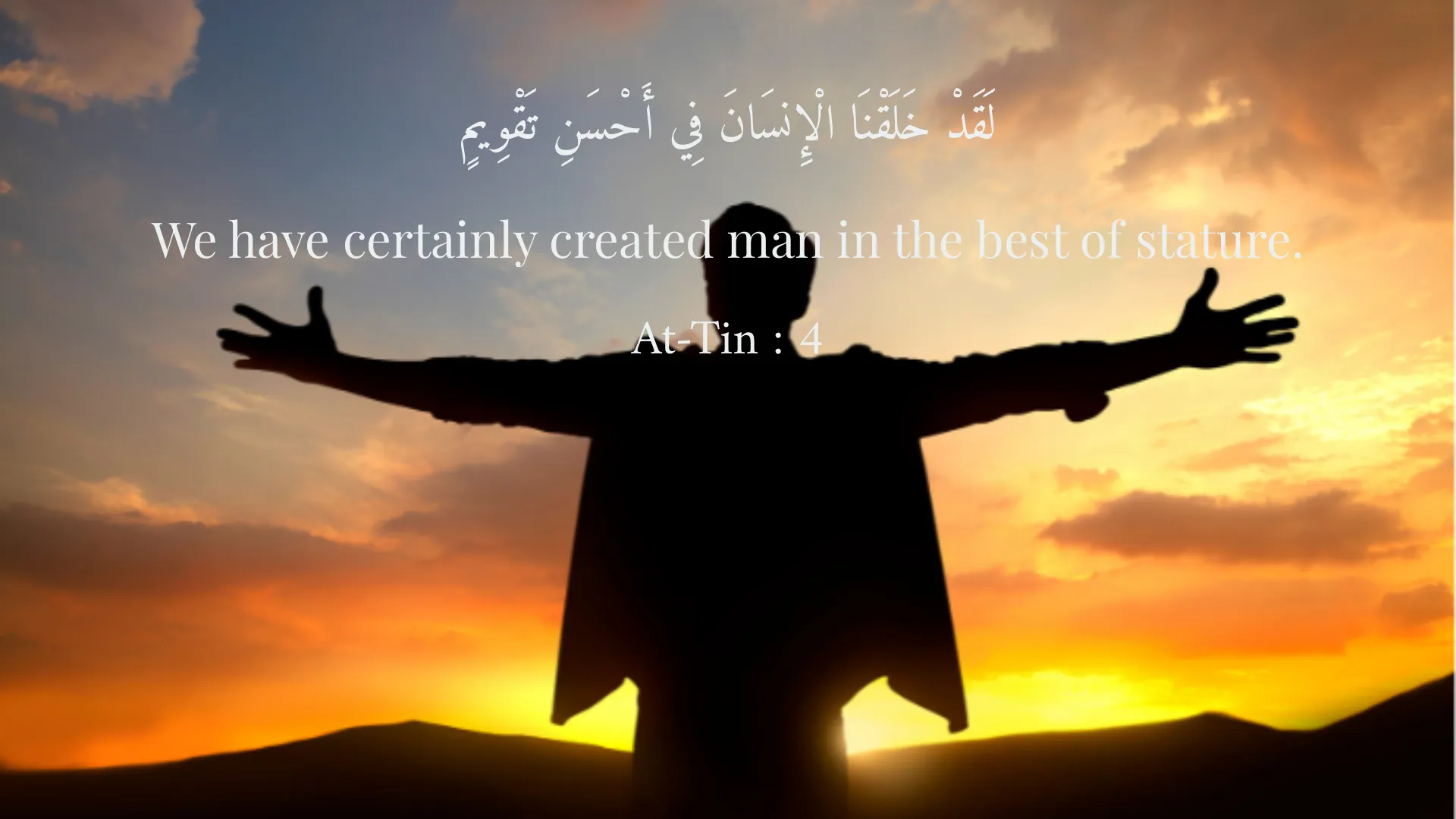
Addressing the profound and vital question, "Why can't I accept myself as I am?", from the perspective of the Holy Quran, requires understanding the foundational Islamic view of human beings, their place in existence, and their relationship with the Almighty. Unlike many human philosophies and theories, the Quran presents a noble, respected, and purposeful image of humanity. The root of self-non-acceptance often lies in comparison, focusing on perceived flaws (whether physical or internal), and forgetting the origin and purpose of creation. The Quran teaches us that every human being, regardless of appearance, social status, possessions, or even worldly successes, possesses inherent dignity and worth bestowed upon them by Allah, and this worth is unaffected by external factors. One of the most fundamental Quranic teachings in this regard is found in Surah At-Tin, verse 4, where Allah states: “لَقَدْ خَلَقْنَا الْإِنسَانَ فِي أَحْسَنِ تَقْوِيمٍ” (We have certainly created man in the best of stature). This foundational verse serves as a starting point for understanding our intrinsic value. Allah, the Exalted, Himself declares that He created humanity in the best and most perfect form possible. This "best of stature" does not only encompass physical perfection and bodily proportionality but also refers to spiritual perfection, the divine nature (fitra), intellect, free will, and the capacity to attain spiritual excellence. When a person comprehends this truth – that their creation was not accidental or purposeless, but rather stemmed from Allah's infinite knowledge and wisdom, and was shaped in the best possible condition – their perception of themselves transforms. This implies that any perceived physical flaws, physical limitations, or even deficiencies that we might see in various aspects of life or within ourselves, are part of the divine plan and a test for our growth and elevation, not a reason to deny our inherent dignity and inner beauty. In fact, these differences and challenges are what provide each individual with the opportunity to develop their character, learn patience, and draw closer to Allah. Accepting the reality that we are all on a journey of growth and perfection, and that Allah accepts and loves us with all our characteristics, is the first step towards true self-acceptance. This acceptance allows us to focus on cultivating what we have, instead of regretting what we lack. This granting of dignity is further emphasized in Surah Al-Isra, verse 70: “وَلَقَدْ كَرَّمْنَا بَنِي آدَمَ وَحَمَلْنَاهُمْ فِي الْبَرِّ وَالْبَحْرِ وَرَزَقْنَاهُم مِّنَ الطَّيِّبَاتِ وَفَضَّلْنَاهُمْ عَلَى كَثِيرٍ مِّمَّنْ خَلَقْنَا تَفْضِيلًا” (And We have certainly honored the children of Adam and carried them on land and sea and provided them with good things and preferred them over much of what We have created, with [definite] preference). This verse clearly states that Allah has honored humanity and granted them superiority over many other creations. This honor is a divine gift inherent in our very being and should not be undermined by perceived flaws or by making unfair comparisons with others. The feeling of self-non-acceptance is, in essence, a disregard for this divine honor and an ingratitude for this great bounty, which can lead us away from the path of gratitude and contentment. Modern society often presents superficial and external criteria for valuing individuals, which can lead to feelings of inadequacy. However, the Quran teaches us that our true worth in the sight of Allah is based on faith, piety, and good deeds, not on fluctuating and transient worldly standards. This deep understanding liberates individuals from the shackles of such comparisons and allows them to accept and love their existence as it is, with trust in Divine wisdom. Often, the inability to accept oneself stems from comparison with others. Instead of focusing on their own path of growth and perfection, individuals constantly look at what others possess or what they appear to be. Such excessive and unfair comparisons, often based on superficial appearances and worldly standards, not only lead to self-non-acceptance but also sow the seeds of envy, sorrow, and despair in the heart. The Quran warns us against this pitfall and instead invites us to express gratitude (shukr) for divine blessings and patience (sabr) in the face of shortcomings and difficulties. Gratitude shifts our focus to what we have, helping us appreciate our intrinsic worth, while patience aids us on our journey of growth and self-correction, teaching us that every hardship and deficiency is an opportunity for closeness to Allah and for cultivating moral virtues. Comparison is like a poison that destroys inner peace, but gratitude and patience are two wings that enable one to soar towards contentment and self-acceptance. When the heart is freed from comparison, there is ample space for self-love and love for others, and one is relieved of the heavy burden of self-validation. A crucial key to achieving self-acceptance and inner peace is the remembrance of Allah (dhikr). Surah Ar-Ra'd, verse 28, states: “الَّذِينَ آمَنُوا وَتَطْمَئِنُّ قُلُوبُهُم بِذِكْرِ اللَّهِ ۗ أَلَا بِذِكْرِ اللَّهِ تَطْمَئِنُّ الْقُلُوبُ” (Those who have believed and whose hearts are assured by the remembrance of Allah. Unquestionably, by the remembrance of Allah hearts are assured). When a person connects with the Source of existence and perfection, Allah, a profound tranquility settles in their heart, liberating them from superficial concerns and fruitless comparisons. The remembrance of Allah reminds individuals that they are a creation of a Wise and Merciful Creator who loves them and desires good for them. This connection strengthens an internal sense of security and worthiness and reminds individuals that they are not alone and are always under the care and support of a compassionate Lord. The remembrance of Allah acts like a sanctuary that protects one from storms of doubt and self-distrust, empowering them to navigate life's path with inner peace and confidence. The more remembrance and attention given to Allah in one's life, the deeper their sense of inner peace and acceptance will become. Shaytan (Satan) is one of the main factors instigating temptation and creating feelings of inadequacy in human beings. He strives to divert people from the path of truth and peace, exaggerating weaknesses through negative thoughts and compelling them towards harmful comparisons. The Quran repeatedly refers to Shaytan's enmity and the necessity of seeking refuge in Allah from his evil. Understanding that much of self-dissatisfaction and self-non-acceptance may arise from satanic whispers, whose purpose is to create despair and hopelessness in humans, can help individuals dismiss these thoughts and, by relying on Allah and seeking His assistance, free themselves from them. Struggling against Shaytan's whispers is itself a form of jihad against the lower self (nafs), leading to self-purification and increased self-awareness, thereby strengthening one's path to self-acceptance. Ultimately, self-acceptance from a Quranic perspective does not mean stagnation or a lack of effort towards improvement. Rather, it signifies accepting one's divine origin, understanding inherent dignity, showing gratitude for blessings, and exercising patience in the face of shortcomings. This acceptance forms the foundation for moving towards perfection and self-purification (tazkiyat al-nafs). The Quran teaches us that life is a test, and each of us is tested with unique trials and characteristics. The important thing is to trust in Divine wisdom, accept our imperfections, strive to rectify them, and constantly turn back to Allah through worship, gratitude, repentance, and seeking forgiveness. This path leads to true tranquility and the acceptance of one's entire being, with all its aspects. Instead of seeking perfection in the mirrors of others, one should seek it in their connection with their Creator and by following Divine guidance. It is here that a person realizes they are too valuable to be confined by comparisons or temporary flaws, for they are chosen and honored by Allah. This perspective not only leads to self-acceptance but also opens a door to inner peace and contentment with divine decree. In this journey, individuals understand that everything they possess and everything they lack is part of Allah's greater plan for their growth and elevation. With this understanding, they no longer feel the need to pretend or engage in endless competition to prove themselves, because their worth lies in their inherent humanity, bestowed upon them by Allah. They learn how to make the best use of their strengths and how to overcome their shortcomings with patience and hope. Accepting these truths forms the backbone of a rich and peaceful spiritual life, paving the way for a deeper understanding of the meaning of one's own existence and that of others.
Related Verses
لَقَدْ خَلَقْنَا الْإِنسَانَ فِي أَحْسَنِ تَقْوِيمٍ
We have certainly created man in the best of stature.
At-Tin : 4
وَلَقَدْ كَرَّمْنَا بَنِي آدَمَ وَحَمَلْنَاهُمْ فِي الْبَرِّ وَالْبَحْرِ وَرَزَقْنَاهُم مِّنَ الطَّيِّبَاتِ وَفَضَّلْنَاهُمْ عَلَىٰ كَثِيرٍ مِّمَّنْ خَلَقْنَا تَفْضِيلًا
And We have certainly honored the children of Adam and carried them on land and sea and provided them with good things and preferred them over much of what We have created, with [definite] preference.
Al-Isra : 70
الَّذِينَ آمَنُوا وَتَطْمَئِنُّ قُلُوبُهُم بِذِكْرِ اللَّهِ ۗ أَلَا بِذِكْرِ اللَّهِ تَطْمَئِنُّ الْقُلُوبُ
Those who have believed and whose hearts are assured by the remembrance of Allah. Unquestionably, by the remembrance of Allah hearts are assured.
Ar-Ra'd : 28
Short Story
It is recounted that there was a king in a peerless plain, who daily looked at himself in the mirror and was displeased with his appearance. He was always in pursuit of beauty and perfection that he imagined in others, feeling deprived of it himself. One day, a wise dervish passed by. The king called him and asked, 'O venerable elder, why am I never content with myself? Why do I always find a flaw in myself whenever I look at another, wishing I were like them?' The dervish, with a warm smile, said: 'O King, you seek your beauty in the mirror of others and your worth in what you lack. But know that Allah has created every particle with unparalleled wisdom. You are like a garden where every flower has its own unique fragrance and color. If every flower wished to be like another, the garden would lose its meaning. True peace lies in accepting what Allah has bestowed upon you, not in yearning for what you see in others. Your worth lies in the eyes of your Creator, not in comparison with creation. As you are, you are dear and honored in the sight of your Lord.' The king was moved by these words and understood that self-acceptance does not come from changing one's appearance, but from changing one's inner perspective and accepting Divine wisdom.